Partner Pipeline Stages: A Model That Holds

What are partner pipeline stages?
Short answer: Partner pipeline stages are the defined steps a partner-sourced or co-sell deal moves through from first identification to closed, each with explicit exit criteria that say what must be true before the deal advances. They give two selling organizations a shared definition of progress, so a deal’s stage means the same thing to the vendor, the partner, and the forecast.
A direct-sales pipeline already has stages, but they assume one selling team with one view of the deal. A partner pipeline adds a second selling organization, and the stages have to account for the moments unique to a co-sell motion, the registration, the joint qualification, the handoff. Borrowing the direct-sales stages unchanged is the most common mistake, because they have no place for the steps that actually gate a partner deal.
The plain way to picture it is a ladder with a written rule on each rung. The rung is the stage; the rule is the exit criterion that must be met to climb to the next. Without the written rule, a stage is just a label a hopeful seller assigns, which is why so many partner pipelines look healthy and forecast badly.
Why partner pipeline stages matter in 2026
Partner pipeline has to be forecastable now, and forecasting is impossible without stages that mean something. Leadership plans around partner revenue, and a pipeline where “stage 3” means one thing to the vendor and another to the partner produces a forecast no one can trust. Defined stages with exit criteria are the precondition for every downstream number.
The second force is the two-organization problem. A co-sell deal is worked by a vendor seller and a partner seller who see different parts of it, and without shared stage definitions they disagree about where the deal actually is. That disagreement is invisible until the deal slips, at which point each side is surprised the other thought it was further along or further behind. Shared stages are how two organizations hold one view of a deal.
The third force is hygiene and coaching. A pipeline with clear exit criteria is coachable, because a manager can ask “what evidence moved this deal to stage 4” and get an answer grounded in the criteria. A pipeline with vague stages is uncoachable, because every stage is a matter of opinion. In a year where partner teams are expected to run with sales-grade discipline, the stage definitions are what make that discipline possible.
How partner pipeline stages actually work
A model that holds runs through a defined set of stages, each with an exit criterion that is observable rather than a feeling. The exact number of stages matters less than the discipline of the criteria.
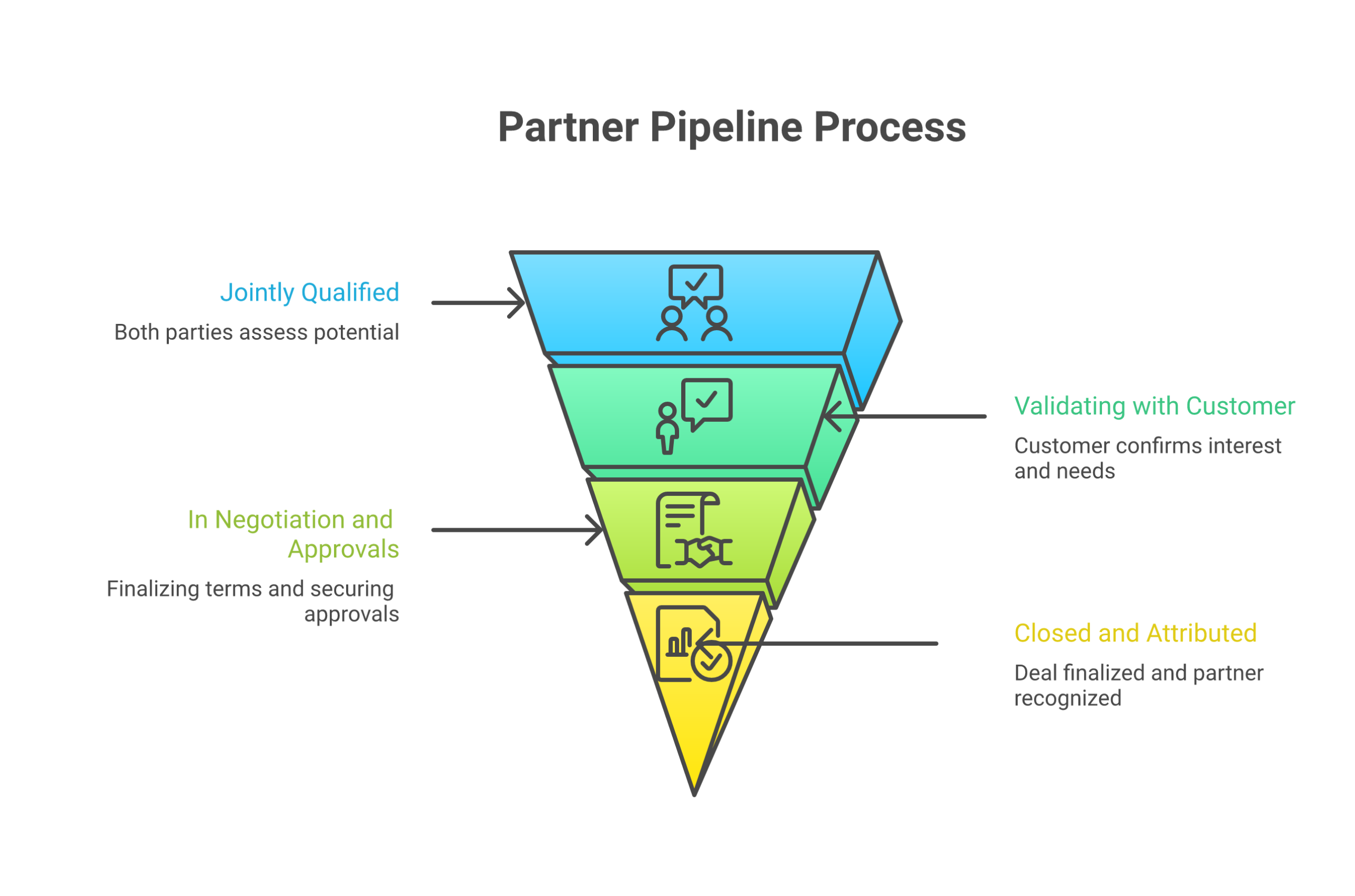
- Identified and registered: The deal is named, the partner has registered it, and the conflict check is clear. The exit criterion is a clean registration with an agreed owner on each side, which is what turns a hallway mention into a tracked deal. This stage is unique to the partner motion and has no direct-sales equivalent.
- Jointly qualified: Both the vendor and the partner have confirmed the customer has a real need, budget, and a reason to act, and have agreed on the joint value the two bring. The exit criterion is a documented joint qualification, not one side’s optimism, which is what stops weakly-qualified deals from clogging the later stages.
- Validating with the customer: The customer is actively evaluating, and a shared close plan exists with the customer’s own steps named. The exit criterion is a customer-confirmed evaluation and a working close plan, which is the point where the deal becomes forecastable with real confidence.
- In negotiation and approvals: Pricing, contract, and the customer’s internal approvals are in motion, with the seller-to-seller handoffs named. The exit criterion is that the open approvals are identified and owned, so the deal does not stall in the gap between the two selling organizations.
- Closed and attributed: The deal is won, and the partner’s contribution is attributed cleanly so the sourced-versus-influenced split is recorded. The exit criterion is a closed deal with attribution resolved, which feeds the forecast accuracy and the partner’s track record for the next deal.
The stages are reviewed in the joint co-sell sync, and a deal only advances when its exit criterion is met, so the pipeline reflects evidence rather than hope and the forecast built on it actually holds.
Common pitfalls in partner pipeline stages
- Borrowing the direct-sales stages unchanged: Direct stages assume one selling team and have no place for registration, joint qualification, or the handoff. Using them for partner deals hides the steps that actually gate a co-sell motion, so the pipeline looks normal and forecasts badly. Build stages around the co-sell moments.
- Stages without exit criteria: A stage that is just a label lets a hopeful seller advance a deal on feeling. Without a written, observable exit criterion, every stage is an opinion, which makes the pipeline uncoachable and the forecast worthless. The criteria are the whole point.
- No joint qualification stage: Skipping a stage where both organizations confirm the deal is real lets weakly-qualified deals flood the later stages, where they stall and distort the forecast. Joint qualification is the filter that keeps the back half of the pipeline honest.
- One-sided stage updates: When only the vendor or only the partner updates the stage, the two organizations drift apart on where the deal is. The stage has to be a shared, jointly-confirmed value, or it records one side’s view of a two-sided deal.
- Ignoring attribution at close: A deal marked closed without resolving the sourced-versus-influenced attribution loses the data that makes the next forecast and the partner’s track record accurate. The close stage has to capture attribution, or the program forgets which partners actually produce.
What this looks like in practice
A partnerships team ran its co-sell deals on the direct team’s pipeline stages and could never forecast them, because the stages had no place for registration or joint qualification and meant different things to the vendor and partner reps. They rebuilt a five-stage model with written exit criteria for each: a clean registration to leave stage one, a documented joint qualification to leave stage two, a customer-confirmed evaluation and close plan to leave stage three, named approval owners to leave stage four, and resolved attribution at close. They reviewed stages jointly in the weekly co-sell sync, and a deal only moved when its criterion was met. Within a quarter the pipeline stopped showing healthy deals that were actually stalled, the forecast landed inside its band, and managers could coach deals by asking what evidence had met the exit criterion. The deals were the same; the stages finally told the truth about them.
Forecastable’s POV on partner pipeline stages
The single highest-leverage fix in most partner pipelines is adding exit criteria, and it costs nothing but discipline. A program can keep its exact stages and transform its forecast accuracy simply by writing down what must be observably true to advance, then enforcing it in the joint review. The reason so few programs do it is that vague stages are comfortable, they let everyone feel good about the pipeline, right up until the quarter misses. The criteria trade comfort for truth, and truth is what forecasts are made of.
The structural point is that partner stages must be built around the co-sell motion, not borrowed from direct sales. The moments that gate a partner deal, the registration, the joint qualification, the seller-to-seller handoff, do not exist in a direct pipeline, so direct stages are blind to exactly the steps where partner deals stall. A program that maps its stages to the real shape of a co-sell deal sees the stalls that a borrowed model hides, which is the whole reason to define partner stages separately.
The honest limit is that stages describe a deal; they do not move it. A perfectly defined pipeline with rigorous exit criteria still requires the sellers to do the work the criteria demand. Stages make progress legible and make stalls visible, but the discipline of meeting the criteria, qualifying jointly, building the close plan, naming the handoffs, is the actual work. The model is the scoreboard, not the game, and a program that polishes the scoreboard without playing the game just has a very accurate view of a pipeline that is not moving.
Forecastable is a partnerships operating platform; any third-party tools or platforms referenced here are independent third-party products, and naming them is not an endorsement of one deployment over another. Evaluate each against your own motion.
Frequently asked questions
How many partner pipeline stages should there be?
Usually four to six. The exact count matters less than each stage having a clear, observable exit criterion. Too many stages create false precision; too few hide the co-sell moments that gate the deal.
Can you reuse the direct-sales pipeline stages for partner deals?
Not without changes. Direct stages assume one selling team and have no place for registration, joint qualification, or the seller handoff, which are exactly the steps that gate a co-sell deal. The stages should be adapted to the partner motion.
What makes a good stage exit criterion?
It is observable rather than a feeling, agreed by both organizations, and specific enough to coach against. A clean registration, a documented joint qualification, and a customer-confirmed evaluation are examples; “the rep thinks it looks good” is not.
Why do partner pipelines forecast badly even with stages?
Usually because the stages lack exit criteria, so deals advance on optimism, or because only one side updates the stage, so the two organizations disagree about where the deal is. Both are fixed by jointly-confirmed criteria.
Who updates the partner pipeline stage?
Both organizations, jointly, in the co-sell sync. A stage updated by only one side records one view of a two-sided deal, which is how the vendor and partner end up surprised by the same slip.
Where does attribution fit in the stages?
At the close stage. Resolving the sourced-versus-influenced split when the deal is won captures the data that feeds forecast accuracy and the partner’s track record, so attribution is an exit criterion of the final stage, not an afterthought.
Next step
If your co-sell deals run on the direct team’s stages and never forecast right, the move this week is to write an observable exit criterion for each stage and enforce it in the joint co-sell review so deals advance on evidence, not hope.
Start your growth journey now to design partner pipeline stages that hold, or read the orientation on the partner program for the broader operating model.
Uncover Your Growth Potential
Schedule a Discovery Call