Partner Ops as a Service: When to Outsource It

What is partner ops as a service?
Short answer: Partner ops as a service is an arrangement where an external team runs the operational backbone of a partner program, the data hygiene, deal-registration administration, reporting, and process design, so the in-house partnerships team can spend its time on relationships and revenue. It is the operational layer of a program delivered as an ongoing service rather than built and staffed internally.
The model exists because partner operations is real, specialized work that most early and mid-stage programs cannot justify hiring a full-time person for, yet cannot run well as a side task. Someone has to keep the partner records clean, process registrations quickly, build the reports leadership asks for, and design the workflows that make the program scale. When that work has no owner, it falls to the partner managers, who do it badly because their job is to be in front of partners, not in a spreadsheet.
The plain framing is a rented operations function. You get the hygiene, the reporting, and the process discipline of a partner-ops hire without carrying the headcount, and you keep the partner relationships and strategy in-house where they belong.
Why partner ops as a service matters in 2026
Partner programs are being held to a higher operational standard. Leadership and finance now expect partner pipeline to be as clean and forecastable as direct pipeline, and that expectation requires real operational discipline that most programs were never staffed to provide. The gap between what is expected and what a two-person team can run is exactly the gap this model fills.
The second force is the cost of a bad first hire. A program that hires a full-time partner-ops person too early can spend a large salary on work that has not yet scaled to a full role, and a program that waits too long lets operational debt pile up until the data is untrustworthy. A service arrangement lets a program get the operational work done at the level it actually needs, scaling the engagement up or down without the binary of a permanent hire.
The third force is speed. Standing up clean partner operations from scratch, the records, the registration workflow, the reporting, takes months of trial and error for a team doing it for the first time. An external team that has built the same backbone many times brings the patterns with them, so the program reaches operational maturity in weeks instead of quarters. In a year where partner revenue is under the microscope, that time difference matters.
How partner ops as a service actually works
A working engagement covers a defined set of operational responsibilities, each with a clear handoff between the external team and the in-house program. The boundary between the two is what makes the arrangement work or fail.
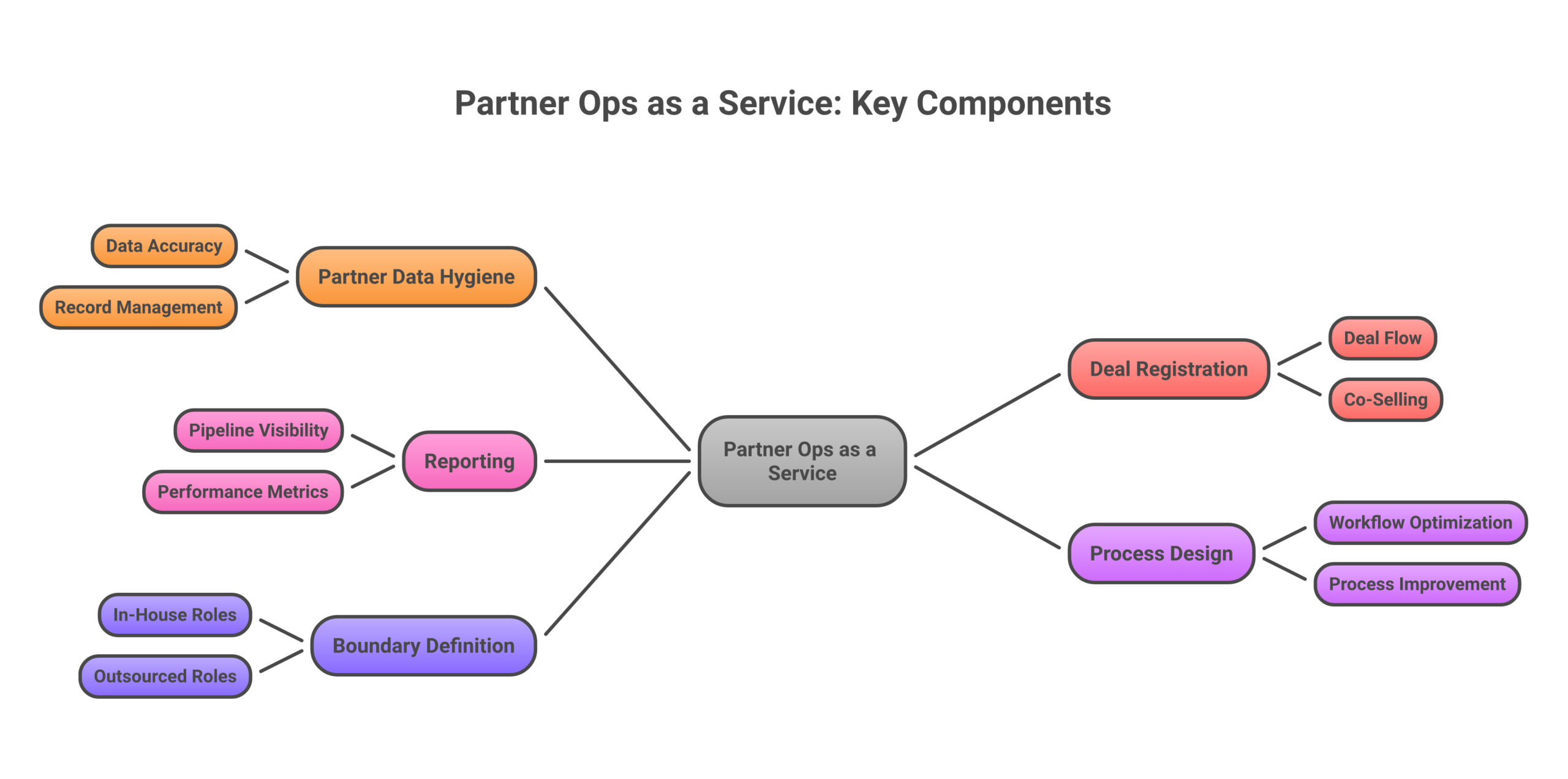
- Partner data hygiene and record management: The external team owns the cleanliness of the partner records, deduplicating accounts, keeping tiers and owners current, and ensuring every partner has the fields the reporting depends on. Clean data is the foundation everything else stands on, and it is the work that decays fastest without an owner.
- Deal-registration and co-sell administration: The team processes registrations, checks for conflicts, and keeps the co-sell queue moving so partners get fast answers. Speed of response is a relationship lever, and handing the administration to a dedicated team is what keeps it fast when the in-house staff is busy selling.
- Reporting and pipeline visibility: The team builds and maintains the dashboards leadership asks for, partner-sourced and partner-influenced pipeline, source rates, attribution, so the program can answer the finance question with a number rather than a scramble. Reporting is recurring work, which makes it a natural fit for an ongoing service.
- Process and workflow design: As the program grows, the team designs the workflows that let it scale, the onboarding sequence, the tiering logic, the registration rules, so the program runs on a system rather than on heroics. Process design is the highest-leverage part of the engagement because it compounds.
- A clear in-house and outsourced boundary: The arrangement only works when ownership is explicit: the external team owns operations, the in-house team owns relationships and strategy. A blurry boundary produces dropped work on both sides, so the scope document that names who owns what is the most important artifact in the engagement.
The engagement runs on a recurring rhythm, a weekly operations review and a monthly reporting cycle, and scales as the program grows, eventually graduating to an internal hire once the operational load justifies a full role.
Common pitfalls in partner ops as a service
- Outsourcing the relationships, not just the ops: The model works when the external team runs operations and the in-house team owns the partner relationships. A program that hands the partner conversations to an outside team loses the trust that makes partnerships work. Outsource the backbone, never the relationship.
- A vague scope that drops work: When the boundary between in-house and outsourced is fuzzy, work falls in the gap, each side assuming the other has it. The scope document has to name who owns each responsibility, or the registration sits unprocessed while both teams think it is handled.
- Buying ops before there is a program: Partner ops as a service accelerates an existing motion; it cannot create one. A company with no partners and no strategy that buys operations first gets a clean backbone with nothing running through it. Get the motion going, then add the operational layer.
- No plan to graduate to a hire: The service is a stage, not a permanent state for a scaling program. A team that never plans the transition to an internal partner-ops hire eventually outgrows the arrangement and pays a premium for work that now justifies a full role. Treat it as a bridge with a planned end.
- Treating ops as data entry: The lowest-value version of the model is pure record-keeping. The real leverage is in process design and reporting that make the program forecastable, so an engagement scoped only to data entry leaves most of the value on the table. Buy the design, not just the typing.
What this looks like in practice
A Series B software company had two partner managers, a growing reseller roster, and partner data that no one trusted, because the registrations piled up and the reporting was rebuilt by hand every board cycle. They brought in an external partner-ops team on a defined scope: own the records, process registrations within one business day, and stand up a partner-sourced pipeline dashboard. The two in-house managers kept every partner relationship. Within six weeks the registration backlog was gone, the partner data was clean enough to forecast from, and leadership had a dashboard that matched finance’s numbers. A year later, when partner pipeline had tripled, the company hired a full-time partner-ops lead and transitioned the work in-house on a planned handoff. The service had carried them across the gap between too small to hire and big enough to justify it.
Forecastable’s POV on partner ops as a service
The model is right far more often than companies admit, because partner operations is specialized work that scales awkwardly. A growing program almost always reaches a point where the operational load is too heavy for the partner managers to carry and too light for a dedicated hire to justify, and that gap can last a year or more. Running the backbone as a service across that gap is usually the better economic decision, even though the instinct is to either ignore the work or over-hire for it.
The deeper conviction is that the relationship and the operations are different jobs and should be split on that line, not on the in-house-versus-outsourced line. The partner relationship is the irreplaceable asset and must stay in-house. The hygiene, the registration processing, and the reporting are interchangeable operational work that an experienced external team often does better than a busy generalist. Drawing the boundary there, rather than trying to keep everything in-house or push everything out, is what makes the arrangement produce.
The candid risk is that the model can become a crutch that hides a missing strategy. Operations make a program run smoothly; they do not make it work. A company that buys a clean operational backbone to avoid confronting the fact that it has no real partner motion gets an efficient machine producing nothing. Use the service to accelerate a motion that exists, plan the graduation to an internal hire, and never let operational tidiness stand in for a strategy.
Forecastable is a partnerships operating platform; any third-party tools or platforms referenced here are independent third-party products, and naming them is not an endorsement of one deployment over another. Evaluate each against your own motion.
Frequently asked questions
What does partner ops as a service actually cover?
The operational backbone of the program: partner data hygiene, deal-registration and co-sell administration, reporting and pipeline visibility, and process design. It does not cover the partner relationships or program strategy, which stay in-house.
When is partner ops as a service the right call?
When the operational load has grown too heavy for the partner managers to carry well but has not yet grown enough to justify a dedicated full-time hire. That gap is the model’s natural home, and it often lasts a year or more for a scaling program.
Does it replace a partner manager?
No. It replaces the operational work that distracts a partner manager, the hygiene and the reporting, so the manager can spend time on partners. The relationship work stays with the in-house team.
How is it different from buying a PRM?
A platform is a tool; partner ops as a service is a team that runs the work, often using whatever tools the program already has. A program can have a PRM and still lack anyone to keep the data clean and the reports current, which is the gap the service fills.
Can a brand-new program use it?
It works best on a motion that already exists, even a small one. A company with no partners and no strategy should establish the motion first, because operations accelerate a program rather than create one.
How do you know when to bring it in-house?
When the operational load consistently justifies a full-time role and the program is stable enough to absorb a planned handoff. Treating the service as a bridge with a planned end, rather than a permanent state, keeps the economics sensible.
Next step
If your partner managers are spending their weeks in spreadsheets instead of in front of partners, the move this week is to list the operational work eating their time and decide which of it could run as a defined external service so they can get back to relationships.
Start your growth journey now to scope which operational work to keep in-house and which to run as a service, or read the orientation on the partner program for the broader operating model.
Uncover Your Growth Potential
Schedule a Discovery Call