Partner Margin Structure: Reseller Economics

What is a partner margin structure?
Short answer: A partner margin structure is the set of discounts, uplifts, and tiers that determine how much a reseller or channel partner earns on a deal, and what behavior earns more. It is the economic engine of a resell program, and it is designed to pay the most for the behavior you most want: registered deals, net-new business, and partner-led selling.
The mistake most programs make is to set a flat discount and leave it there. A flat margin pays the same whether a partner registers a deal early or shows up at the contract, whether they bring net-new business or resell to an account you already had. The result is margin spent without behavior changed. A structured margin pays for the behavior, not just the transaction.
A margin structure is an incentive design problem, not a pricing afterthought.
Why a partner margin structure matters in 2026
Channel margin is one of the largest line items in a resell program, and most of it is spent without steering behavior. When the margin is flat, partners take the discount and keep doing whatever they were already doing, which means the program pays full price for deals it would have gotten anyway. A structure that varies the margin by behavior turns that spend into a lever.
The second force is channel conflict. As more vendors run both direct and channel motions, the margin structure has to protect the partner who does the work, or partners stop investing. Deal registration with a margin uplift is the mechanism that tells a partner the deal they sourced is theirs to win, and without it the channel learns that the vendor will undercut them. The margin structure is where channel trust is built or destroyed.
The third force is that finance now models channel margin against partner-sourced revenue, the same way it models sales compensation against quota. A margin structure that cannot show what behavior each dollar of margin bought will be challenged in planning. In 2026 the programs that defend their channel margin are the ones that can tie the structure to registered, net-new, partner-led revenue. A flat discount cannot tell that story.
How a partner margin structure actually works
A working margin structure is built from four components. Each component has a named purpose and a named artifact, and each component is what gets flattened away when margin is treated as a single discount number.
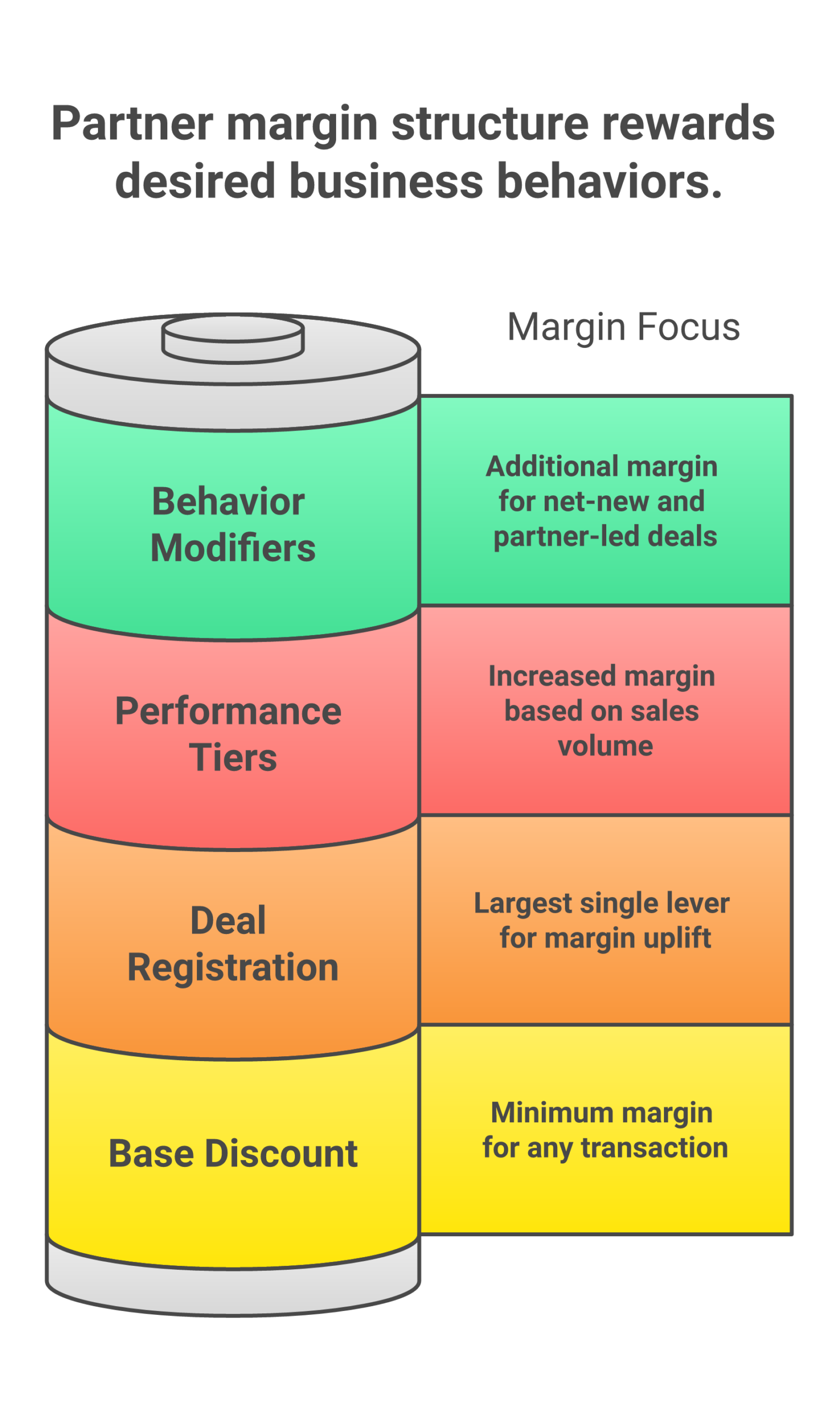
- A base discount for being a partner: The floor margin a partner earns for transacting at all. It is deliberately modest, because it pays for presence, not performance, and the structure is designed so the real money sits above it.
- A deal-registration uplift: The largest single lever. A partner who registers a deal early, before it is contested, earns a meaningful uplift over the base, which protects the partner who sourced the opportunity and steers the channel toward early registration. The registration runs through the PRM (Introw, Euler, Impartner, PartnerStack, or Channelscaler) with the deal record as the artifact.
- Performance tiers with a clear ladder: Annual or rolling tiers (for example silver, gold, platinum) that raise the base and the uplift as a partner produces more, with the thresholds and the rewards written down so a partner can see exactly what the next tier is worth.
- Behavior modifiers for net-new and partner-led deals: Additional uplift for net-new logos and for deals the partner led end to end, so the structure pays the most for the business you most want and least for resold renewals you would have kept anyway.
The structure is published to partners in a single tier ladder, modeled by finance against partner-sourced revenue, and reviewed annually as the production data shows which levers actually moved behavior.
Common pitfalls in a partner margin structure
- Setting a flat discount: A single margin number pays the same for every behavior and steers none of it. Vary the margin by registration, tier, and deal type so the spend buys the behavior you want.
- No deal-registration uplift: Without a registration uplift, partners have no economic reason to register early and no protection when a deal is contested. The uplift is the lever that protects the sourcing partner and earns channel trust.
- A tier ladder partners cannot see: When the thresholds and rewards are opaque, partners cannot aim for the next tier and the tiers stop motivating. Publish the ladder so a partner knows exactly what the next level is worth.
- Paying full margin on renewals you would have kept: A structure that pays the same for a net-new logo and a resold renewal spends margin on revenue you already had. Modify the margin for net-new and partner-led deals so the spend follows the value.
- Never modeling the structure against revenue: A margin structure finance has not modeled will be cut in planning. Tie each lever to partner-sourced revenue so the program can show what behavior the margin bought.
What this looks like in practice
A B2B vendor ran a flat twenty percent reseller discount and could not explain what the margin bought. They rebuilt it as a structure: a ten percent base for transacting, a deal-registration uplift to twenty-five percent for deals registered early, three performance tiers raising the ceiling to thirty percent at the top, and a five-point net-new modifier verified against account status in Crossbeam, all registered and tracked in Introw. Finance modeled the structure against the prior year’s partner-sourced revenue before publishing. Within two quarters, early deal registration rose sharply because the uplift now rewarded it, channel conflict complaints dropped because the sourcing partner was protected, and the share of partner revenue that was net-new climbed because the modifier paid for it. The total margin spend was close to flat; what changed was the behavior it bought.
Forecastable’s POV on partner margin structure
Margin is the loudest message a program sends to its partners, and most programs send a muddled one. A flat discount tells partners that nothing they do changes their economics, so they optimize for volume and ignore registration, net-new, and partner-led selling. A structured margin tells partners exactly what you value, and partners are rational actors who follow the money. Design the structure as a message about behavior, and the channel behaves accordingly.
The deeper read is that the deal-registration uplift is the single most important lever, because it is where channel trust lives. A partner who registers a deal and then watches the vendor route it to a cheaper partner or close it direct learns, permanently, not to invest. The registration uplift, paired with a real protection policy, is the mechanism that tells partners the deals they source are theirs to win, and it pays for itself many times over in channel investment.
The candor on margin spend is that the goal is not to minimize it but to direct it. A program that cuts margin to save money will lose the partners who do the work; a program that holds margin roughly flat but restructures it to pay for registration, tiers, and net-new will get more behavior for the same spend. The number to watch is not the margin percentage, it is what behavior each point of margin bought.
Forecastable is a partnerships operating platform; the tools above (Introw, Euler, Impartner, PartnerStack, Channelscaler, Crossbeam, Pocus, Common Room) are independent third-party platforms, and naming them is not an endorsement of any specific deployment over another. Evaluate each against your own motion.
Frequently asked questions
What is a partner margin structure?
The set of discounts, uplifts, and tiers that determine how much a reseller earns on a deal and what behavior earns more. It is designed to pay the most for registered, net-new, partner-led business.
What components belong in a partner margin structure?
A modest base discount, a deal-registration uplift, performance tiers with a published ladder, and behavior modifiers for net-new logos and partner-led deals.
Why is the deal-registration uplift so important?
It protects the partner who sourced the opportunity and steers the channel toward early registration. It is where channel trust is built, and without it partners stop investing.
How do you prevent channel conflict in a margin structure?
Pair a deal-registration uplift with a real deal-protection policy, tracked in the PRM, so a partner who registers a deal knows it is theirs to win rather than something the vendor will undercut.
Should margin be the same for net-new and renewals?
No. Paying full margin on resold renewals you would have kept anyway spends margin on revenue you already had. Add a net-new and partner-led modifier so the spend follows the value.
How do you set the tier thresholds?
Model the structure against partner-sourced revenue with finance, set thresholds that reward real production gains, and publish the ladder so partners can see what the next tier is worth.
Next step
If your channel runs on a flat discount today, the move this week is to model a structure with a base, a deal-registration uplift, performance tiers, and a net-new modifier against last year’s partner-sourced revenue, then publish the tier ladder to partners.
Start your growth journey now to design the margin structure for your specific channel, or read the orientation on the partner program for the broader operating model.
Uncover Your Growth Potential
Schedule a Discovery Call