Skip to content
Logo โ€” Itโ€™s All AboutThe Team
  • Home
  • Who We Serve
    • By Category
      • SaaS
      • Professional Services
      • Platforms (Large Ecosystems)
      • Private Equity
    • By Role
      • Chief Revenue Officers (CRO)
      • Chief Financial Officers (CFO)
      • Chief Marketing Officers (CMO)
      • Chief Executive Officers (CEO)
      • Sales Leaders
      • Partnership Professionals
  • Solutions
    • By Partner Program Maturity
      • Partnerships Foundation
      • Partnerships Acceleration
      • Ecosystem-Wide Orchestration
    • Specialized Solutions
      • Net-New Named Account Development
      • Large Ecosystems
      • M&A: Post-Acquisition Internal Cross-Selling
  • Pricing
  • Education
  • Company
    • Our History
    • Security
  • Login
Logo โ€” Itโ€™s All AboutThe Team
  • Home
  • Who We Serve
    • By Category
      • SaaS
      • Professional Services
      • Platforms (Large Ecosystems)
      • Private Equity
    • By Role
      • Chief Revenue Officers (CRO)
      • Chief Financial Officers (CFO)
      • Chief Marketing Officers (CMO)
      • Chief Executive Officers (CEO)
      • Sales Leaders
      • Partnership Professionals
  • Solutions
    • By Partner Program Maturity
      • Partnerships Foundation
      • Partnerships Acceleration
      • Ecosystem-Wide Orchestration
    • Specialized Solutions
      • Net-New Named Account Development
      • Large Ecosystems
      • M&A: Post-Acquisition Internal Cross-Selling
  • Pricing
  • Education
  • Company
    • Our History
    • Security
  • Login
  • Home
  • Who We Serve
    • By Category
      • SaaS
      • Professional Services
      • Platforms (Large Ecosystems)
      • Private Equity
    • By Role
      • Chief Revenue Officers (CRO)
      • Chief Financial Officers (CFO)
      • Chief Marketing Officers (CMO)
      • Chief Executive Officers (CEO)
      • Sales Leaders
      • Partnership Professionals
  • Solutions
    • By Partner Program Maturity
      • Partnerships Foundation
      • Partnerships Acceleration
      • Ecosystem-Wide Orchestration
    • Specialized Solutions
      • Net-New Named Account Development
      • Large Ecosystems
      • M&A: Post-Acquisition Internal Cross-Selling
  • Pricing
  • Education
  • Company
    • Our History
    • Security
  • Login
Back to all blogs
  • Partnerships Roles & Hiring
Alex Buckles

Partner-Influenced Revenue: How to Measure It

A partnerships leader and a CFO at a conference table reviewing a printed partner influenced revenue report showing closed-won deals with a partner touch by quarter on a laptop screen between them, deep navy and warm amber palette

What is partner-influenced revenue?

Short answer: Partner influenced revenue is closed-won revenue from deals a partner touched or advanced without originating, measured against a signed attribution definition. It is the revenue-stage counterpart of partner influenced pipeline, and it answers the question a CFO actually asks: how much of what we closed had a partnerโ€™s fingerprints on it.

The mistake most teams make is to wait until a board slide is due and then estimate an influenced revenue figure backward from intuition. A number assembled that way does not survive a finance review, and once it is challenged the whole partner story loses credibility. The teams that get credit measure influenced revenue continuously off the same signed definition they use for pipeline, so the closed number is just the pipeline number that converted.

Partner influenced revenue is a measurement discipline, not a board-deck estimate.

Why partner-influenced revenue matters in 2026

Revenue is the only number that ends the budget argument. Pipeline persuades, but closed-won revenue with a partner touch is what justifies the partnerships headcount and the program spend in a planning cycle. A program that can show the share of total closed revenue that was partner influenced has a seat at the revenue table; a program that can only show activity does not.

The second force is that the influenced share is usually large and usually hidden. Across many B2B motions, the revenue a partner originated outright is a fraction of the revenue a partner touched, and most reporting captures only the originated slice. When the influenced revenue is measured properly, it frequently turns out to be the larger contribution, and surfacing it changes how the executive team values the partner motion.

The third force is auditability. The same finance scrutiny that hits influenced pipeline hits influenced revenue harder, because revenue feeds forecasts and compensation. An influenced revenue number that cannot be traced to a logged partner touch on each deal will be discounted to zero in a review. In 2026 the influenced revenue figure is only as good as the evidence trail behind it.

How partner-influenced revenue actually works

A credible influenced-revenue measurement runs on a four-part model. Each part has a named owner and a named artifact, and each part is what gets skipped when the number is estimated rather than measured.
Operating model for partner influenced revenue: The same signed influence definition used for pipeline, A logged partner touch carried through to close, Continuous capture in the PRM, A report stated as a share of total revenue.

  1. The same signed influence definition used for pipeline: Influenced revenue uses the exact rule already signed with sales and finance for influenced pipeline, a logged partner touch on an opportunity within a defined window, so the closed number is the pipeline number that converted, not a separate estimate.
  2. A logged partner touch carried through to close: The introduction, co-sell meeting, or reference logged at the opportunity stage stays attached as the deal closes, so every influenced closed-won deal carries its evidence. No retroactive tagging at quarter end.
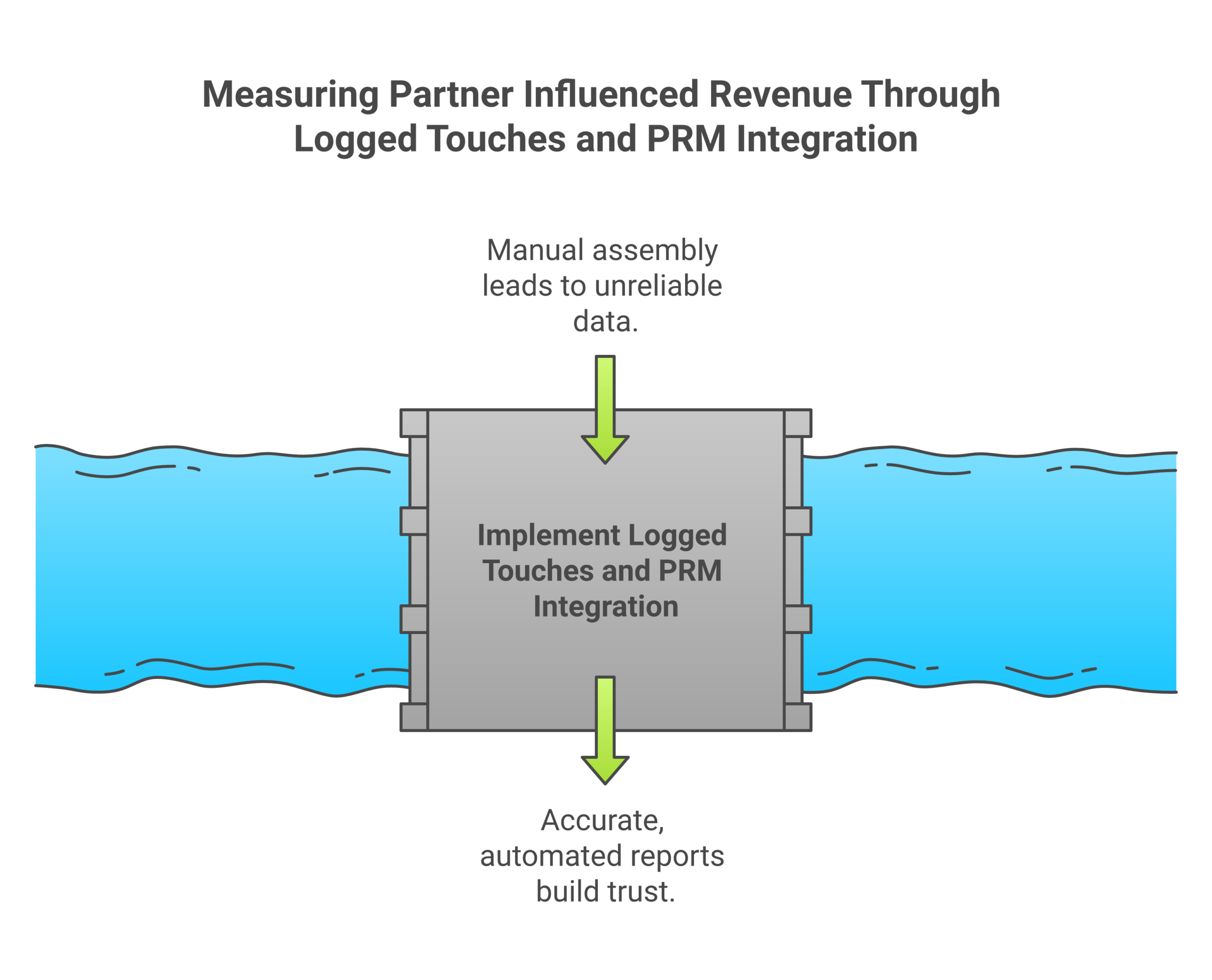
  3. Continuous capture in the PRM: Crossbeam, Pocus, or Common Room surface the overlap, and the PRM (Introw, Euler, Impartner, PartnerStack, or Channelscaler) carries the touch from open opportunity to closed-won, so the influenced revenue report is generated, not assembled by hand.
  4. A report stated as a share of total revenue: Influenced revenue is most credible expressed as a percentage of total closed-won revenue, alongside sourced revenue as a separate figure. The share is what the CFO reads and what the planning cycle acts on.

The model reruns every close cycle, and because it uses the same definition as pipeline, the influenced revenue number is consistent with the influenced pipeline that produced it.

Common pitfalls in partner-influenced revenue

  • Estimating it backward for a board slide: A number reverse-engineered from intuition the week a slide is due will not survive a finance review. Measure it continuously off the signed definition so the closed figure is already there when the slide is due.
  • Using a different definition than influenced pipeline: When revenue uses a looser rule than pipeline, the two numbers stop reconciling and finance distrusts both. Use the identical signed definition end to end.
  • Retroactive tagging at quarter end: Tagging deals as influenced after they close, from memory, produces an unauditable number. Carry the logged touch from the open opportunity through to close.
  • Reporting an absolute number with no denominator: A raw influenced revenue figure means little without the total it came from. State it as a share of total closed-won revenue so the executive team can size the contribution.
  • Letting influenced and sourced revenue blur: Blending the two hides which motion produced what and invites a finance discount. Keep sourced and influenced revenue as separate, clearly defined figures.

What this looks like in practice

A B2B company wanted to justify expanding its partnerships team and needed a credible influenced revenue figure for the planning cycle. They already had a signed influence definition for pipeline, so they extended it through to close rather than inventing a new one: any closed-won deal carrying a logged partner touch within the ninety-day window counted as influenced, with the evidence carried from the open opportunity through Introw. The report showed sourced revenue of about one and a half million dollars and influenced revenue of about four and a half million, stated as roughly thirty percent of total closed-won revenue. Finance audited a sample, confirmed a logged touch on each deal, and accepted the thirty percent share. That single defensible number, not the activity metrics the program had led with before, won the headcount.

Forecastableโ€™s POV on partner-influenced revenue

Influenced revenue is the number that moves an executive team, and it is almost always under-reported. The reason is structural: programs measure what is easy to claim cleanly, which is sourced revenue, and avoid the harder measurement of influence, which is most of the contribution. The programs that win the resourcing argument are the ones that do the harder measurement and surface the influenced share, because that share is usually the bulk of the partner motionโ€™s value.

The deeper read is that influenced revenue should never be a separate project from influenced pipeline. If the pipeline definition is signed and the touch is logged continuously, influenced revenue is simply the slice of that pipeline that closed, and it requires no new work at quarter end. Programs get into trouble when they treat revenue attribution as a distinct, late-stage exercise instead of the natural endpoint of the pipeline model they already run. Build it once, end to end.

The candor for the CFO is that the influenced share is an estimate of contribution, not a claim of sole credit, and it should be presented that way. A partner-influenced deal had a seller, a marketer, and a product behind it too; the influenced revenue figure says the partner touched it materially, not that the partner closed it alone. Presented with that honesty, the number earns trust. Overclaimed, it earns a discount.

Forecastable is a partnerships operating platform; the tools above (Crossbeam, Pocus, Common Room, Introw, Euler, Impartner, PartnerStack, Channelscaler) are independent third-party platforms, and naming them is not an endorsement of any specific deployment over another. Evaluate each against your own motion.

Frequently asked questions

What is partner influenced revenue?
Closed-won revenue from deals a partner touched or advanced without originating, measured against a signed attribution definition. It is the revenue-stage counterpart of partner influenced pipeline.

How is influenced revenue different from sourced revenue?
Sourced revenue comes from deals a partner originated; influenced revenue comes from deals a partner touched or advanced. Report them as separate figures, never blended.

How do you measure partner influenced revenue credibly?
Use the same signed definition as influenced pipeline, carry the logged partner touch from open opportunity through to close, and state the result as a share of total closed-won revenue.

Why express influenced revenue as a percentage?
Because a raw figure has no context. Stating it as a share of total closed-won revenue lets the executive team size the partner motionโ€™s contribution against the whole.

Does influenced revenue mean the partner closed the deal alone?
No. It means the partner touched the deal materially under the signed definition. Present it as a contribution estimate, not a sole-credit claim, and it earns financeโ€™s trust.

How do you keep influenced revenue auditable?
Carry the logged touch from the open opportunity to closed-won in the PRM, so every influenced deal has evidence at close. Avoid retroactive, memory-based tagging entirely.

Next step

If you assemble an influenced revenue figure for board slides today, the move this week is to extend your signed influenced-pipeline definition through to close and generate the share of total revenue continuously instead of by hand.

Start your growth journey now to build the revenue attribution model for your specific motion, or read the orientation on the partner program for the broader operating model.

Uncover Your Growth Potential

Whether starting with a single sales team or a single partner, any co-sell motion can be live within 30 days.

Schedule a Discovery Call
Latest Insights
A partnerships leader presenting a partner pipeline for the CFO on a wall monitor showing sourced versus influenced revenue with conversion rates, the finance chief reviewing a printed attribution summary across the table, deep navy and warm amber palette
  • Partnerships Roles & Hiring
Alex Buckles

Partner Pipeline for the CFO: Making It Real

What is partner pipeline for the CFO? Short answer: Partner pipeline for the CFO is the view of partner-influenced and partner-sourced revenue translated into the language a finance leader uses to make budget decisions, conversion rates, attribution clarity, and a defensible return on the program’s cost. It is the difference between a partnerships team that […]

Read Article
A founder and an outsourced partnerships lead reviewing a partner-as-a-service engagement on a wall monitor showing a managed partner program with milestones and handback points, a printed scope of work on the table, deep navy and warm amber palette
  • Partnerships Roles & Hiring
Alex Buckles

Partner-as-a-Service: What It Is and When to Use It

What is partner-as-a-service? Short answer: Partner-as-a-service is a model in which a company hires an external team to run some or all of its partnership operations, recruiting, onboarding, enabling, and managing partners, rather than building that capability entirely in house. It lets a company stand up or scale a partner motion without first hiring and […]

Read Article
An account executive and a partner rep sitting on the same side of the table in front of a customer during a partner-assisted selling meeting, a shared account plan and printed proposal between them, deep navy and warm amber palette
  • Partnerships Roles & Hiring
Alex Buckles

Partner-Assisted Selling: How It Actually Works

What is partner-assisted selling? Short answer: Partner-assisted selling is a motion in which a partner actively helps your own seller win a deal, contributing trust, technical credibility, customer access, or a complementary product, rather than simply handing over a lead and stepping back. It sits between a pure referral, where the partner passes a name, […]

Read Article
A go-to-market leadership team standing at a wall monitor that maps a partner-led GTM with partners as the primary route to market, a printed coverage map showing partner territories on the table, deep navy and warm amber palette
  • Partnerships Roles & Hiring
Alex Buckles

Partner-Led GTM: A Go-to-Market Built on Partners

What is partner-led GTM? Short answer: Partner-led GTM is a go-to-market model in which partners are the primary route to reaching, selling, and serving customers, rather than a supplementary channel layered on top of a direct sales motion. It means the company designs its entire commercial engine, sales, marketing, support, and product, around partners carrying […]

Read Article
Logo โ€” Itโ€™s All AboutThe Team

Quick Links

  • Who We Serve
  • Solutions
  • Resources
  • Pricing
  • Our History

Social Media

  • Linkedin

Legal

  • Privacy Policy
  • Terms of Service
Quick Links
  • Who We Serve
  • Solutions
  • Resources
  • Pricing
  • Our History
Social Media
  • Linkedin
Legal
  • Privacy Policy
  • Terms of Service

Stay ahead on ecosystem-led growth

Logo โ€” Itโ€™s All AboutThe Team
ยฉ 2025 Forecastable. All rights reserved.
Book Your Strategy Call
Request Enrollment Details

[contact-form-7 id=”dfbeed3″ title=”Request Enrollment Details”]

Mollie Bodensteiner

Revops Advisory
  Mollie Bodensteiner is an experienced operations professional with a demonstrated track record of utilizing technology to support operational processes that drive performance and innovation. She currently is the Vice President of Operations at Sound and owns go-to-market agency, MB Solutions. Mollie has previously held operations leadership roles at Deel, Syncari, Corteva and Marketo. She has over 14 years of experience in both B2C and B2B operations and technology. When she is not working, Mollie enjoys spending time with her husband, three small children, and two large dogs. Childhood Career/Dream: Growing up in the age of Disney and Nick@Nite I always wanted to be a child actor (good thing that never was actually pursued ๐Ÿ™‚ Favorite Win: I am not sure I have a specific โ€œwinโ€ but I think I get the most joy and excitement from coaching others and watching them hit major milestones in their career. The first time you get to promote someone on your team or watch them lead a major project – are always career highlights! Personal Fun Facts: Favorite Song: If itโ€™s love, Train Favorite Movie: Good Will Hunting Favorite Meme: Disaster Girl
Forecastable resources: Co-Sell Orchestration Platform · All Use Cases · Live in 30 Days · Co-Sell Playbook

Kelsey Buckles

Director of Operations


My journey from Education to Operations has equipped me with a unique perspective and skill set that perfectly aligns with Forecastable’s mission to help businesses improve sales collaboration through partner co-selling strategies.

At Forecastable, I am passionate about empowering teams and organizations to unlock the full potential of strategic partnerships. By leveraging my expertise in communication, leadership, and operational efficiency, I contribute to creating seamless co-selling processes that align with business goals and deliver exceptional results.

The intersection of my educational foundation and operational experience fuels my dedication to fostering alignment, building trust, and enhancing collaboration between partners. I am driven by the opportunity to contribute to a platform that not only optimizes sales strategies but also strengthens relationships that lead to long-term growth.

Paul Jonhson

Chief Technology Officer (Co-founder)


Paul Johnson has 20+ years of software development and consulting experience for a variety of organizations, ranging from startups to large-enterprise organization with highly-complex needs.

Mr. Johnson has a long track record of successful technology deployments.
This, combined with his deep passion for machine learning and exceptional user experience design, allows him to lead our technical direction from the front with confidence.

Alex Buckles

Product, Partnerships, and Value Engineering (Co-founder)


After serving in The United States Marine Corps, Alex Buckles spent the next two decades as a student of revenue production and an advocate for innovation.

Along the way, he has helped numerous companies achieve double and triple-digit growth by crafting and executing high-performing go-to-market strategies, with co-selling at the center of each.

As a once-advanced technical marketer, an expert sales & partner professional, and a strong customer success advocate, Mr. Buckles understands the impact of these functions aligning not only on revenue production, but on the day-to-day execution of the go-to-market strategy. This concept of revenue-team alignment is what quickly became the foundation of Forecastable back in January of 2018.

In his free time, youโ€™ll find him spending quality time with his children, one of whom is on the autism spectrum. 1 in 36 children in the U.S. are on the spectrum and boys are four times more likely to be diagnosed than girls.

With that in mind, Mr. Buckles plans on dedicating the rest of his life serving those living with autism, through his organization Pathways for Autism. From his perspective, there must be a scalable and financially self-sustaining infrastructure established to put as many individuals with autism as possible on a path towards complete independence as adults.