Partner Field Marketing: A Pipeline Operating Model

What is partner field marketing?
Short answer: Partner field marketing is the regional, in-person and account-targeted marketing motion that two companies run together to build pipeline in a defined territory, against a named target account list and a closed-loop report. It covers dinners, workshops, roadshows, and joint local campaigns, and it is measured as a pipeline motion, not as a brand activity.
The mistake most teams make is to treat field marketing as logo placement and goodwill. A co-branded breakfast with no target list and no follow-up is a nice morning and zero pipeline. The teams that produce treat each field motion as a small GTM campaign with a target account list, AE coverage, and a sourced and influenced report.
Field marketing is sales motion with a marketing budget, not the other way around.
Why partner field marketing matters in 2026
Top-of-funnel digital has lost effectiveness for high-value B2B segments, and account-targeted in-person motion now outperforms paid digital for the executive buyer. Partner field marketing sits exactly at that intersection: it pairs your reach with a partner’s reach in a specific territory, against accounts both sides care about. That combination is hard for a single-vendor campaign to match.
The second force is that field marketing is where partnerships and marketing actually have to operate as one team. The partner manager owns the relationship, the field marketer owns the motion, and the regional AE owns the coverage, and a field program only produces when those three roles run a shared cadence. Programs that keep them siloed run events that look fine and book nothing.
The third force is accountability. Field marketing budgets are now measured against pipeline in the same forecast cadence as the rest of GTM, and the partner co-funding the motion expects a sourced and influenced report. The programs that keep their field budget in 2026 are the ones that can show the territory pipeline the motion produced, by stage, within a week of each event. Field marketing without a closed loop is the first line cut in a tight budget.
How partner field marketing actually works
A working field program runs on a four-part operating model. Each part has a named owner and a named artifact, and each part is what quietly breaks when field marketing is run as brand activity.
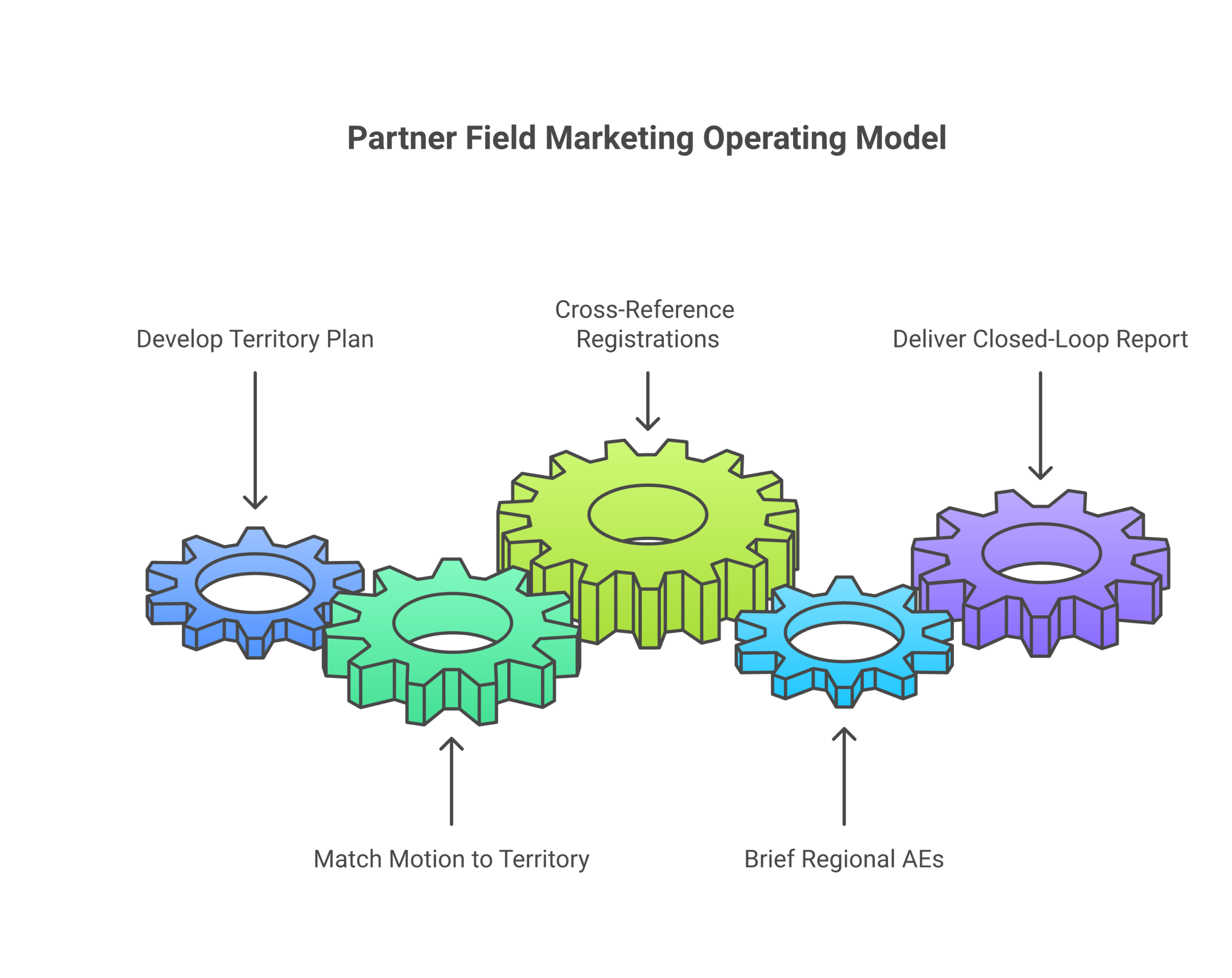
- A territory plan with a target account list: The field marketer and the partner manager name the accounts in the territory both sides want, sized to the motion (twenty to forty for a dinner, sixty to one hundred and twenty for a workshop). The list is built before any spend is approved.
- A motion matched to the territory: Choose the format that fits the territory and the goal, an executive dinner for depth, a regional workshop for breadth, a roadshow for a multi-city push. The partner brings the product moment and a joint value frame; the host brings the run-of-show.
- A registration overlay and AE pre-brief: Cross-reference registrations against the target list with Crossbeam, Pocus, or Common Room, and brief the regional AEs on who is coming and what the partner story is before the event, not after.
- A closed-loop report tied to the territory pipeline goal: Within seven business days, deliver sourced and influenced opportunities by stage to the co-funding partner, tagged to the event and the territory in the PRM (Introw, Euler, Impartner, PartnerStack, or Channelscaler). The report is what unlocks the next territory motion.
The model reruns across the territory two to four times before the field motion becomes a repeatable regional engine.
Common pitfalls in partner field marketing
- Running it as brand instead of pipeline: A co-branded event with no target list and no follow-up produces goodwill and nothing else. Build the target account list before the spend and the closed-loop report after, every time.
- Siloing partnerships, marketing, and sales: When the partner manager, the field marketer, and the regional AE do not share a cadence, the event runs and the pipeline falls through the handoff. Run the three roles as one team around each motion.
- No AE coverage in the territory: A full room with no AE assigned to work the accounts produces a list of names and no deals. Assign and pre-brief the AEs before the event, and hold them to the post-event next steps.
- Spending on the venue instead of the motion: The most expensive room with a generic agenda books nothing. Spend on the partner product moment, the target list, and the AE coverage, not on the steakhouse.
- Skipping the closed-loop report: The co-funding partner will not fund the next territory motion without a sourced and influenced report. Deliver it within seven business days or the field budget dries up.
What this looks like in practice
A B2B program ran a three-city regional roadshow co-funded with a Tier 1 reseller in a single territory. The field marketer and the partner manager built a one-hundred-account target list per city from Crossbeam overlap, the reseller brought a thirty-minute customer-outcome story and a joint value frame to each stop, and two regional AEs were pre-briefed on the accounts coming to each city. The loaded cost across three cities ran about forty thousand dollars. Within seven business days of the final stop, the closed-loop report named eleven sourced opportunities and fourteen influenced opportunities across the three cities, roughly five hundred and fifty thousand dollars in territory pipeline. The reseller co-funded the next territory on the strength of the report, and the three roles kept the shared cadence into the following quarter.
Forecastable’s POV on partner field marketing
Field marketing is the place where partnerships either becomes a revenue function or stays a relationship function. The motion forces partnerships, marketing, and sales to operate as one team around a shared target list and a shared report, and a program that can run that cadence in one territory can run it in every territory. The field motion is the proving ground for whether the partnership produces pipeline or just produces meetings.
The deeper read is that the territory is the unit, not the event. A single well-run dinner is a data point; a territory worked across three or four motions with the same partner is an engine. The strategy should concentrate field spend on the territories where a partner overlap is real and a multi-motion arc can compound, rather than scattering one-off events across markets where neither side has density. Pick the territory, then run it repeatedly.
The candor on the marketing-versus-sales question is that field marketing reports to pipeline, full stop. The budget sits in marketing, the relationship sits in partnerships, but the scoreboard is the sourced and influenced pipeline the AEs work. A field program that cannot name its territory pipeline is a brand program with a partner logo on it, and it will be the first thing cut when budgets tighten.
Forecastable is a partnerships operating platform; the tools above (Crossbeam, Pocus, Common Room, Introw, Euler, Impartner, PartnerStack, Channelscaler, Tackle, Labra, Suger, Clazar) are independent third-party platforms, and naming them is not an endorsement of any specific deployment over another. Evaluate each against your own motion.
Frequently asked questions
What is the difference between partner field marketing and partner events?
Field marketing is the broader regional, account-targeted motion across a territory; events are the individual formats inside it. A field program sequences several events against a territory target list and pipeline goal.
Who owns partner field marketing?
It is a shared motion: the field marketer owns the event, the partner manager owns the relationship, and the regional AE owns the coverage. It only produces when the three run a shared cadence.
How is partner field marketing measured?
As sourced and influenced pipeline by stage against the territory goal, reported within seven business days of each motion and tagged to the event and territory in the PRM.
What field marketing formats work best?
Executive dinners for depth with a small account set, regional workshops for breadth across a mid-market list, and multi-city roadshows for a territory push. Match the format to the territory and the goal.
How much should a partner field motion cost?
The visible spend is the venue and catering, but load the partner manager time, AE coverage, and outreach. Spend on the partner product moment and the target list, not on the venue.
How does field marketing tie into co-funding?
The co-funding partner expects a sourced and influenced report tagged to the event. Deliver it within seven business days, and the report is what unlocks the next co-funded territory motion.
Next step
If your field events run as brand activity today, the move this week is to build a territory target account list with your strongest regional partner, assign and pre-brief the AEs, and lock the closed-loop report before the next motion.
Start your growth journey now to design the field operating model for your specific territories, or read the orientation on the partner program for the broader operating model.
Uncover Your Growth Potential
Schedule a Discovery Call