Partner Event Strategy: A Pipeline-First Playbook

What is a partner event strategy?
Short answer: A partner event strategy is the plan for which partner-involved events to run across a quarter or year, why each one exists, and how each ties to a named pipeline goal and a target account list. It treats events as a sequenced portfolio with a purpose per event, not as a calendar of one-off activities booked when budget appears.
The mistake most teams make is to run events reactively, saying yes to a conference booth here and a dinner there as invitations and budget arrive. The teams that produce pipeline decide in advance what mix of event types serves the program goal, then book each event against a target. Strategy is the difference between a calendar and a plan.
A real strategy answers one question first: what is each event supposed to produce?
Why a partner event strategy matters in 2026
Event budgets are finite and the field team’s time is more finite still. Without a strategy, a program spends the budget on whatever invitations land first, which means the events that get funded are the ones with the most aggressive sponsor outreach, not the ones that serve the program. A strategy reorders that, funding the events that move the named pipeline goal.
The second force is that different event types do different jobs, and conflating them wastes money. An executive dinner builds depth with a small set of high-value accounts; a regional workshop builds pipeline across a mid-market list; a conference booth builds reach and top-of-funnel. A program that runs three dinners when it needs reach, or one booth when it needs depth, has the wrong portfolio regardless of how well each event runs.
The third force is the partner relationship itself. Co-funded events are one of the strongest signals of a real partnership, and the sequence of events you run with a given partner is a relationship arc, not a series of transactions. A strategy that runs two or three events with the same Tier 1 partner across a year builds a co-sell motion; a strategy that runs one event with twelve different partners builds nothing. In 2026 the programs that compound are the ones that sequence events with intent.
How a partner event strategy actually works
A working strategy is built in four moves. Each move has a named owner and a named artifact, and each move is what gets skipped when events are booked reactively.
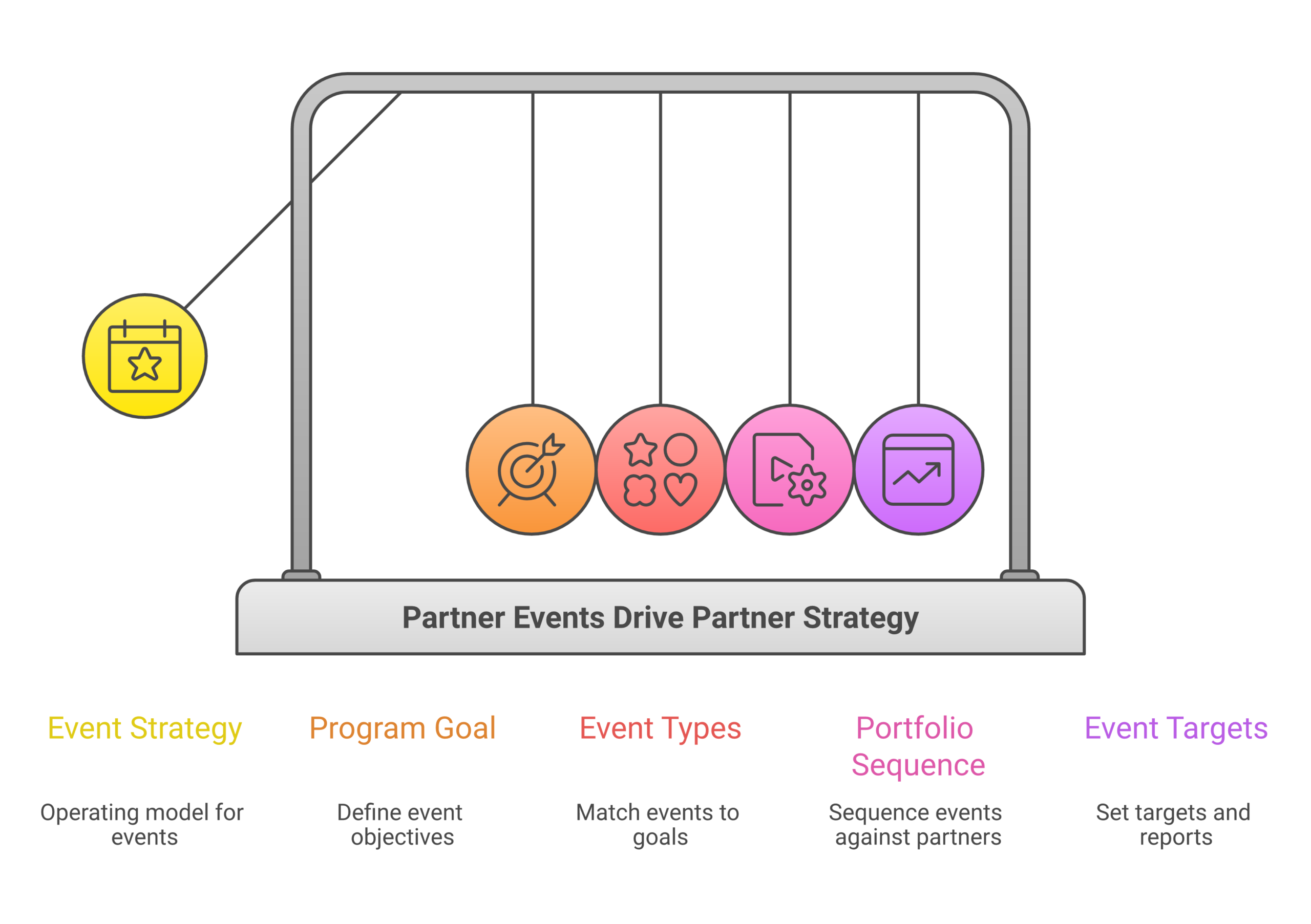
- Name the program goal the events serve: Depth with strategic accounts, reach into a new segment, or pipeline acceleration on an existing list. The goal determines the event mix, so it is decided first, in dollars and accounts.
- Match event types to the goal: Executive dinners and small roundtables for depth, regional workshops for mid-market pipeline, conference presence for reach, and joint webinars for low-cost top-of-funnel. Each type gets a target appropriate to its job.
- Sequence the quarter against the partner portfolio: Decide which partners co-fund which events and in what order, weighting the calendar toward the Tier 1 partners where a multi-event arc can build a co-sell motion. Use Crossbeam, Pocus, or Common Room to ground the target lists in real account overlap.
- Set a target and a closed-loop report per event: Every event in the plan carries a pre-event pipeline target and a committed closed-loop report. The PRM (Introw, Euler, Impartner, PartnerStack, or Channelscaler) tags each event so the sourced and influenced pipeline rolls up to the partner and to the program goal.
The strategy is reviewed at the start of each quarter and adjusted as the closed-loop reports show which event types and which partners actually produced.
Common pitfalls in a partner event strategy
- Booking reactively instead of planning the portfolio: A calendar filled by incoming invitations is not a strategy. Decide the event mix against the program goal first, then accept or decline invitations based on whether they fit the plan.
- Running the wrong event type for the goal: A conference booth will not build depth with ten strategic accounts, and a dinner will not deliver reach into a new segment. Match the type to the job, or spend the budget without moving the goal.
- Spreading events across too many partners: One event each with a dozen partners builds no momentum with any of them. Concentrate the calendar on the Tier 1 partners where a multi-event arc can build a real co-sell motion.
- No target per event: A strategy where individual events carry no pipeline target cannot be graded or adjusted. Each event needs a number set before it runs, or the portfolio review at quarter end has nothing to read.
- Treating the strategy as fixed: A plan that never adjusts to what the closed-loop reports show will keep funding event types that do not produce. Read the reports each quarter and reallocate toward what works.
What this looks like in practice
A B2B program entered the quarter with a goal of accelerating pipeline on an existing two-hundred-account enterprise list, and a budget that could fund four events. Instead of accepting two conference-booth invitations that had already arrived, they declined both, because reach was not the goal. They sequenced two executive dinners and two regional workshops, all co-funded with their two strongest SI partners, and used Crossbeam to build each event’s target list from accounts where overlap with those partners already existed. Each event carried a pipeline target and a closed-loop report tagged to the partner in Introw. At quarter end the four events produced roughly six hundred thousand dollars in sourced and influenced pipeline against the two-hundred-account goal, and the multi-event arc with the two SI partners turned into a standing co-sell cadence that outlasted the quarter.
Forecastable’s POV on partner event strategy
Event strategy starts with the program goal, not the event calendar. The reason most partner event spend underperforms is that the events are chosen before anyone names what they are supposed to produce. Once the goal is named in dollars and accounts, the event mix becomes almost mechanical: depth goals pull dinners, reach goals pull conference presence, pipeline goals pull workshops. Name the goal and the portfolio designs itself.
The deeper read is that events are a relationship instrument, not just a pipeline instrument. The sequence of events you run with a given partner is the clearest signal you can send about how much you value the relationship, and a multi-event arc with a Tier 1 partner builds a co-sell motion that no single event can. So the strategy should concentrate, not spread, weighting the calendar toward the few partners where the arc can compound.
The candor on budget is that declining the wrong event is as important as funding the right one. The hardest discipline in event strategy is saying no to a well-marketed booth that does not serve the goal, especially when the budget exists and the invitation is flattering. The programs that compound are the ones willing to leave budget unspent rather than fund an event that does not move the named goal.
Forecastable is a partnerships operating platform; the tools above (Crossbeam, Pocus, Common Room, Introw, Euler, Impartner, PartnerStack, Channelscaler, Tackle, Labra, Suger, Clazar) are independent third-party platforms, and naming them is not an endorsement of any specific deployment over another. Evaluate each against your own motion.
Frequently asked questions
What is the first step in building a partner event strategy?
Name the program goal the events serve, in dollars and accounts: depth with strategic accounts, reach into a new segment, or pipeline acceleration on an existing list. The goal determines the event mix.
Which partner event types build pipeline fastest?
Regional workshops and executive dinners against a target account list tend to build pipeline fastest, because they pair a focused list with a partner product moment and AE coverage. Conference booths build reach, not near-term pipeline.
How many events should a partner program run per quarter?
It depends on budget and team capacity, but concentration beats volume. A few well-targeted events co-funded with your strongest partners outperform a crowded calendar spread across many partners.
How do events tie into the rest of the partner program?
Each event carries a pre-event pipeline target and a closed-loop report tagged in the PRM, so sourced and influenced pipeline rolls up to the partner and to the program goal alongside every other partner motion.
Should every event be co-funded by a partner?
Not necessarily, but co-funding is a strong signal of a real partnership and concentrates the relationship. Weight the calendar toward co-funded events with Tier 1 partners where a multi-event arc can build a co-sell motion.
How do you decide which event invitations to decline?
Decline any invitation whose event type does not serve the named program goal, even when budget exists. Saying no to the wrong event protects the budget for the right one.
Next step
If your event calendar is filled by incoming invitations today, the move this week is to name the program goal your events should serve, match event types to that goal, and sequence the quarter around your two strongest partners.
Start your growth journey now to build the event portfolio for your specific program, or read the orientation on the partner program for the broader operating model.
Uncover Your Growth Potential
Schedule a Discovery Call