Partner Event ROI: How to Measure It Properly

What is partner event ROI?
Short answer: Partner event ROI is the ratio of sourced and influenced pipeline (and eventually closed revenue) to the fully loaded cost of a partner-involved event, measured against a target set before the event runs. It is a forecasting question, not a recap, and it depends entirely on whether the event had a target account list before the budget was approved.
The mistake most teams make is to measure the event by attendance and sentiment. A full room and a good vibe feel like success, but neither one is pipeline. The teams that can defend partner event spend measure named opportunities by stage against a number they committed to before the doors opened.
ROI is not a slide you build after the event. It is a target you set before it.
Why partner event ROI matters in 2026
In-person partner events have moved back to the center of high-value B2B GTM, and with them has come a sharper budget question. A CFO who approves a regional workshop or an executive dinner now expects the same pipeline accounting that any other GTM line gets. The era of measuring a partner event by the photo of the full room is over.
The second force is that partner events are expensive in ways teams underweight. The visible cost is the venue and the catering; the real cost includes the partner manager’s time, the AE coverage, the pre-event outreach, and the opportunity cost of the field team being off their desks. When you load the full cost, the ROI bar moves, and many events that looked break-even on the venue line were underwater on the loaded cost.
The third force is repeatability. A program that can prove partner event ROI gets the budget to run the next four; a program that cannot gets cut in the next planning cycle. The proof is a closed-loop report, and the report is only credible if the target was set in advance and the costs were loaded honestly. In 2026 the events that survive are the ones with a defensible number.
How partner event ROI actually works
A credible ROI measurement runs on a four-part model. Each part has a named owner and a named artifact, and each part is what gets skipped when an event is run as brand activity rather than as a GTM motion.
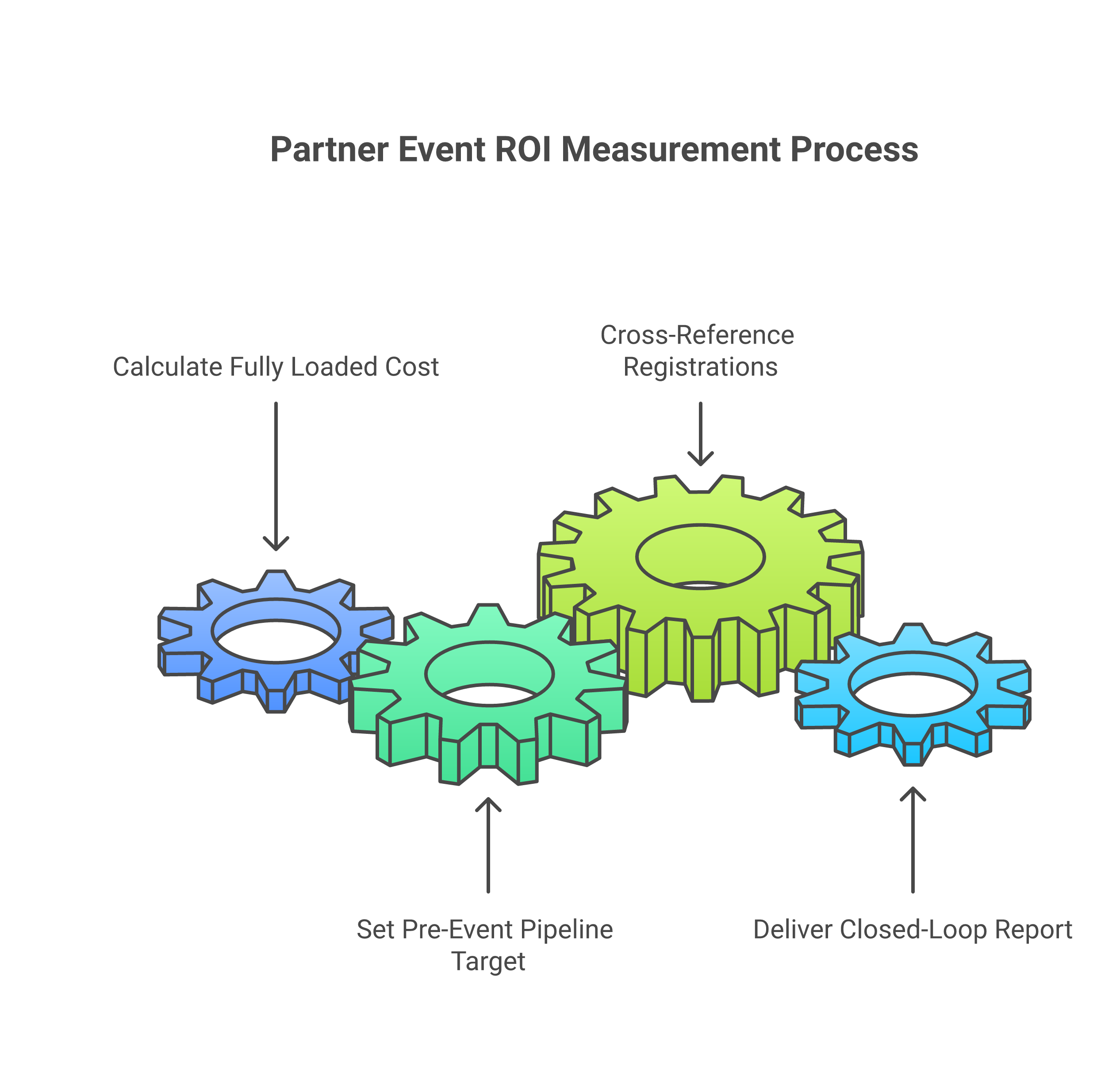
- A fully loaded cost number: Add the venue, catering, travel, and content to the partner manager hours, the AE coverage hours, and the pre-event outreach. The loaded number is usually two to three times the visible spend, and it is the denominator of the ratio.
- A pre-event pipeline target by stage: Before the budget is approved, commit to a sourced and influenced target in dollars by stage. The target is what makes the post-event number meaningful instead of a story told after the fact.
- A registration overlay against a target account list: Cross-reference registrations against the named target accounts with Crossbeam, Pocus, or Common Room. The overlay tells you, before the event, whether the right people are even coming.
- A closed-loop report within seven business days: Deliver named sourced opportunities, named influenced opportunities, the AE owner, and the next step, all by stage, within a week. The report compared against the pre-event target is the ROI. Anything later than seven days loses the attribution.
The model reruns at every event, and the targets get sharper as the historical sourced and influenced rates accumulate.
Common pitfalls in partner event ROI
- Measuring attendance instead of pipeline: A full room is an input, not a return. Count named opportunities by stage against the pre-event target, not heads through the door.
- Forgetting to load the real cost: A team that counts only venue and catering understates cost by half or more. Load the partner manager time, the AE coverage, and the outreach, or the ROI is fiction.
- Setting the target after the event: A target invented during the recap is not a target. Commit the sourced and influenced number in dollars by stage before the budget is approved, or the ROI cannot be judged.
- No registration overlay: Without an overlay against the target account list, you discover after the event that the room was full of the wrong people. Run the overlay before the event so you can fix the guest list while there is still time.
- Skipping the closed-loop report: The single most common failure. The event runs, attendees go home, and no report is written, so the pipeline never gets attributed and the next budget gets cut. Write the report within seven business days, every time.
What this looks like in practice
A mid-market B2B team ran a partner-involved regional workshop with a visible spend of nine thousand dollars in venue, catering, and travel. Loaded honestly, the cost reached roughly twenty-two thousand dollars once partner manager hours, two AEs of coverage, and three weeks of pre-event outreach were added. They committed to a pre-event target of one hundred and fifty thousand dollars in sourced and influenced pipeline, ran a Crossbeam overlay that showed registrations running two to one over the seventy-account target list, and delivered a closed-loop report six business days out. The report named five sourced opportunities at stage two and seven influenced opportunities at stage three or later, totaling about two hundred and ten thousand dollars in pipeline. Against the loaded cost, that is close to a ten-to-one return, and because the target and the costs were both honest, finance approved the next two workshops without debate.
Forecastable’s POV on partner event ROI
Partner event ROI is decided before the event, not after it. The single highest-leverage move is to set a sourced and influenced target in dollars by stage before the budget is approved, because the target forces every other decision: the target account list, the registration overlay, the AE coverage, and the closed-loop report all follow from a committed number. An event with no pre-event target is an event you cannot grade.
The deeper read is that the cost denominator is where most ROI claims fall apart. Teams systematically understate partner event cost because the visible spend is the venue and the real spend is people’s time. When you load the cost honestly, the ROI number gets smaller but it gets credible, and a credible smaller number wins the next budget where an inflated big one gets challenged and cut. Load the cost like a CFO would.
The candor on attribution is that sourced and influenced pipeline from an event has to be defined and signed before the event, in the same language the rest of the partner motion uses. If the definition is improvised during the recap, the report gets argued every quarter and the ROI never lands. Sign the definition once and reuse it at every event.
Forecastable is a partnerships operating platform; the tools above (Crossbeam, Common Room, Pocus, Introw, Euler, Impartner, PartnerStack, Channelscaler, Tackle, Labra, Suger, Clazar) are independent third-party platforms, and naming them is not an endorsement of any specific deployment over another. Evaluate each against your own motion.
Frequently asked questions
How do you calculate partner event ROI?
Divide the sourced and influenced pipeline (and eventually closed revenue) by the fully loaded cost of the event, and compare it against a target set before the event ran. The loaded cost and the pre-event target are what make the ratio honest.
What costs should be loaded into a partner event?
Venue, catering, travel, and content, plus partner manager hours, AE coverage hours, and pre-event outreach. The loaded number is usually two to three times the visible spend.
What is a good partner event ROI?
Working programs target five to fifteen times the loaded cost in sourced and influenced pipeline. The exact bar depends on segment and deal size, but the ratio should be set and committed before the event.
How soon should the ROI report be delivered?
Within seven business days. After that, attendees disperse, attribution decays, and the report loses credibility with both the funding partner and finance.
How do you measure influenced versus sourced pipeline?
Sourced opportunities originated at or through the event; influenced opportunities existed already and were advanced by it. Define both before the event and tag them against the event ID in the PRM.
Can you measure ROI on a brand-only event?
Not as pipeline. If an event has no target account list and no pipeline target, it is a brand activity and should be funded and judged as one, not dressed up as a pipeline play.
Next step
If a partner event is on the calendar this quarter, the move this week is to load the full cost, commit a sourced and influenced target in dollars by stage before the budget is approved, and lock the closed-loop report template now.
Start your growth journey now to build the ROI model for your specific event, or read the orientation on the partner program for the broader operating model.
Uncover Your Growth Potential
Schedule a Discovery Call