Partner Email Tracking: Accountability That Holds

What is partner email tracking accountability?
Short answer: Partner email tracking accountability is the operating discipline of logging every partner-facing email against a named owner and a cadence target, so follow-through becomes measurable instead of assumed. It turns the partner inbox from a private black box into a forecastable signal a partner operations leader can actually manage.
The mistake most programs make is to treat partner email as a personal habit that lives in each partner manager’s individual inbox. When the follow-up is invisible, no one can tell the difference between a partner manager who touches twelve partners a week and one who touches two. The fix is to make the touch a logged event with an owner, a date, and a next step, the same way a sales team tracks activity against an opportunity.
This is not about surveillance. It is about making the cadence real so a partner who goes quiet for six weeks shows up as a gap, not as a surprise at the quarterly business review.
Why partner email tracking accountability matters in 2026
Partner programs have grown past the point where follow-through can run on memory. A partner manager with forty named partners cannot hold the last-touch date for each one in their head, and a program leader with four partner managers cannot audit four inboxes by hand. The result, in most programs, is that the loudest partners get the attention and the quiet ones decay until they churn.
The second force is the CFO. Partnerships budgets are now scrutinized the same way sales budgets are, and the first question a finance partner asks is whether the team is actually working the partners it signed. A logged cadence answers that question with a number. An unlogged cadence answers it with a shrug.
The third force is tooling. The PRM and CRM systems that partner teams already run, paired with email sync, make activity capture nearly free. The platforms log the touch automatically; the only remaining work is to define the cadence target and to read the report. The teams that win in 2026 are the ones that close that last loop and treat the touch log as a managed metric, not a nice-to-have.
How partner email tracking accountability actually works
A working system runs on a four-part operating model. Each part has a named owner and a named artifact, and each part is what quietly breaks when a program lets partner email run on personal habit.
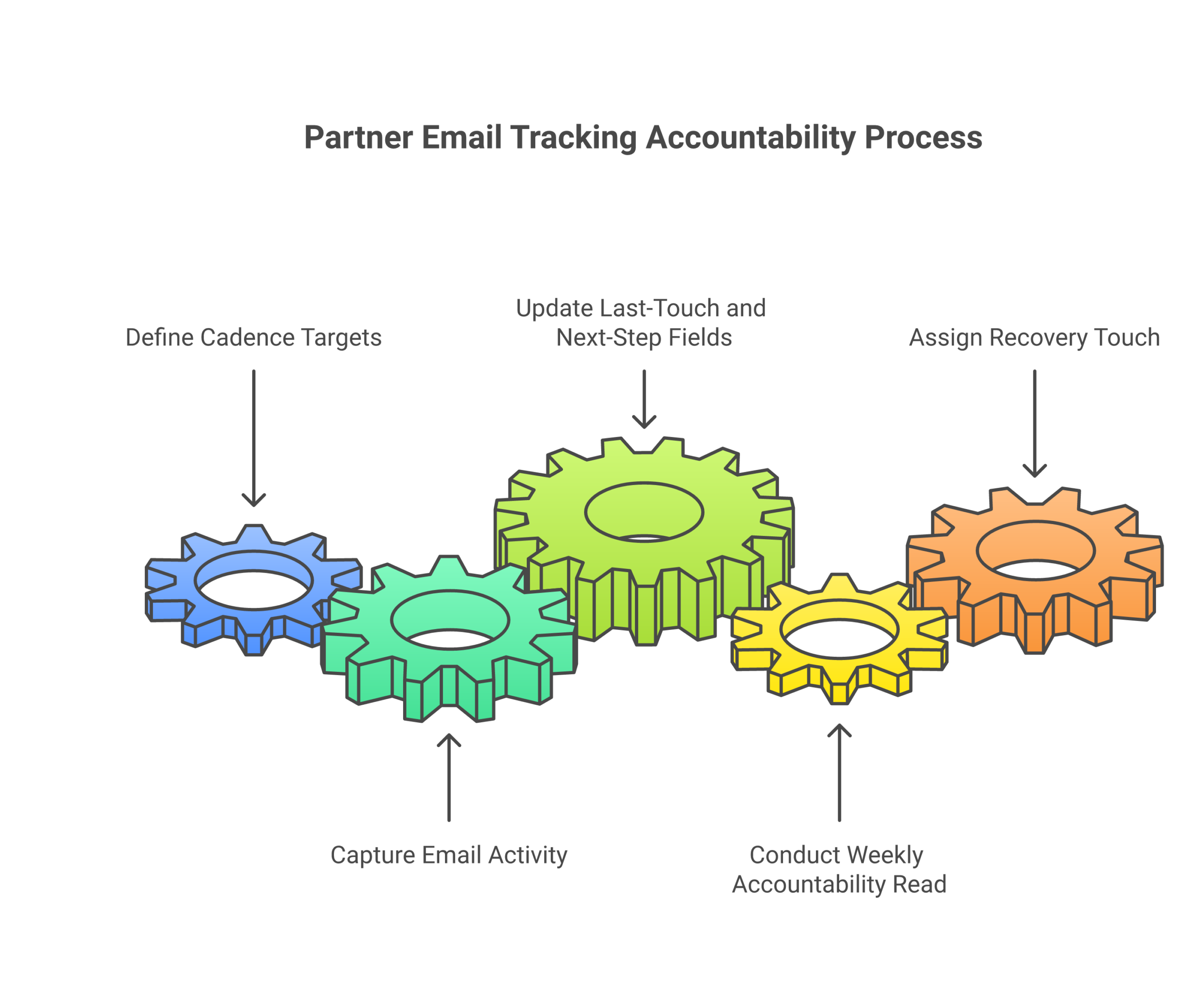
- A defined cadence target per partner tier: Tier 1 partners get a logged touch every week, Tier 2 every two weeks, Tier 3 monthly. The target is written down, not implied, and it is the line every report is measured against.
- Automatic activity capture in the PRM or CRM: Email sync logs every partner-facing thread against the partner record with a date and an owner. Introw and Euler handle this natively on the PRM side, and Impartner, PartnerStack, and Channelscaler capture it where the program already runs on one of those. The capture is automatic so the partner manager never logs anything by hand.
- A last-touch and next-step field on every partner record: The two fields that make the log actionable are the date of the last logged touch and the agreed next step. A record with a last touch of forty days ago and no next step is a flag, not a mystery.
- A weekly accountability read: The partner operations lead reviews the cadence report once a week, names the partners that have slipped past their tier target, and assigns the recovery touch. The read takes twenty minutes and it is the step that turns the data into behavior.
The cycle reruns every week, and within a quarter the partner managers internalize the cadence because the gaps are visible to everyone.
Common pitfalls in partner email tracking accountability
- Confusing volume with follow-through: A partner manager can send forty emails a week and still leave the ten most important partners untouched. Track the cadence per partner against the tier target, not the raw email count. The right metric is coverage, not output.
- Manual logging that no one does: If the system asks partner managers to log touches by hand, the log will be half-empty within a month. Capture has to be automatic through email sync, or it will not happen. Never build a process that depends on voluntary data entry.
- Tracking without a target: A last-touch date means nothing without a cadence target to measure it against. A forty-day gap is fine for a Tier 3 partner and a crisis for a Tier 1. Set the target per tier first, then read the gaps.
- Reading the report and doing nothing: The most common failure is a beautiful dashboard that no one acts on. The weekly read has to end with named partners and assigned recovery touches, or the accountability is theater.
- Using the log to punish instead of to coach: The moment the touch log becomes a stick, partner managers will game it with empty emails. Use it to find the partners who need attention and to coach the cadence, not to rank people.
What this looks like in practice
A B2B software program with three partner managers and ninety named partners moved partner email out of personal inboxes and into PRM email sync through Introw. They set a tier cadence (Tier 1 weekly, Tier 2 every two weeks, Tier 3 monthly), added a last-touch and next-step field to every partner record, and ran a twenty-minute weekly read. In the first month the report showed that eleven Tier 1 partners had not been touched in over three weeks, all of them quiet revenue partners that no one had noticed slipping. The recovery touches recovered four stalled co-sell motions and reactivated two partners that were a week from going dark. By the end of the quarter, Tier 1 cadence coverage ran above ninety percent, and the partner managers no longer needed to be reminded because the gaps were visible to the whole team.
Forecastable’s POV on partner email tracking accountability
Partner email tracking is a forecasting problem disguised as a productivity problem. The reason to log the touch is not to measure how busy the partner managers are; it is to make partner engagement a leading indicator you can read before a partner churns. A quiet partner is the single most reliable predictor of a dead partner, and the only way to see quiet early is to track the cadence.
The deeper read is that accountability follows visibility, not pressure. When the last-touch date is visible to the whole team, partner managers manage their own cadence because no one wants to be the person with eleven untouched Tier 1 partners on the Monday report. The leader’s job is to make the data visible and to run the weekly read, not to chase individuals. Build the visibility and the behavior follows.
The candor on tooling is that the system matters less than the cadence target. A program with a perfect PRM and no tier target will produce a tidy log that means nothing. A program with a plain CRM and a written cadence target will outperform it, because the target is what turns a date into a decision. Set the target first.
Forecastable is a partnerships operating platform; the tools above (Introw, Euler, Impartner, PartnerStack, Channelscaler, Salesforce, HubSpot, Crossbeam, Pocus, Common Room) are independent third-party platforms, and naming them is not an endorsement of any specific deployment over another. Evaluate each against your own motion.
Frequently asked questions
What is the right cadence target for partner email?
Most working programs run Tier 1 partners at a weekly logged touch, Tier 2 every two weeks, and Tier 3 monthly. Set the target per tier before you read any report.
Does partner email tracking require a PRM?
No. Email sync into the core CRM against the partner account record works fine. A PRM such as Introw or Euler makes the cadence reporting cleaner, but the discipline matters more than the platform.
Will partner managers see this as surveillance?
Only if you use it to punish. Frame it as coverage so quiet partners do not churn, run it as a coaching tool, and the team adopts it because it protects their book.
How is this different from sales activity tracking?
The mechanics are the same; the unit of measure is different. Sales tracks activity against an opportunity, while partner email tracking measures cadence coverage against a partner tier so the relationship does not decay between deals.
What metric should leadership read?
Cadence coverage, the share of partners in each tier touched within their target window. Raw email volume is a vanity number; coverage tells you whether the book is actually being worked.
How long before this changes behavior?
About a quarter. Once the gaps are visible on a weekly report, partner managers internalize the cadence and the recovery-touch list shrinks on its own.
Next step
If partner follow-through runs on personal habit today, the move this week is to set a cadence target per partner tier, turn on email sync so capture is automatic, and add a last-touch and next-step field to every partner record before the next weekly read.
Start your growth journey now to design the cadence model for your specific program, or read the orientation on the partner program for the broader operating model.
Uncover Your Growth Potential
Schedule a Discovery Call