Outsourced Partnerships: When It Works, When It Fails

What are outsourced partnerships?
Short answer: Outsourced partnerships is the engagement model where a B2B company hires a fractional partnerships leader, a partner-sourced GTM agency, or a partner-as-a-service vendor to run all or part of the partnerships motion instead of (or alongside) building an in-house team. It exists because partnerships is a slow-to-build function with a long ramp on internal hires, and the early-stage GTM cannot wait the four to six quarters an in-house program needs to produce pipeline.
The outsourced model works in a narrow set of conditions and fails outside them. The shortcut is to scope the engagement to a specific motion (recruit Tier 1 partners, install a co-sell cadence, build a marketplace listing, run an MDF event cycle) with a named partner target list, a forecasted pipeline outcome, and a defined transition to internal ownership.
Why outsourced partnerships matters in 2026
Three forces have made the outsourced partnerships question central to GTM planning. First, the cost of a senior in-house partnerships leader has risen, and the ramp to a productive in-house program runs four to six quarters; companies that need pipeline in two quarters cannot wait. Second, the partnerships consultancy and fractional-leader market has matured, with named vendors building actual playbooks instead of one-off consulting engagements. Third, the partner-side platforms (Crossbeam, Pocus, Common Room, Introw, Euler) have made the operating model installable in months rather than years, which lowers the bar for an outside engagement to ship a working motion.
The motion is not a substitute for an in-house partnerships function at scale. It is a bridge for the eighteen to twenty-four months before the in-house function is built, or a permanent supplement for a specific motion (marketplace, regional reseller, MDF events) where the in-house team does not have the muscle.
The outsourced partnerships question fails when the buying team treats the engagement as a permanent solution and never builds the in-house transition plan; it succeeds when the engagement is scoped to a specific motion with a named transition.
How outsourced partnerships actually works
A working engagement runs on five components. Each component has a named owner on the host side and a named deliverable from the outsourced side.
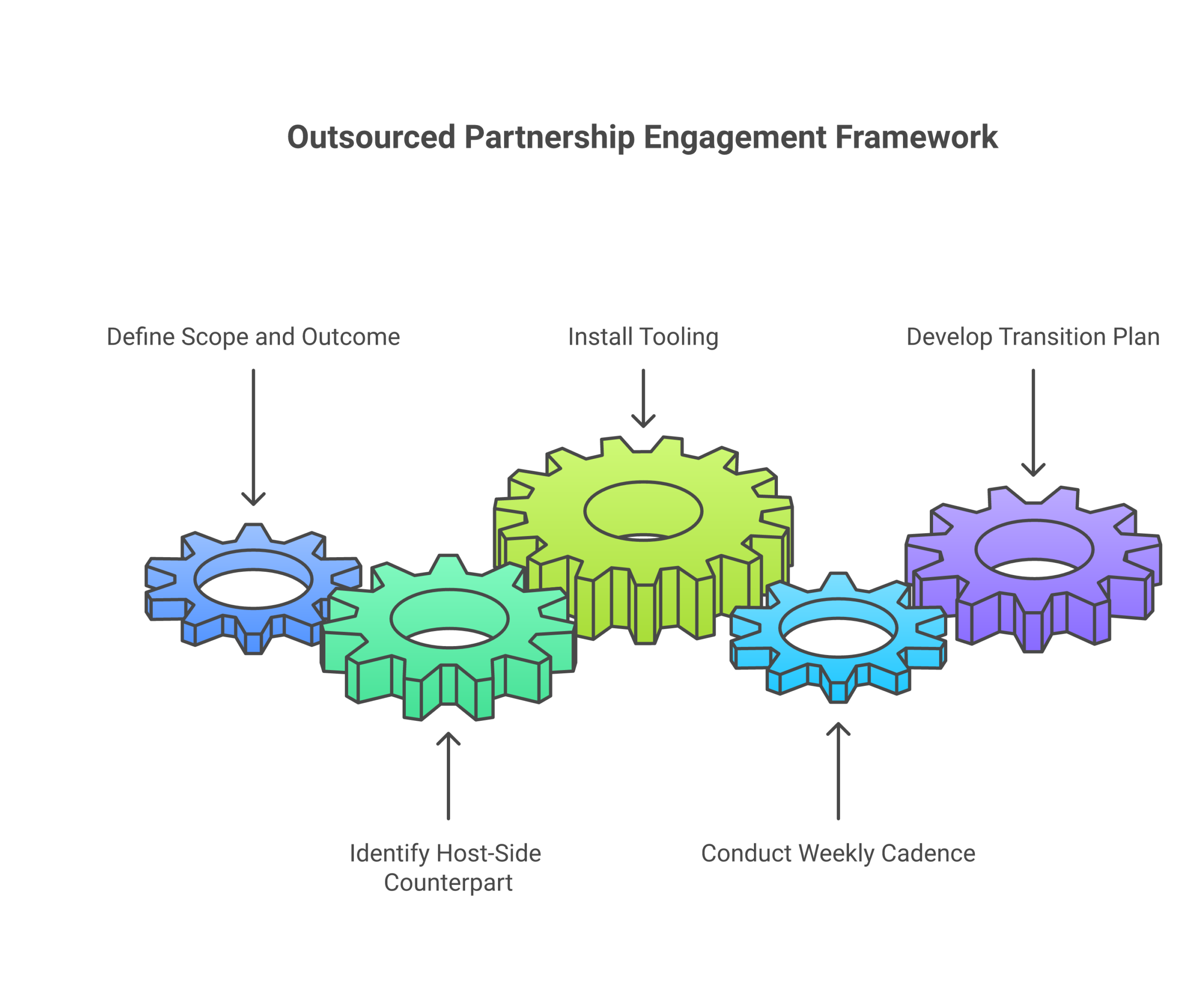
- Scoped motion with a named outcome: Not “build the partner program”; instead “recruit five Tier 1 SI partners and install a co-sell cadence that produces X dollars in sourced pipeline in two quarters.” Name the motion, the target list, the forecast, and the timeline.
- Named host-side counterpart with executive air cover: A CRO, a head of revenue, or a head of GTM owns the engagement on the host side and clears blockers (CRM access, legal review, MDF approvals). Without executive air cover, the engagement stalls.
- Tooling installed under the host’s account, not the vendor’s: The PRM (Introw, Euler, Impartner, PartnerStack, or Channelscaler), the overlap platform (Crossbeam, Pocus, Common Room), and the deal-registration workflow live on the host’s tenant. The outsourced team operates the tools; the host owns them.
- Weekly cadence with a named artifact set: A weekly partner pipeline review, a monthly partner business review, and a quarterly executive readout. The same cadence the in-house team would run, with the outsourced team in the partner manager seat.
- Defined transition plan to internal ownership: At month nine to twelve, the engagement transitions to an in-house partner manager or a hybrid model. The transition is scoped at engagement signing, not at engagement renewal.
The cycle compounds only if the host side commits to the transition plan.
Common pitfalls in running an outsourced partnerships engagement
- Scoping the engagement as “build the partner program”: An unbounded scope produces unbounded drag. A real engagement names the motion (recruit, co-sell, marketplace, MDF), the target list, the forecast, and the timeline. Anything broader is consulting, not execution.
- Letting the outsourced team operate on its own tenant: The PRM, the CRM workflows, the deal-registration records, and the overlap data have to live on the host’s tenant. When the engagement ends, the host keeps the operating system; if the data lives on the vendor’s side, the host has to start over.
- No executive air cover from the host side: The outsourced partner manager needs the CRO or the head of GTM to clear blockers (CRM access, MDF approvals, legal review, AE introductions). Without air cover, the engagement gets stuck in procurement and never ships the motion.
- Treating the engagement as permanent: The outsourced model is a bridge, not a destination. A program that runs on fractional or agency support past month eighteen is signaling that the in-house function is not being built. Name the transition at engagement signing.
- No closed-loop reporting to the executive team: The host CRO needs the same weekly pipeline review and the same monthly partner business review that an in-house team would deliver. Without the cadence, the executive team cannot tell whether the engagement is working.
What this looks like in practice
A series B B2B SaaS team had four months of runway before the next board update and needed a partner-sourced pipeline number on the slide. The CRO hired an outsourced partnerships engagement scoped to recruit five Tier 1 SI partners, install a co-sell cadence with the top two, and produce three hundred thousand dollars of sourced pipeline by the board meeting. The engagement ran on the host’s Crossbeam tenant, the host’s Introw PRM, and a weekly thirty-minute pipeline review with the CRO. By week ten, four of five Tier 1 partners had signed, two had run a joint pitch, and the partner-sourced pipeline number on the board slide was four hundred and twenty thousand dollars. The transition plan named a director of partnerships hire at month nine and an outsourced-to-internal hand-off in quarter three; the hire shipped on time and the engagement ramped down to fractional executive coaching for the new director.
Forecastable’s POV on outsourced partnerships
Outsourced partnerships works as a bridge and fails as a destination. The teams that get value from the engagement scope it to a specific motion, name the transition plan at signing, and install the operating model on their own tenant. The teams that lose money on the engagement treat it as a permanent substitute for an in-house function and never build the muscle to run the motion after the engagement ends.
The deeper read is that the outsourced model is a forcing function for installing the operating cadence and the tooling discipline that an in-house team would also need. A company that hires an outsourced partnerships team and refuses to install the cadence or commit to the transition plan would have failed with an in-house team for the same reason; the model is not the problem.
The candor on the engagement-versus-hire question is that the right answer depends on the time horizon. If the company needs pipeline in two quarters, an outsourced engagement is faster than an in-house hire. If the company can wait four to six quarters, the in-house hire is cheaper per dollar of pipeline and produces a more durable operating system. Most early-stage GTMs run a hybrid: outsourced for the first eighteen months, in-house for the long run.
The candor on the vendor selection question is that the market is uneven. Some outsourced partnerships vendors run actual playbooks with named outcomes; some run open-ended consulting engagements that produce no operating system. The scoping conversation is the test: a vendor that cannot scope to a named motion and a named forecast in the first thirty minutes is the wrong vendor.
Forecastable is a partnerships operating platform that supports both in-house and outsourced engagement models; the tools above (Crossbeam, Pocus, Common Room, Tackle, Labra, Suger, Clazar, Introw, Euler, Impartner, PartnerStack, Channelscaler) are independent third-party platforms, and naming them is not an endorsement of any specific deployment over another. Evaluate each on your own motion.
Frequently asked questions
When does outsourced partnerships work and when does it fail?
It works when scoped to a specific motion with a named target list, a named forecast, and a defined transition. It fails when scoped as “build the partner program” or treated as a permanent substitute for an in-house function.
What is the typical engagement length?
Six to eighteen months for the bridge model, with a transition to in-house ownership in quarter three or four. Engagements past eighteen months should signal a hybrid model, not a continued bridge.
How much does outsourced partnerships cost?
Fractional leaders run twenty to forty thousand dollars per month; agency execution engagements run thirty to eighty thousand per month depending on scope. The cost is competitive with an in-house director-plus-team only when the engagement ships a measurable motion in the first two quarters.
Should we let the outsourced team own the partner relationships?
No. The host CRO and head of partnerships own the strategic partner relationships; the outsourced team operates the cadence. When the engagement ends, the relationships have to stay with the host.
Does outsourced partnerships work for marketplace motions?
Yes, and marketplace is one of the highest-fit scopes because the work is specific (build the listing, install Tackle, Labra, Suger, or Clazar, run the co-sell motion with the hyperscaler) and the outcome is measurable.
How does outsourced partnerships tie into the PRM?
The PRM (Introw, Euler, Impartner, PartnerStack, or Channelscaler) lives on the host tenant. The outsourced team configures and operates it; the host owns the data. At engagement end, the operating system stays with the host.
Should we use outsourced partnerships if we already have a head of partnerships?
Sometimes. Fractional or agency support can be additive on a specific motion (marketplace launch, regional reseller expansion, MDF event cycle) the in-house team does not have the muscle to run. Scope the engagement to the gap, not to the function.
Next step
If an outsourced partnerships engagement is open this quarter, the move this week is to scope the motion with a named target list and a named forecast, lock the transition plan, and require the tooling to install on the host tenant.
Start your growth journey now to scope an outsourced partnerships engagement in your specific environment, or read the orientation on the partner program for the broader operating model.
Uncover Your Growth Potential
Schedule a Discovery Call