MDF Event: A Working Playbook for Partner Pipeline

What is an MDF event?
Short answer: An MDF event is a partner-funded or jointly funded field marketing motion where market development funds underwrite a customer-facing activity (executive dinner, regional workshop, conference booth, or industry breakfast) with a named pipeline target and a sourced and influenced reporting back to the funding partner. It is not a logo placement and it is not a free meal; it is a paid GTM motion with a forecasted return.
The mistake most teams make is to treat the spend as marketing brand work and the meeting as a friendly catch-up. The teams that produce pipeline treat the spend as a sales motion with a registration list, a target-account overlay, an agenda built around the partner’s product story, and a closed-loop report that names sourced and influenced opportunities by stage.
Why MDF events matter in 2026
Partner-funded field marketing has moved back into the center of B2B GTM because three forces have converged. First, digital channels have lost effectiveness at the top of the funnel for high-ACV segments, and account-targeted in-person motion now outperforms paid digital for the executive buyer. Second, partner programs have matured enough that MDF is a recurring line item rather than a one-off promotion, and the partner side now expects a sourced-and-influenced report back. Third, CFOs have started asking partnerships teams to show pipeline returns on MDF spend in the same forecast cadence as the rest of the GTM motion.
The MDF event question is no longer whether to fund one; it is how to fund and run one that books real pipeline. A typical mid-market MDF check runs five to twenty-five thousand dollars per event, and the median return across the events that do not invest in the run-of-show is roughly nothing. The same check, run with a registration overlay and a closed-loop report, runs five to fifteen times back in sourced and influenced pipeline.
The shortcut is to treat each MDF event as a small GTM campaign with a registration list, a target account list, and a forecast. Everything downstream of that runs cleaner.
How an MDF event actually works
A working MDF event runs on a four-step operating cycle. Each step has named owners and a named artifact, and each step is what gets cut when teams treat the event as brand work.
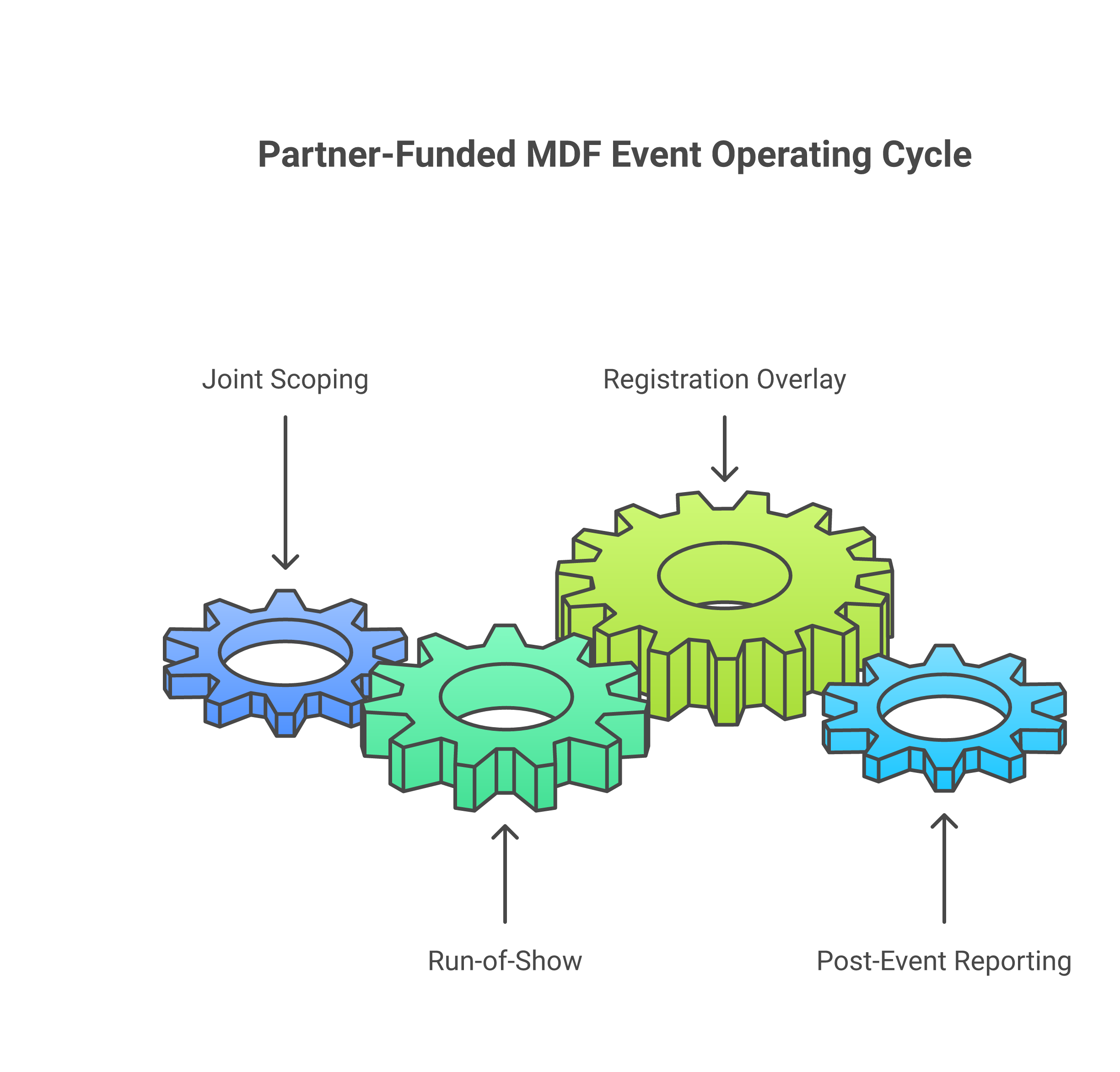
- Joint scoping with the funding partner: Name the target account list (twenty-five to two hundred accounts), the persona, the geography, and the pipeline target in dollars by stage. Co-sign the scope before the spend is approved.
- Run-of-show with a partner product moment: Build the agenda around a thirty-to-sixty minute partner product story, not a generic industry panel. The partner brings the keynote speaker, a one-page joint value frame, and a printed account-mapping handout.
- Registration overlay and pre-event outreach: Cross-reference registrations against the target account list with Crossbeam, Pocus, or Common Room. Pre-event outreach goes from the partner side to the partner’s accounts and from the host side to the host’s accounts. Walkup-only attendance is a leading indicator of a failed event.
- Post-event closed-loop reporting: Within seven business days, deliver a sourced-and-influenced report by stage to the funding partner with named opportunities, AE owner, partner-side counterpart, and next step. The closed-loop report is what unlocks the next MDF check.
The cycle reruns at the same partner two to four times before the motion is repeatable.
Common pitfalls in running an MDF event
- Spending the check on the venue instead of the run-of-show: A great steakhouse with a generic agenda books zero pipeline. The same money, with the partner keynote and the registration overlay, books five to fifteen times back. Spend on the agenda, not the room.
- No target account list before the spend approval: The funding partner has accounts they care about, and the host has accounts they care about. If those two lists are not overlaid before the spend, the event runs against the wrong people. Run the overlay before the budget approval, not after.
- Skipping the closed-loop report: The single most common failure pattern. The funding partner writes the check, the event runs, attendees go home, and the host never sends a sourced-and-influenced report back. The funding partner will not write the next check. Send the report within seven business days, every time.
- Treating walkups as a win: Walkup attendance is a vanity metric. Pipeline comes from named registrants on the target account list. A room of forty walkups with no AE coverage produces nothing; a room of fifteen registered target accounts with named AEs produces deals.
- No AE pre-brief: AEs from the host and the partner need a one-page brief on which accounts are coming, what the partner story is, and what the next step is. Without the brief, AEs talk to the wrong people, and the post-event handoff falls apart.
What this looks like in practice
A growth-stage B2B SaaS team ran a partner-funded executive dinner in Chicago against a sixty-account target list, co-scoped with a Tier 1 SI partner. The fifteen-thousand-dollar MDF check covered the venue, the keynote travel, and one pre-event regional workshop the prior afternoon. Registration ran two-to-one over target on the dinner and one-to-one on the workshop. The partner brought a thirty-minute keynote on a joint customer outcome, the host brought the run-of-show and the AE coverage, and the account-mapping handout went to every registered table. Within seven business days, the closed-loop report named four sourced opportunities at stage two, six influenced opportunities at stage three or later, and three exec follow-up meetings the partner asked the host to set. Forecasted return on the fifteen thousand dollar check was approximately three hundred and twenty thousand in sourced and influenced pipeline. The same partner approved the next two events on the spot.
Forecastable’s POV on MDF events
MDF events are a GTM motion, not a marketing motion. The teams that produce pipeline treat the spend as a paid sales play with a target account list, an AE coverage plan, and a closed-loop report. The teams that produce nothing treat the spend as a brand activity with a venue and a hope. The operating model has to be the first decision, before the venue, before the agenda, before the spend approval.
The deeper read is that MDF events are the most teachable partner motion a partnerships team can run, because the cycle is short (six to eight weeks from joint scoping to closed-loop report), the artifact set is small (scope memo, run-of-show, target list, AE pre-brief, closed-loop report), and the feedback loop is direct (the funding partner either writes the next check or does not). A team that runs four MDF events in a quarter with the closed-loop discipline intact will have installed a partner-marketing operating cadence the rest of the program can lean on for the year.
The candor on the budget question is that the MDF check itself is the least important variable. A five-thousand-dollar regional workshop with the closed-loop report intact will outperform a fifty-thousand-dollar conference booth with no target list. Spend on the cycle, not the venue.
The candor on attribution is that sourced and influenced pipeline from an MDF event has to be reported the same way the rest of the partner motion is reported, with a signed definition the host and the partner agree on before the event. If the definition is not signed, the closed-loop report will be argued every quarter.
Forecastable is a partnerships operating platform; the tools above (Crossbeam, Common Room, Pocus, Tackle, Labra, Suger, Clazar, Introw, Euler, Impartner, PartnerStack, Channelscaler) are independent third-party platforms, and naming them is not an endorsement of any specific deployment over another. Evaluate each on your own motion.
Frequently asked questions
What is the right MDF event budget for a mid-market partner program?
Most working programs run MDF events at five to twenty-five thousand dollars per event, with four to eight events a quarter across the top partners. The check size matters less than the closed-loop discipline.
Who owns the MDF event run-of-show, the partner or the host?
The host owns the run-of-show; the partner owns the keynote and the account-mapping handout. Co-scoping happens at the front of the cycle, not at the agenda stage.
How do we measure MDF event return?
Sourced opportunities, influenced opportunities, and exec follow-up meetings, reported by stage and by named AE within seven business days of the event. Forecasted pipeline return is the headline metric the funding partner reads.
What if the partner does not have MDF dollars to fund the event?
Run the same operating cycle on a host-funded budget, but treat the partner as the co-presenter and ask for the keynote and the account list. The closed-loop report still goes back; the next conversation is whether the partner can fund the second event.
How many target accounts should be on the list?
Twenty-five to two hundred named accounts, sized to the event format. Executive dinners run twenty to forty registered accounts; regional workshops run sixty to one hundred and twenty; conference booths run one hundred to two hundred.
Should walkups be invited?
Walkup capacity should be planned but not relied on. The pipeline comes from the named registered target accounts with AE coverage. A walkup-only event is a leading indicator of a missing target list.
How does MDF event reporting tie into the PRM?
The MDF request, approval, and closed-loop report run through the PRM (Introw, Euler, Impartner, PartnerStack, or Channelscaler), with the deal registration and the sourced and influenced opportunity records linked to the event ID. The PRM is the system of record; the closed-loop report is the human-readable rollup the funding partner reads.
Next step
If an MDF event is on the calendar this quarter, the move this week is to write the scope memo with the funding partner, run the target-account overlay through Crossbeam or Common Room, and lock the closed-loop report template before the run-of-show is built.
Start your growth journey now to walk through the MDF event operating cycle in your specific environment, or read the orientation on the partner program for the broader operating model.
Uncover Your Growth Potential
Schedule a Discovery Call