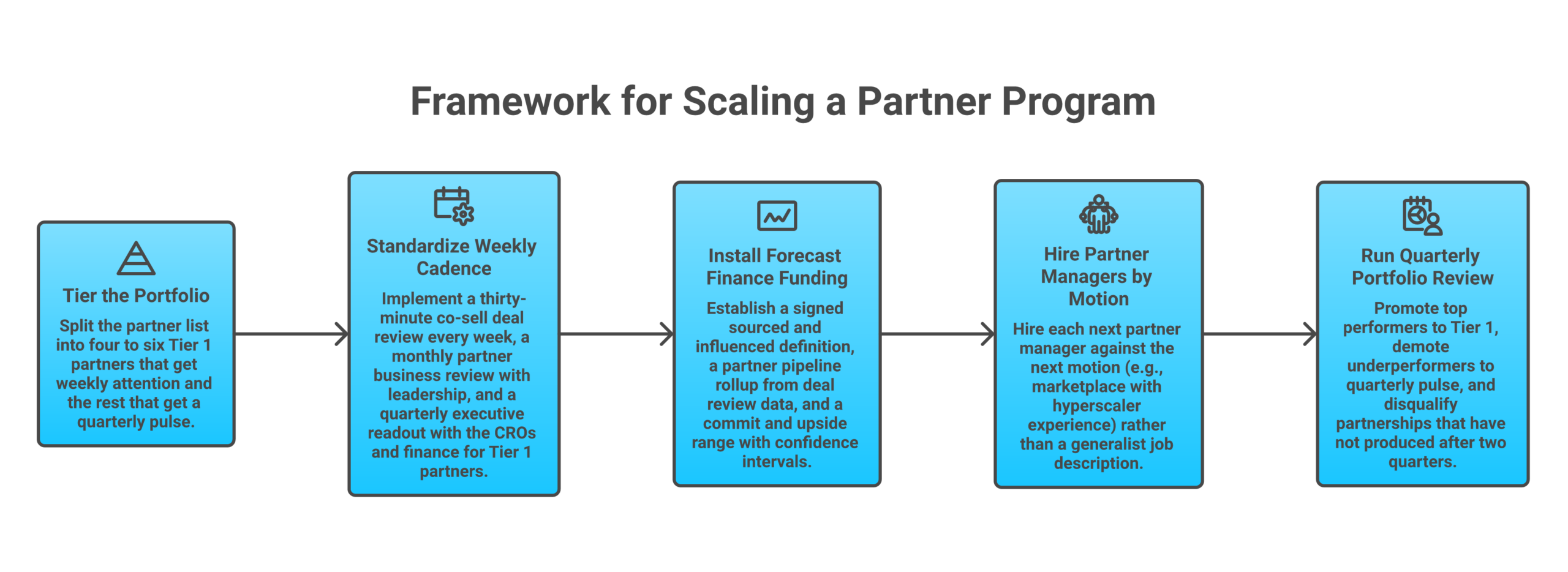
Short answer: How to scale a partner program is to tier the portfolio so four to six partners get weekly attention and the rest get a quarterly pulse, standardize a weekly co-sell deal review and quarterly executive readout across every Tier 1 partnership, install a sourced and influenced forecast that finance will fund, and hire each next partner manager against the specific motion they will run. Scaling is not adding partners; it is making the operating model survive the next ten partnerships and the next two reorgs.
The failure mode at every scaling inflection is identical. The team adds partners faster than it adds operating muscle. Activity goes up, sourced and influenced revenue does not, and finance flatlines the budget in the next cycle.
Why scaling a partner program matters in 2026
Three pressures have made scaling a partner program the rate-limiting factor for B2B revenue growth in 2026. Direct sales efficiency has plateaued in most categories. Paid acquisition costs sit at uncomfortable highs. And ecosystem-routed revenue now closes at higher win rates and lower CAC than self-sourced pipeline for the average B2B SaaS company.
The math forces an investment in partner program scale. The board approves the headcount, the partnerships team expands, and within two quarters the pattern repeats: more partners, more activity, no measurable lift in joint pipeline or closed revenue. Finance reads the rollup, the budget conversation gets harder, and the team contracts.
The scaling motion that works treats partnerships the same way revenue operations treats direct sales. An operating model, a forecast, and a hiring rubric. Without those three, scaling is just hiring.
How to scale a partner program, step by step
The scaling motion that survives runs on five steps. Each one solves a problem the next one depends on.
Tier the portfolio honestly: Split the partner list into four to six Tier 1 partners that get weekly attention and the rest that get a quarterly pulse. Without tiering, the team gives twenty partners the same care, and every partner ends up at the bottom of the calendar.
Standardize the weekly cadence across every Tier 1: A thirty-minute co-sell deal review every week, a monthly partner business review with leadership, and a quarterly executive readout with the CROs and finance. Same template, same artifacts, every partnership.
Install a forecast finance will fund: A signed sourced and influenced definition, a partner pipeline rollup that comes out of the same data the deal review used, and a commit and upside range with confidence intervals. Without the forecast, scaling is unfundable.
Hire each next partner manager against the next motion, not against a generalist JD: If the next motion is marketplace, hire someone with hyperscaler experience. If the next motion is regional reseller, hire someone with channel experience. Generalist hires produce generalist results.
Run a quarterly portfolio review: Promote the top performers to Tier 1, demote the underperformers to quarterly pulse, and disqualify the partnerships that have not produced after two quarters. Without the review, the portfolio bloats and the cadence breaks.
Common pitfalls that kill scaling
Adding partners faster than operating muscle: A team that doubles its partner count without doubling its cadence muscle produces twice the activity and no lift in pipeline. The cadence is the constraint, not the partner count.
Cadence templates that vary by partner manager: When every partner manager runs a different deal review template, the rollup cannot be standardized and the forecast cannot be trusted. Standardize the template, not the personality.
Hiring a generalist partner manager for the next specialized motion: A marketplace motion needs marketplace experience. A regional reseller motion needs channel experience. Generalist hires produce mediocre results across the board.
Skipping the quarterly portfolio review: Without the review, the portfolio bloats, the cadence stretches thin, and the joint pipeline number stagnates. The review is what keeps the program lean enough to actually scale.
A forecast finance cannot audit: A partner pipeline number with no traceable definition is a budget liability. Sign the definition once and never change it without re-signing.
What this looks like in practice
A growth-stage B2B SaaS company scaled from three partnerships to twelve by tiering the portfolio (four Tier 1, eight quarterly pulse), standardizing the weekly thirty-minute deal review template across every Tier 1, installing a signed sourced and influenced forecast definition with finance, and hiring two additional partner managers against the specific next motions (marketplace and regional reseller). Within three quarters, partner-sourced and influenced pipeline ran four times the prior baseline and finance funded an additional partner manager headcount in the next cycle.
Forecastable’s POV on scaling a partner program
Scaling a partner program is not a logo-acquisition motion; it is an operating-model maturity motion. The teams that scale successfully tier the portfolio, standardize the cadence, install the forecast, hire against the next motion, and run the quarterly review. The teams that fail add partners and assume the rest follows.
Finance reads the difference within a quarter. A partner program with a tiered portfolio, a standardized cadence, and a signed forecast definition is a fundable revenue motion. A partner program with twenty new logos and no operating model is a budget risk.
The honest read is that most partner programs at the scaling inflection have a hiring problem and a cadence problem before they have a partner problem. Fix those two and scale takes care of itself.
Forecastable is a partnerships operating platform; the tools above are independent third-party platforms, and naming them is not an endorsement of any specific deployment over another. Evaluate each on your own motion.
Frequently asked questions
How many partners can one partner manager realistically run?
Two to three Tier 1 partnerships with full weekly cadence per partner manager. More than three and the cadence breaks. Quarterly-pulse partnerships are different math; one partner manager can run twenty.
Should we hire a head of partnerships before we have five partners?
Yes, if the motion is core to the growth plan. The operating muscle has to be installed before the partner count grows, not after.
How do we know when to promote a partner from quarterly pulse to Tier 1?
When the partnership produces meaningful pipeline in a quarter and the partner CRO is willing to commit to a joint number. Both signals required.
What is the right ratio of partner managers to AEs?
One partner manager per four to six AEs is a working baseline for a co-sell-led motion. Marketplace-led motions can run lighter ratios.
Do we need a PRM to scale?
Once the program exceeds three Tier 1 partnerships, yes. A PRM (Introw, Euler, Impartner, PartnerStack, Channelscaler) makes the cadence repeatable and the forecast clean across the portfolio.
Next step
If the partner program is at the scaling inflection, the move this quarter is to tier the portfolio in writing, standardize the weekly deal review template, and sign the sourced and influenced definition with finance.
Start your growth journey now to walk through what a scaled partner program operating model looks like in your specific environment, or read the orientation on the partner program for the broader model.
Uncover Your Growth Potential
Whether starting with a single sales team or a single partner, any co-sell motion can be live within 30 days.
What is channel partner recruitment? Short answer: Channel partner recruitment is the process of finding, qualifying, and signing the partners who will actually sell, service, or implement your product. It is the front door of a partner program, and it decides more about the program’s results than any later stage, because you cannot enable or […]
What is a deal registration form? Short answer: A deal registration form is the structured submission a partner completes to claim an opportunity they sourced and request the vendor’s protection for it. It captures the facts the vendor needs to verify the deal, the account, contact, size, and timing, and it starts the clock on […]
What are deal registration best practices? Short answer: Deal registration best practices are the rules that make a registration program worth trusting: fast and transparent approvals, protections that are always honored, rewards for genuine early sourcing, and claims that expire when deals stall. They exist because a registration program does nothing unless partners believe the […]
What is partner enablement? Short answer: Partner enablement is the work of getting a partner ready and able to sell, service, or implement your product, so a signed partner becomes a producing one. It covers the training, tools, messaging, and support a partner needs to win deals, plus the coaching that turns that knowledge into […]
Mollie Bodensteiner is an experienced operations professional with a demonstrated track record of utilizing technology to support operational processes that drive performance and innovation.
She currently is the Vice President of Operations at Sound and owns go-to-market agency, MB Solutions. Mollie has previously held operations leadership roles at Deel, Syncari, Corteva and Marketo.
She has over 14 years of experience in both B2C and B2B operations and technology. When she is not working, Mollie enjoys spending time with her husband, three small children, and two large dogs.
Childhood Career/Dream:
Growing up in the age of Disney and Nick@Nite I always wanted to be a child actor (good thing that never was actually pursued 🙂
Favorite Win:
I am not sure I have a specific “win” but I think I get the most joy and excitement from coaching others and watching them hit major milestones in their career. The first time you get to promote someone on your team or watch them lead a major project – are always career highlights!
Personal Fun Facts:
Favorite Song: If it’s love, Train
Favorite Movie: Good Will Hunting
Favorite Meme: Disaster Girl
My journey from Education to Operations has equipped me with a unique perspective and skill set that perfectly aligns with Forecastable’s mission to help businesses improve sales collaboration through partner co-selling strategies.
At Forecastable, I am passionate about empowering teams and organizations to unlock the full potential of strategic partnerships. By leveraging my expertise in communication, leadership, and operational efficiency, I contribute to creating seamless co-selling processes that align with business goals and deliver exceptional results.
The intersection of my educational foundation and operational experience fuels my dedication to fostering alignment, building trust, and enhancing collaboration between partners. I am driven by the opportunity to contribute to a platform that not only optimizes sales strategies but also strengthens relationships that lead to long-term growth.
Paul Jonhson
Chief Technology Officer (Co-founder)
Paul Johnson has 20+ years of software development and consulting experience for a variety of organizations, ranging from startups to large-enterprise organization with highly-complex needs.
Mr. Johnson has a long track record of successful technology deployments.
This, combined with his deep passion for machine learning and exceptional user experience design, allows him to lead our technical direction from the front with confidence.
Alex Buckles
Product, Partnerships, and Value Engineering (Co-founder)
After serving in The United States Marine Corps, Alex Buckles spent the next two decades as a student of revenue production and an advocate for innovation.
Along the way, he has helped numerous companies achieve double and triple-digit growth by crafting and executing high-performing go-to-market strategies, with co-selling at the center of each.
As a once-advanced technical marketer, an expert sales & partner professional, and a strong customer success advocate, Mr. Buckles understands the impact of these functions aligning not only on revenue production, but on the day-to-day execution of the go-to-market strategy. This concept of revenue-team alignment is what quickly became the foundation of Forecastable back in January of 2018.
In his free time, you’ll find him spending quality time with his children, one of whom is on the autism spectrum. 1 in 36 children in the U.S. are on the spectrum and boys are four times more likely to be diagnosed than girls.
With that in mind, Mr. Buckles plans on dedicating the rest of his life serving those living with autism, through his organization Pathways for Autism. From his perspective, there must be a scalable and financially self-sustaining infrastructure established to put as many individuals with autism as possible on a path towards complete independence as adults.