How to Recruit Partners in 2026: A Field Guide

What does recruiting a partner actually look like?
Short answer: How to recruit partners is to define an ideal partner profile, source candidates against it, lead the first conversation with overlap data and a specific small joint motion rather than a brand pitch, and qualify against the joint number both sides could commit to. Recruiting works when it looks like outbound sales, not networking. The first meeting either produces a working agreement on a tight first motion or both sides part friendly with no follow-up.
Most partner recruiting is theatre. A LinkedIn introduction, a thirty-minute “explore” call, a follow-up that goes silent. The motion that produces working partners is operationally narrow and looks more like an AE running discovery than a marketing kickoff.
Why partner recruiting matters in 2026
Three forces have made partner recruiting harder and more important in 2026. The talent market for senior partnerships leaders has thinned, which means many programs are run by people doing partner recruiting for the first time. The volume of partner outreach has roughly doubled in the last two years, so a candidate partner’s calendar is filled with low-signal “explore” calls and the bar to earn a serious meeting has risen. And finance has started discounting partner programs that cannot show working partners with real pipeline within two quarters of recruiting.
Recruiting the wrong partner costs four to six quarters of partnership team capacity. Recruiting the right one shows up in the joint pipeline rollup within a single quarter. The leverage is enormous and the room for error is small.
The motion that works treats partner recruiting the same way revenue treats new logo acquisition: qualified outbound, fast disqualification, and a specific first motion to commit to.
How to recruit partners, step by step
The recruiting motion that produces working partners runs on five steps. Each one filters out a specific failure mode.
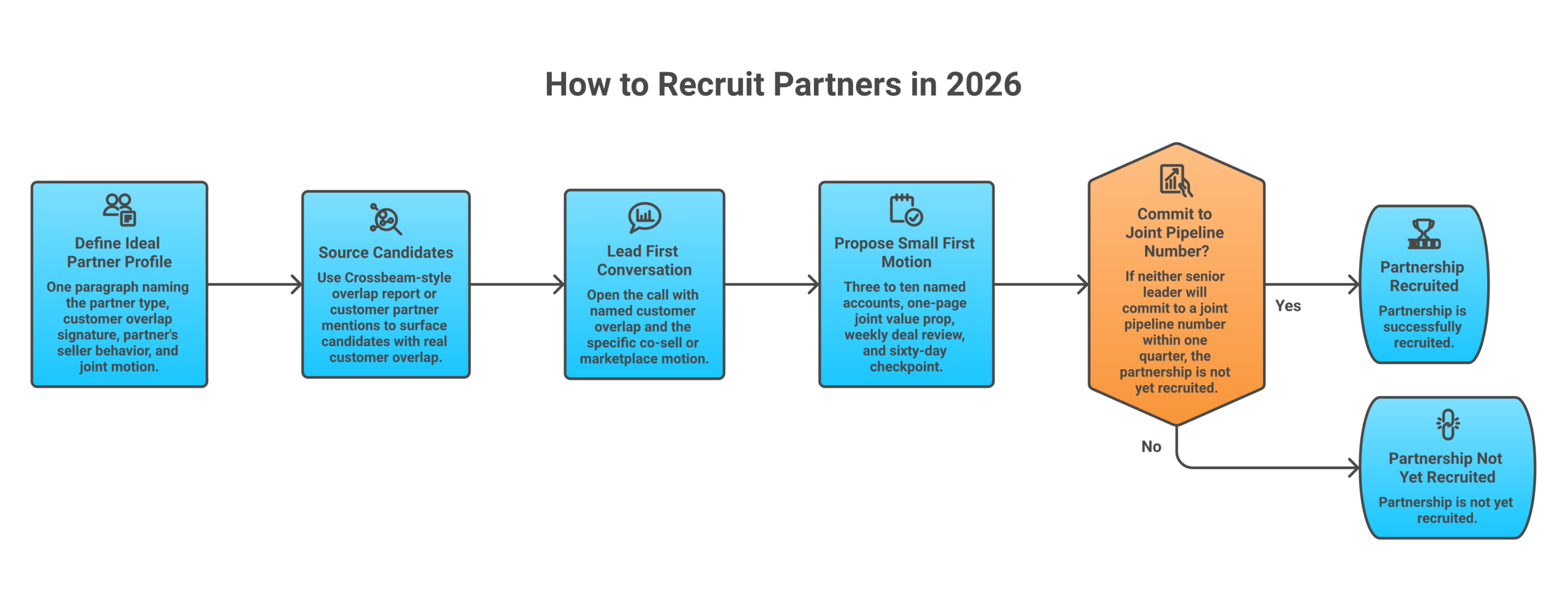
- Define the ideal partner profile: One paragraph naming the partner type (ISV, regional reseller, strategic SI, hyperscaler marketplace), the customer overlap signature, the partner’s seller behavior, and the joint motion the partnership would run. A partner program without an ideal partner profile recruits randomly.
- Source candidates against the profile, not against logo lists: Use a Crossbeam-style overlap report or your customers’ partner mentions to surface candidates with real customer overlap. Logo-list recruiting produces brand handshakes; overlap-driven recruiting produces deals.
- Lead the first conversation with overlap data and a specific motion: Open the call with the named customer overlap and the one specific co-sell or marketplace motion the partnership would run. Five minutes in, the partner CRO knows whether this is a real conversation or another brand handshake.
- Propose a small first motion within thirty days: Three to ten named accounts, a one-page joint value prop, a weekly thirty-minute deal review, and a sixty-day checkpoint. Small enough to fit in both calendars; large enough to produce signal.
- Qualify against the joint number both sides could commit to: If neither senior leader will commit to a joint pipeline number within one quarter, the partnership is not yet recruited. Disqualify and move on. Most “soft yes” partnerships die at this step anyway, just slower.
Common pitfalls that kill partner recruiting
- Recruiting from a logo list with no overlap: Brand prestige does not produce revenue. Recruit candidates with real customer overlap; logo-only recruiting produces partnerships that look great in deck and produce nothing in pipeline.
- Opening with a brand pitch instead of overlap: The first conversation has thirty minutes. Spending twenty on brand and ten on data inverts the signal. Open with the overlap and the motion.
- Proposing a giant first motion: A hundred-account joint plan in week one signals naivete. Three to ten named accounts in the first thirty days signals operating maturity.
- Slow qualification: Carrying a “soft yes” partner for two quarters consumes the partnership team’s capacity. Disqualify within four weeks if the candidate will not commit to a joint number.
- Signing the agreement before naming the cadence: A signed contract without a calendar invite for the weekly deal review is a souvenir. The cadence is the program.
What this looks like in practice
A B2B SaaS company replaced a logo-list recruiting motion with an overlap-driven motion using Crossbeam. The team surfaced twelve candidate partners with strong customer overlap. The first conversations opened with the overlap and a proposed three-account motion. Within eight weeks, four partnerships had a signed working agreement, a weekly deal review on the calendar, and the first co-sell deals in flight; eight were disqualified within four weeks. The team produced more partner pipeline in one quarter than the prior twelve months combined.
Forecastable’s POV on partner recruiting
Partner recruiting is outbound sales with a longer cycle and a higher reward. The teams that win treat it like outbound: qualified targeting, overlap-led discovery, fast disqualification, and a small first motion to commit to. The teams that struggle treat it like networking and produce a roster of friendly partners that never move pipeline.
Finance reads recruiting outputs by the same logic. A partner program that shows three new partnerships in a quarter with working cadence and live pipeline gets funded; a program that shows ten signed logos with no live motion gets discounted. The difference is the recruiting motion, not the partners themselves.
The honest read is that most partner programs recruit too much and qualify too little. Cut the candidate list in half, raise the bar at the qualifying step, and the working-partner count goes up, not down.
Forecastable is a partnerships operating platform; the tools above are independent third-party platforms, and naming them is not an endorsement of any specific deployment over another. Evaluate each on your own motion.
Frequently asked questions
How many partners should we recruit per quarter? Three to five working partners per quarter is the working ceiling for a single partner manager. More produces signing theater without working motions.
Should we recruit large-logo partners first? Only if the overlap is real. Logo prestige without customer overlap produces partnerships that look great in deck and produce nothing in the pipeline rollup.
How long should the recruiting cycle take? First call to signed working agreement should run four to eight weeks. Longer than twelve weeks means one or both sides did not commit; disqualify and move on.
Do we need a partner agreement template before recruiting? A one-page working agreement is enough for the first thirty days. The full mutual NDA and partner agreement can sign in parallel with the first motion running.
Do we need a PRM to recruit partners? Not for recruiting itself. Bring in a PRM (Introw, Euler, Impartner, PartnerStack, Channelscaler) for the post-recruiting motion: deal registration, joint plans, partner workspace.
Next step
If partner recruiting is open this quarter, the move this week is to run an overlap report against the candidate set, write the ideal partner profile in one paragraph, and design the first conversation around overlap data and a three-account motion.
Start your growth journey now to walk through what an overlap-led recruiting motion looks like in your specific environment, or read the orientation on the partner program for the broader operating model.
Uncover Your Growth Potential
Schedule a Discovery Call