Execution Discipline in Partnerships: A 2026 Field Guide

What is execution discipline in partnerships?
Short answer: Execution discipline in partnerships is the operating habit of running a small number of joint motions on a fixed weekly cadence, with named owners on both sides, a written artifact for every step, and a forecast-grade metric that finance accepts. It is not heroics; it is the boring repetition that turns partner activity into closed revenue you can predict.
The discipline replaces the two failure modes most partnerships teams default to. The first is the hero model where a partner manager hand-carries one or two deals to close every quarter and nothing else moves. The second is the busy theater model where the team is in calls all day, lighting up dashboards, and the sourced and influenced numbers still drift downward each quarter.
A disciplined team picks fewer motions, runs them on a calendar, and writes everything down so the work survives a reorg.
Why execution discipline in partnerships matters in 2026
Three forces have made discipline the rate-limiting factor for partnership revenue in 2026. The first is finance scrutiny. After two budget cycles of soft attribution claims, CFOs now ask for the cadence behind a partner-sourced number before they fund the next headcount, and a team that cannot describe its weekly motion loses the budget conversation.
The second is rep turnover. Partner managers and AEs both turn over every eighteen months on average. A motion documented in someone’s head leaves with them. A motion documented in a recurring meeting, a shared deal-review template, and a tracked overlap report survives.
The third is partner sprawl. Most companies now sit in twenty or more partnerships and cannot run all of them deeply. Discipline means picking the four to six that get the cadence and being honest that the rest get a quarterly check-in.
The teams that win in this market are not the most creative. They are the most repeatable.
How execution discipline in partnerships actually works
A disciplined partnerships motion runs on five linked habits. Each one creates an artifact the next quarter can audit.
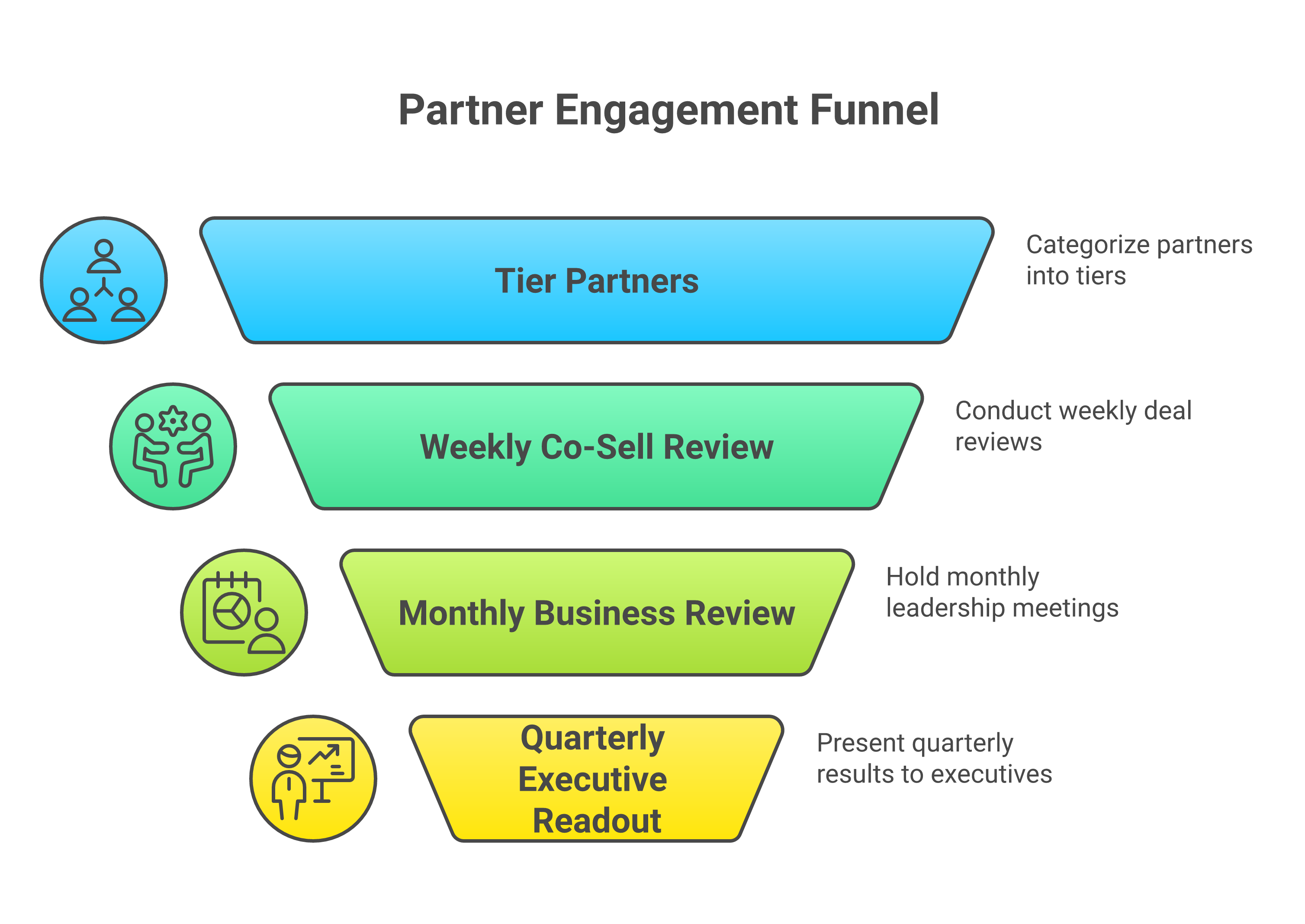
- Tier the portfolio honestly: Before any cadence works, split the partner list into four to six Tier 1 partners that get weekly attention and the rest that get a quarterly pulse. Most teams skip this step and try to give twenty partners the same care, which is how every partner ends up at the bottom of someone’s calendar.
- A weekly co-sell deal review: Thirty minutes, same time every week, two partner managers and the AE owners on both sides. Look at the joint pipeline, name the next action on every deal, and note any deal that has not moved in two weeks. This is the single most underused meeting in B2B partnerships.
- A monthly partner business review: Sixty minutes with partner leadership. Look at the joint pipeline number, the sourced versus influenced split, the deals lost and why, and the next month’s pursuit list. Decide one or two changes to the motion and write them down.
- A quarterly executive readout: Ninety minutes with the CRO, the partner CRO, and finance from at least one side. Cover revenue produced, the forecast for the next quarter, and the asks each side has of the other. This is where executive alignment is renewed rather than assumed.
- Written artifacts for every step: Every cadence above produces a one-page artifact, the same way each time. A weekly deal-review note, a monthly PBR summary, a quarterly readout deck. The artifacts are the memory of the motion. Without them, a personnel change resets the partnership.
The pattern across all five is the same. A fixed cadence, named owners, a written artifact, and a metric that finance accepts. Nothing in here is clever. Cleverness is not what is missing.
Common pitfalls
Execution discipline fails in predictable ways. Each of these is a pattern a healthy partnership has to actively avoid.
- Treating cadence as optional: The weekly deal review gets bumped for one quarter of customer meetings and is gone within two months. Cadence either runs every week or it dies.
- No tiering, so everyone gets nothing: Twenty partners on the books, four hours of meeting time per week per partner manager, and a calendar that papers over the lack of focus. Without honest tiering, the math forces a thin cadence on every partner.
- Owners by team, not by name: “Sales owns this deal” is not an owner. A named AE on a specific deal is. Diffuse ownership is what kills partner-sourced pipeline between the first call and the close.
- Artifacts as theater: A PBR deck with thirty slides and no decision is worse than no PBR. Each artifact should fit on a page and end with two or three commitments.
- Forecast-blind metrics: Counting introductions or webinar attendees while ignoring sourced and influenced pipeline is how a team posts great activity numbers and gets defunded.
What this looks like in practice
A disciplined motion is not a software story; it is a cadence story. The tools support the cadence.
A mid-market data platform tiered twenty-three partners down to five Tier 1 in 2026 Q1. The partner manager and the partner counterpart held a thirty-minute weekly deal review on Thursdays, a monthly PBR on the first Friday, and a quarterly executive readout on the third Tuesday of the closing month. The team kept a one-page template for each. Partner-sourced pipeline rose from forty percent to sixty-three percent of total partner pipeline by Q3, and the sourced number passed finance’s audit on the first try.
A contrast is a partnerships org that ran twenty-two partner relationships with the same weekly attention. The team posted strong activity numbers, but the sourced split sat at twenty-eight percent and finance held the next headcount until the discipline showed up.
Forecastable’s POV
The interesting argument in partnerships in 2026 is not whether discipline matters. It is whether discipline is enough. We think it is not.
Discipline gets a team to predictable activity. Forecasting gets a team to predictable revenue. The two are linked, but a partnerships org can run a flawless cadence and still post a forecast finance laughs at, because the inputs into the forecast are partner-reported, lagged, and frequently revised. Discipline is necessary, not sufficient.
The teams getting funded in 2026 are pairing the cadence with a forecasting model that the CRO and the CFO both sign. That means a sourced and influenced split with a clear definition, a stage progression that mirrors the direct funnel, and a partner-level deal commit that the partner manager attaches their name to. The discipline produces the data. The forecast turns the data into a number finance will fund.
This is not a tools problem. It is an operating-model problem. The partnerships org that wins the budget conversation is the one that runs the cadence and produces a forecast finance trusts, every quarter, on the same template.
Vendors named above are listed as independent third-party providers Forecastable has worked alongside. Forecastable does not endorse a single tool category leader and recommends independent third-party evaluation against your own ecosystem before any purchase.
Frequently asked questions
How is execution discipline different from a partner program?
A partner program is the structure: tiers, agreements, benefits, certifications. Execution discipline is the weekly behavior inside that structure. A team can have a polished program with no discipline and produce nothing, and a team with a basic program and tight discipline outperforms it.
Who owns execution discipline in partnerships?
The head of partnerships owns it operationally, but the CRO has to back the cadence in calendar terms, or the weekly review gets bumped indefinitely. Both names sit on the readout.
How many partners can one partner manager run with full discipline?
Four to six Tier 1 partners is the field-tested ceiling. More than that and the cadence thins to a monthly check and the deal review becomes a status meeting.
What is the single most important artifact?
The weekly deal review note, because it is the only artifact that touches the deal motion at the rate the deal motion actually moves. Monthly and quarterly artifacts matter, but they are lagging.
How long does it take to install execution discipline?
A quarter to put the cadence in place, a quarter to make it real, and a quarter to see it in the pipeline number. Plan for three quarters before you measure honestly.
Can a small partnerships team run this?
Yes. A single partner manager covering three Tier 1 partners can run the full cadence in under six hours of meeting time per week, including prep.
Does this replace a partner program management tool?
No. The tool supports the cadence; it does not replace it. A PRM with no cadence in it is a directory.
Next step
If your partnerships motion is busy but not predictable, start with the tiering exercise and one cadence. Pick the four partners that matter, install the weekly deal review, and write the one-page note every Friday for a quarter. The forecast follows the cadence, not the other way around.
Start your growth journey with a working session on the cadence and the forecast that comes out of it.
Uncover Your Growth Potential
Schedule a Discovery Call