Fractional VP Partnerships: When to Hire One in 2026

What is a fractional VP of partnerships?
Short answer: Fractional VP partnerships is a senior leader engaged part-time to install the operating model, run the first two quarters of cadence, and either hand the function to a full-time hire or stay on for ongoing oversight. The role exists because most companies need senior judgment well before the volume justifies a full-time VP hire.
A fractional VP is not an advisor. Advisors give counsel; a fractional VP runs the function. They build the tiering, sit in the executive alignment meetings, sign the attribution definition with finance, and own the joint pipeline number until a successor is in seat.
This post is a working guide to when the role makes sense, what it covers, what it costs, and how to set the engagement up to succeed.
Why a fractional VP of partnerships matters in 2026
The fractional VP role has grown sharply in 2026 for three reasons that compound on each other.
First, the cost of a full-time VP of partnerships has risen at the same time the function has come under more scrutiny. A two hundred fifty to three hundred and fifty thousand dollar all-in cost for a function that is still proving its forecast is a hard sell to a CFO, and many companies cannot make the leap directly.
Second, the operating model has gotten more demanding. A partnerships function in 2026 needs tiering, a co-sell cadence, a signed attribution definition, and a forecast finance trusts. None of that is built in a quarter, and a full-time hire who arrives with no operating model installed often spends three quarters building it from scratch.
Third, the talent market has matured. Experienced VPs of partnerships are increasingly available as fractional operators, both between full-time roles and as a deliberate practice model. The supply has caught up to the demand.
The result is that the fractional VP role is no longer a stopgap; it is a legitimate operating choice that many B2B companies now plan for from the start.
How a fractional VP of partnerships actually works
A working fractional VP engagement runs on four phases. Each phase has a deliverable and a calendar.
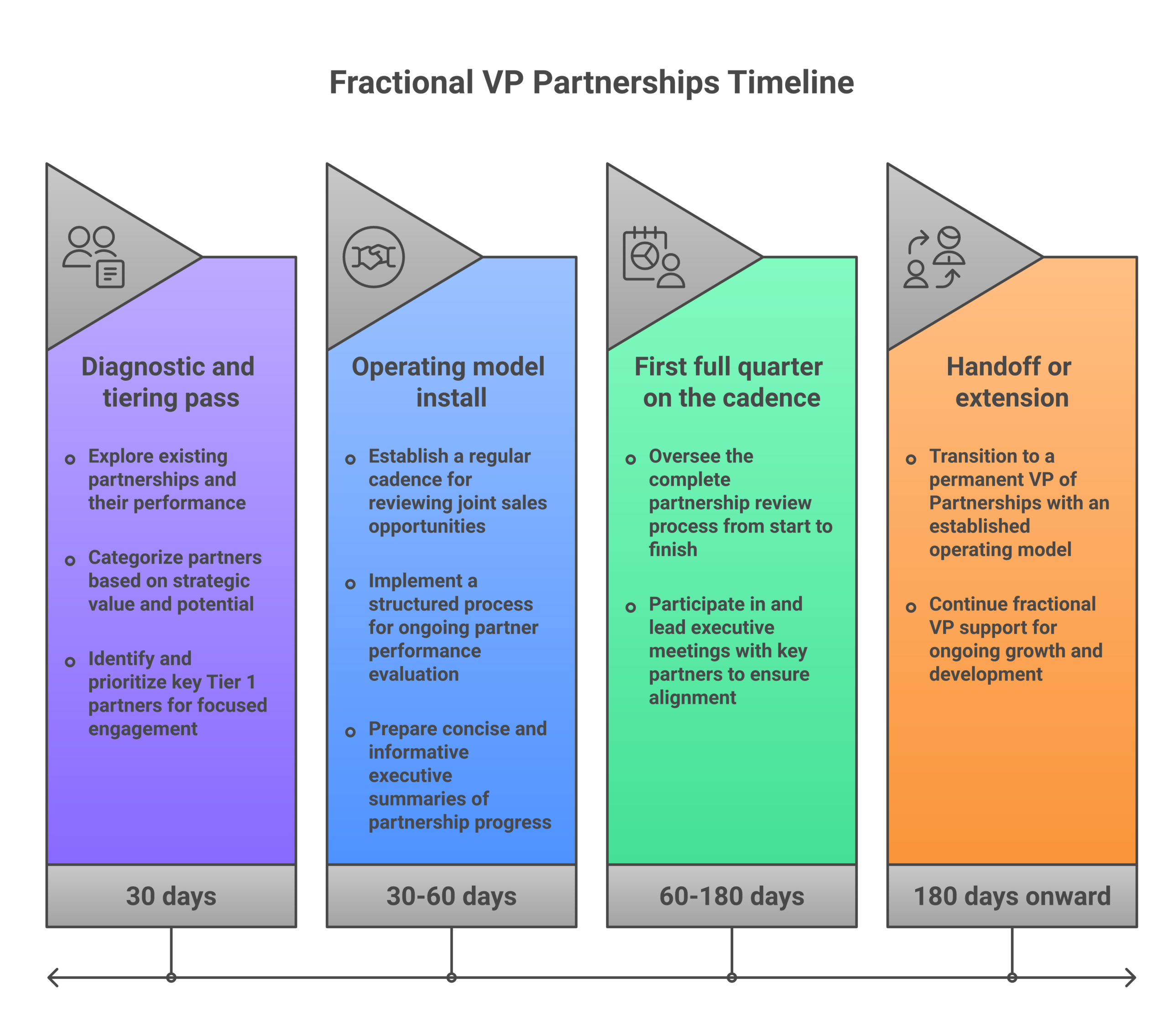
- Diagnostic and tiering pass, first thirty days: The fractional VP inventories the partnerships motion, tiers the partner list, names the three to five Tier 1 partners that will get the cadence, and produces a written ninety-day plan with the CRO. This is the foundation everything else builds on.
- Operating model install, days thirty to sixty: Weekly co-sell deal review template, monthly partner business review template, quarterly executive readout template, and the attribution definition signed with finance. The fractional VP runs the first meeting in each cadence personally.
- A first full quarter on the cadence, days sixty to one hundred eighty: The fractional VP runs the cadence end to end for a full quarter, sits in the executive alignment meetings with each Tier 1 partner, and produces the first joint pipeline forecast. By the end of this phase the team is running the cadence without intervention.
- Handoff or extension, day one hundred eighty onward: Either a full-time VP is hired and onboarded by the fractional, with the operating model already running, or the fractional engagement extends at a reduced cadence (one to two days a week) as ongoing oversight. The decision is data-driven and made together.
The engagement is typically two to three days a week for the first six months and one to two days a week thereafter. The total cost is a fraction of a full-time VP and the time to first signed forecast is meaningfully shorter than a full-time hiring cycle.
Common pitfalls in a fractional VP engagement
The role fails in predictable ways when the engagement is set up poorly. Each of these is avoidable.
- Treating the fractional as an advisor: The fractional VP needs to be inside the operating model, not outside it. An advisor seat at a monthly meeting does not install the cadence.
- No CEO or CRO sponsor: A fractional VP without a senior sponsor cannot install discipline that touches the AE motion. The sponsor is the unblocking mechanism.
- Underscoping the time commitment: One day a week is insufficient for the install. Two to three days a week is the floor for the first quarter; thinner engagements deliver advice, not installation.
- No handoff plan: A successful fractional engagement that has no full-time successor identified by month four either extends indefinitely or collapses on the handoff. The succession decision is part of the engagement.
- Skipping the finance signoff: The fractional VP who does not get the attribution definition signed by finance early leaves a successor with the hardest conversation still unfinished.
Tools and the operating stack
A fractional VP works with the partnerships stack the company already has or quickly stands up. A short view of the layers.
| Layer | What it supports | Examples |
|---|---|---|
| Ecosystem data | The shared account set the motion targets | Crossbeam |
| Partner program operations | Deal registration, partner profiles, enablement | Impartner, PartnerStack, Channelscaler, Introw, Euler |
| Marketplace co-sell ops | Hyperscaler attribution | Tackle, Labra, Suger, Clazar |
| Forecasting | Joint partner pipeline number with commit and upside | Forecastable |
A worked example. A Series B SaaS vendor brought on a fractional VP of partnerships in 2026 Q1 at two days a week. The first thirty days produced a tiering, a ninety-day plan, and a list of four Tier 1 partners. The next thirty installed the cadence and got the attribution definition signed by the CFO. Q2 ran the cadence end to end and produced a joint pipeline forecast that the board accepted as the partnership number. In Q3 a full-time VP was hired and onboarded by the fractional, who stayed on for one day a week through Q4 as oversight. Total cost across the engagement was roughly one-third of a full-time VP for the year, and the function was operating against a finance-signed forecast by month six.
The contrast is a Series B that hired a full-time VP into a function with no operating model installed. The new VP spent the first three quarters building the model from scratch and producing the first forecast at the end of year one. The fractional path would have delivered the same outcome by month six.
Forecastable’s POV
The fractional VP of partnerships is an underused operating choice for most B2B SaaS companies in the Series A to Series C window, and we recommend it more often than the market expects.
The reason is simple. The risk in a full-time VP hire at that stage is not the candidate; it is the time to operating model. A senior leader needs nine to twelve months to build the cadence, sign the attribution, and produce a forecast finance trusts. During those months, the function is still proving its value and the CFO is still skeptical of the partnership budget. The new VP is fighting the budget conversation while building the system that would win it.
A fractional engagement compresses the cycle. The operating model is installed in ninety days because a fractional VP has installed it before. The forecast is produced in the second quarter. The credibility with finance is earned in the first half of the year. By the time a full-time VP arrives, the function is producing a signed number, and the hire is being made into a working system rather than a blank page.
This sequence consistently produces better outcomes and a smaller total spend. The companies that resist it are usually responding to a perceived signal cost (“hiring a fractional looks junior”). In our experience the signal cost is the opposite; the boards and the CFOs we see treat the fractional path as evidence of operating discipline.
Vendors named above are listed as independent third-party providers Forecastable has worked alongside. Forecastable does not endorse a single tool category leader and recommends independent third-party evaluation against your own ecosystem before any purchase.
Frequently asked questions
What does a fractional VP of partnerships actually do?
Runs the function. They install the tiering, the cadence, the attribution definition, and the forecast, and they sit in the executive alignment meetings with each Tier 1 partner.
How is a fractional VP different from an advisor?
An advisor counsels from outside the operating model. A fractional VP is inside the operating model: they run the cadence, sign the attribution with finance, and own the joint pipeline number.
What does a typical engagement cost?
Most engagements run between one-third and one-half of the all-in cost of a full-time VP for the first year, depending on the time commitment.
How long does an engagement last?
Most engagements are six to twelve months, sometimes extended at a reduced cadence as oversight after a full-time hire.
When should I hire fractional versus full-time?
Series A to Series C with no operating model installed and an active CFO skepticism about partner spend is the cleanest fit for fractional. A Series D with an installed model and a defensible forecast is the cleanest fit for full-time.
Who sponsors the fractional VP internally?
The CRO or the CEO. The sponsor is the unblocking mechanism for cross-functional decisions the partnership motion needs.
What is the handoff look like?
The fractional onboards the full-time successor over thirty to sixty days, with the operating model already running, and stays on as oversight for a quarter at a reduced cadence.
Next step
If you are weighing whether to hire a full-time VP of partnerships now or to install the operating model first, the fractional path is worth a working session before you post the role.
Start your growth journey with a working session on the scope and the operating model. For broader context on the function the role is installing, see the Partner Program pillar.
Uncover Your Growth Potential
Schedule a Discovery Call