Ecosystem ROI: How to Measure It Properly

What is ecosystem ROI?
Short answer: Ecosystem ROI is the return a company earns on what it invests in its partner ecosystem, measured as the revenue and efficiency the ecosystem produces against the cost of running it. It is measured badly far more often than it is measured well, usually because teams count only the most visible slice of the return.
The investment side is straightforward: partnerships headcount, partner-tech tooling, partner incentives, and program costs. The return side is where the measurement breaks, because the ecosystem produces value in several forms and most teams count only one.
The slice teams count is partner-sourced revenue, deals a partner originated. It is the easiest to attribute and the smallest part of the return. The larger parts, influence on direct deals, faster cycles, larger deals, and retention, get left out, and the ROI a team reports is a fraction of the ROI it actually earned.
This post lays out the components of a proper ecosystem ROI calculation, where measurement goes wrong, and how to present a number finance will trust.
Why ecosystem ROI matters in 2026
Ecosystem ROI matters because partnerships budgets are now defended, not assumed. A few years ago a partner program could exist on belief. In 2026 it is asked, like every other function, to show a return, and a program that cannot will be cut or starved regardless of what it actually produces.
The case for measuring it well has three layers. At the funding layer, the ROI number is what determines next year’s budget, so an undercounted return directly shrinks the program. At the credibility layer, a number finance can trust earns the partnerships leader a seat in revenue planning, while a vague or inflated number loses it. At the decision layer, a proper ROI breakdown shows which partners and which motions produce, so the program can reinvest where the return is real.
The reality most teams live is one of two failures. Either they report only sourced revenue and undersell the program, or they claim every influenced deal in full and report a number finance does not believe. Both failures cost the program, one by undercounting and one by losing credibility.
How to measure ecosystem ROI properly
A proper ecosystem ROI calculation has four return components and one cost side. The discipline is counting all four returns and counting each one honestly.
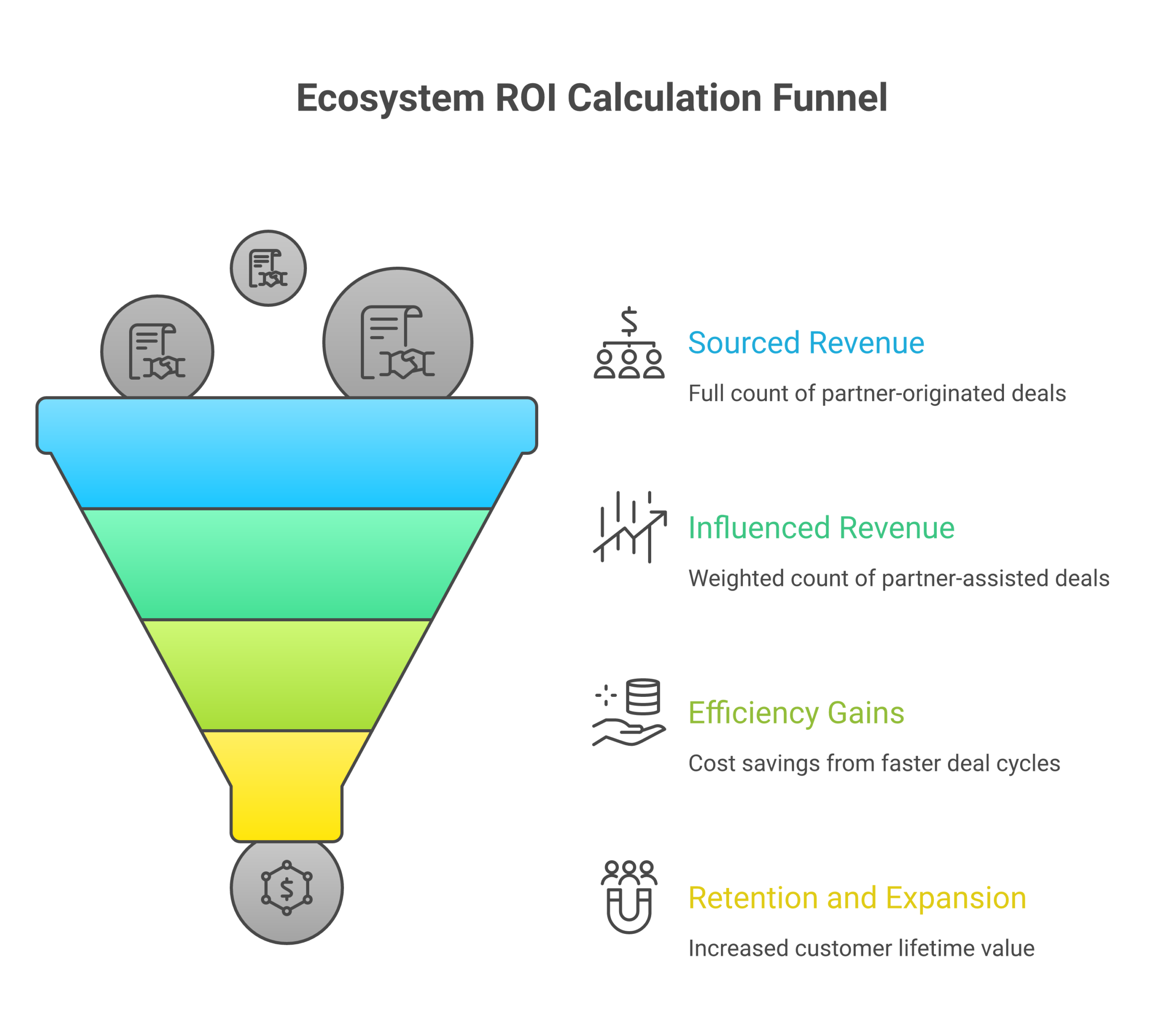
- Sourced revenue: Deals a partner originated. Count these in full; the partner created the opportunity. This is the smallest and most defensible component.
- Influenced revenue, weighted: Direct deals a partner measurably helped, through a reference, an introduction, or a de-risking integration. Do not count these in full, because the company also drove them. Apply an influence weight, an agreed fraction, so finance sees a credible contribution rather than a double count.
- Efficiency gains: Partner-involved deals tend to close faster and at higher win rates. Faster cycles and better win rates are real return, expressible as cost saved per deal, and almost always omitted.
- Retention and expansion: Customers who came through or are served by a partner often retain and expand at higher rates. The lifetime-value difference is ecosystem return and belongs in the calculation.
The cost side is the total program investment: headcount, tooling, incentives, and program spend. ROI is the sum of the four return components, against that cost.
The point is that ecosystem ROI is a sum, not a single line. Reporting only sourced revenue undercounts the program badly. Reporting influenced revenue at full credit overcounts it and loses finance. A weighted, four-component number is both larger than the sourced-only number and more credible than the full-influence number, which is exactly what a partnerships leader needs.
Common pitfalls
Ecosystem ROI gets measured wrong in consistent ways, and each error costs the program.
- Counting only sourced revenue: The most common error. It undercounts the return by leaving out influence, efficiency, and retention, and it makes a strong program look weak.
- Claiming influenced revenue in full: The opposite error. Counting every deal a partner touched as fully partner-driven produces a number finance will not believe, and disbelief costs more than the inflation gained.
- Ignoring efficiency entirely: Faster cycles and higher win rates are real, quantifiable return, and they almost never appear in the ROI calculation.
- No agreed influence weight: Without a weighting agreed with finance in advance, every influenced number is a negotiation, and the program loses the argument it did not set up.
- Measuring ROI without partner-level detail: A single program-wide number cannot tell the company which partners produce. ROI with no breakdown cannot guide reinvestment.
What this looks like in practice
Ecosystem ROI is calculated from attribution data a stack produces.
A partnerships leader has been reporting sourced revenue only, and the program looks marginal against its cost. The leader rebuilds the number. Sourced revenue stays as is. Influenced revenue is added at an influence weight agreed with finance in advance. Efficiency gains are quantified from the faster cycle time and higher win rate on partner-involved deals. Retention uplift is added from the lifetime-value difference. The four-component number is several times the sourced-only figure, and because the influence weight was agreed up front, finance accepts it. The program’s budget is defended on a number that is both bigger and trusted.
The contrast is a leader who reported every partner-touched dollar at full credit. The number was huge and finance discounted all of it, because it was obviously double-counted against direct sales. The program lost the budget argument by overclaiming, the mirror image of the team that lost it by underclaiming.
Forecastable’s POV
Ecosystem ROI is mostly a measurement problem, not a performance problem. We see strong programs report weak ROI because they count only sourced revenue, and we see programs lose credibility because they count influence at full credit. The program in the middle, producing real return and reporting it as a weighted four-component number, is often the same program. What changed was the math, not the work.
Across our client base, the highest-leverage move is to agree the influence weight with finance before the number is ever presented. Influenced revenue is the largest component and the most contested. A weight negotiated in advance turns it from an argument into an input. A weight defended after the fact turns the whole ROI presentation into a fight the partnerships leader rarely wins.
The contrarian point is that the goal of an ecosystem ROI number is not to be as large as possible. It is to be as trusted as possible. A smaller number finance believes funds the program. A larger number finance discounts does not. Partnerships leaders who internalize that stop optimizing for the headline figure and start optimizing for credibility, and credibility is what actually protects the budget.
Forecastable is an independent third-party professional services company. Our evaluations of ecosystem measurement and tooling are based on publicly-available information as of May 2026 and our own client experience.
Frequently asked questions
What is ecosystem ROI?
The return a company earns on its partner ecosystem: the revenue and efficiency the ecosystem produces, measured against the cost of running the program.
How do you measure ecosystem ROI properly?
Sum four return components, sourced revenue, weighted influenced revenue, efficiency gains, and retention uplift, and measure them against total program cost.
Why is sourced revenue not enough?
Sourced revenue is the smallest part of the return. Counting only it leaves out influence, faster cycles, and retention, and makes a strong program look weak.
Why not count influenced revenue in full?
Because the company also drove those deals. Full credit double-counts against direct sales and produces a number finance will not believe. Apply an agreed weight.
What is an influence weight?
An agreed fraction, set with finance in advance, applied to influenced revenue so it contributes a credible share to the ROI number rather than a contested full count.
Should ecosystem ROI be measured per partner?
Yes. A single program-wide number cannot show which partners produce. Partner-level ROI is what guides where the program reinvests.
Next step
If your partnerships program is reported on sourced revenue alone, the ROI number you are showing is a fraction of the return you actually earn. Rebuild it as a weighted four-component number, agree the influence weight with finance first, and present a figure that is both larger and trusted.
Talk to our team about measuring your ecosystem ROI →
The partner program hub holds the broader operating context, and the ecosystem-led growth deal size increase write-up covers one of the return components in depth.
Uncover Your Growth Potential
Schedule a Discovery Call