Ecosystem-Qualified Leads: What an EQL Is

What are ecosystem-qualified leads?
Short answer: Ecosystem-qualified leads are leads that meet a qualification bar set by partner signal rather than by marketing activity alone. They are accounts a partner already works with, has a relationship inside, or shares as a customer, and that overlap is the qualifying evidence that the lead is real and reachable.
A marketing qualified lead is scored on behavior: pages viewed, content downloaded, emails opened. A sales qualified lead is scored on a seller’s judgment after a conversation. An ecosystem-qualified lead, or EQL, is scored on a third kind of evidence: a partner’s existing relationship with the account.
That evidence answers a different question. Behavior tells you an account is curious. Partner signal tells you an account is connected to someone the buyer already trusts, which makes the lead both more credible and easier to reach. An EQL is a lead qualified by who already has a foot in the door.
This post lays out what qualifies an EQL, the components of the definition, where teams get it wrong, and why EQLs convert better than behavior-scored leads.
Why ecosystem-qualified leads matter in 2026
EQLs matter because the other lead types have lost signal. Behavior scoring is noisier than it used to be, since buyers research anonymously and across channels, and the open-and-click trail no longer maps cleanly to intent. Partner signal has held its value, because a partner relationship is hard to fake and easy to act on.
The case for the EQL has three layers. At the conversion layer, leads with partner overlap convert at higher rates because a trusted partner shortens the distance between first touch and a real conversation. At the efficiency layer, an EQL comes with a built-in path in, the partner introduction, so it costs less to work than a cold behavior-scored lead. At the prioritization layer, sales development time is finite, and an EQL gives reps a defensible reason to work one account before another.
The reality most teams live is a lead funnel that ignores partner signal entirely. Marketing scores leads on behavior, sales works them in that order, and the fact that a partner already sells into half of those accounts never enters the scoring. The EQL is the lead type that puts that signal back into the funnel.
How ecosystem-qualified leads actually work
An EQL is defined by four components. A lead has to clear all four to qualify, the same way an MQL clears a behavior threshold.
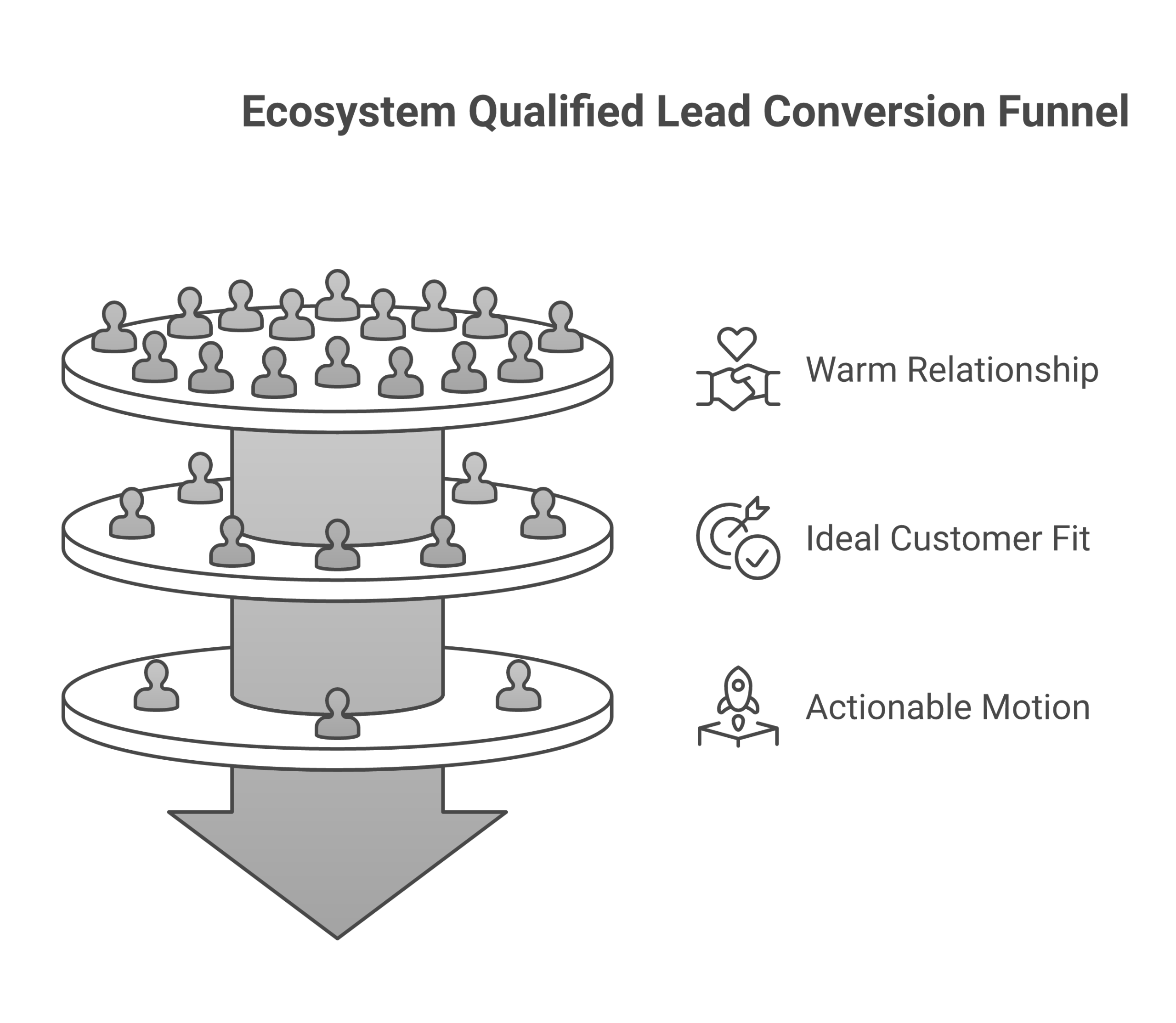
- Partner overlap exists: A partner shares the account as a customer, a prospect, or an open opportunity. This is the base qualifying fact, the evidence that a relevant relationship is already present.
- The partner relationship is warm enough to act on: Overlap alone is not enough. The partner has to have a real, current relationship inside the account, strong enough that an introduction or a co-sell conversation is realistic.
- The account fits the ideal customer profile: An EQL still has to be a good-fit account. Partner signal qualifies the path in; it does not override fit. A poor-fit account a partner knows is not an EQL.
- A motion exists to act on it: An EQL is only a qualified lead if someone will do something with the signal, route it to a rep, trigger a partner introduction, start a co-sell conversation. Signal with no motion is data, not a lead.
The point is that an EQL is a real qualification, not a relabeled list of partner accounts. The first component is data, the second is judgment, the third is fit, and the fourth is operational. A lead that has overlap but no warm relationship, or fits but has no motion to act on it, is not an EQL. It is a candidate for one.
Common pitfalls
EQL programs fail in consistent ways, and most failures collapse the definition down to its first component.
- Treating any overlap as an EQL: A partner having an account in its system gets called an EQL. Cold overlap is not a qualified lead; the relationship has to be warm enough to act on.
- Skipping the fit check: Partner signal qualifies the path, and teams let it override the ideal customer profile. A partner can know an account that will never be a good customer.
- No routing or motion: EQLs get identified and land in a report nobody works. A qualification with no downstream action is a definition, not a program.
- Counting EQLs as a vanity metric: The program reports a large EQL number to look productive. EQL count means nothing without the conversion rate next to it.
- No feedback to the partner: Reps work EQLs and never tell the partner what happened. The partner stops surfacing signal because the relationship feels one-directional.
What this looks like in practice
EQLs are produced by partner signal and worked through a motion. A small stack supports both.
A company adds an EQL stage to its funnel. It uses overlap data to find accounts partners share, filters to accounts where the partner relationship is warm and the account fits the ideal customer profile, and routes each EQL to a rep with a triggered partner-introduction request. Over two quarters, EQLs convert to opportunity at a clearly higher rate than behavior-scored leads, and reps start asking for more of them. The program also closes the loop, telling partners which EQLs progressed, so partners keep surfacing signal.
The contrast is a company that called every partner-overlap account an EQL, posted a large number, and routed none of them with a motion. Conversion was no better than cold leads, because the list was overlap with no qualification and no action. The label was new; the funnel was not.
Forecastable’s POV
Ecosystem qualified leads are a real and useful addition to the funnel, and the term gets diluted fast. The dilution always happens the same way: a team equates EQL with partner overlap, drops the warmth check, the fit check, and the motion, and ends up with a renamed account list. An EQL that is just overlap converts like a cold lead, because that is what it is.
Across our client base, the component teams most often skip is the second one, whether the partner relationship is warm enough to act on. Overlap data is easy to pull and feels like an answer. Whether the partner can actually make a credible introduction is a judgment call that takes a conversation, and it is the difference between an EQL and a list. The data finds the candidate; the partner conversation qualifies it.
The contrarian point is that EQL count is a metric worth ignoring on its own. A program that reports how many EQLs it generated, with no conversion rate beside it, is measuring an activity, not an outcome. The number that matters is whether EQLs convert better than behavior-scored leads. If they do, the qualification is real. If they do not, the program is relabeling, and a new acronym did not add signal.
Forecastable is an independent third-party professional services company. Our evaluations of ecosystem motions and tooling are based on publicly-available information as of May 2026 and our own client experience.
Frequently asked questions
What is an ecosystem qualified lead?
A lead qualified by partner signal: an account a partner already works with, has a warm relationship inside, that fits your ideal customer profile, and has a motion to act on it.
What does EQL stand for?
EQL stands for ecosystem qualified lead, a lead type scored on partner relationship signal rather than on marketing behavior or a seller’s post-call judgment.
How is an EQL different from an MQL?
An MQL is scored on behavior, pages viewed and content downloaded. An EQL is scored on a partner’s existing relationship with the account, which is harder to fake and easier to act on.
Why do EQLs convert better?
A trusted partner shortens the distance between first touch and a real conversation, and the EQL arrives with a built-in path in, the partner introduction.
Is any partner overlap an EQL?
No. Cold overlap is a candidate, not an EQL. The partner relationship has to be warm enough to act on, and the account still has to fit your profile.
How do I measure an EQL program?
By the conversion rate of EQLs against behavior-scored leads. EQL count alone is a vanity metric; the conversion comparison is the real test.
Next step
If your lead funnel scores behavior and ignores which accounts your partners already work, you are leaving your strongest signal out of qualification. Define the EQL with all four components, route it with a real motion, and measure it by conversion against your other lead types.
Talk to our team about adding an EQL stage to your funnel →
The partner program hub holds the broader operating context, and the ecosystem ROI write-up covers how EQL conversion feeds the full return picture.
Uncover Your Growth Potential
Schedule a Discovery Call