Skip to content
Logo — It’s All AboutThe Team
  • Home
  • Who We Serve
    • By Category
      • SaaS
      • Professional Services
      • Platforms (Large Ecosystems)
      • Private Equity
    • By Role
      • Chief Revenue Officers (CRO)
      • Chief Financial Officers (CFO)
      • Chief Marketing Officers (CMO)
      • Chief Executive Officers (CEO)
      • Sales Leaders
      • Partnership Professionals
  • Solutions
    • By Partner Program Maturity
      • Partnerships Foundation
      • Partnerships Acceleration
      • Ecosystem-Wide Orchestration
    • Specialized Solutions
      • Net-New Named Account Development
      • Large Ecosystems
      • M&A: Post-Acquisition Internal Cross-Selling
  • Education
  • Company
    • Our History
    • Security
  • Login
Logo — It’s All AboutThe Team
  • Home
  • Who We Serve
    • By Category
      • SaaS
      • Professional Services
      • Platforms (Large Ecosystems)
      • Private Equity
    • By Role
      • Chief Revenue Officers (CRO)
      • Chief Financial Officers (CFO)
      • Chief Marketing Officers (CMO)
      • Chief Executive Officers (CEO)
      • Sales Leaders
      • Partnership Professionals
  • Solutions
    • By Partner Program Maturity
      • Partnerships Foundation
      • Partnerships Acceleration
      • Ecosystem-Wide Orchestration
    • Specialized Solutions
      • Net-New Named Account Development
      • Large Ecosystems
      • M&A: Post-Acquisition Internal Cross-Selling
  • Education
  • Company
    • Our History
    • Security
  • Login
  • Home
  • Who We Serve
    • By Category
      • SaaS
      • Professional Services
      • Platforms (Large Ecosystems)
      • Private Equity
    • By Role
      • Chief Revenue Officers (CRO)
      • Chief Financial Officers (CFO)
      • Chief Marketing Officers (CMO)
      • Chief Executive Officers (CEO)
      • Sales Leaders
      • Partnership Professionals
  • Solutions
    • By Partner Program Maturity
      • Partnerships Foundation
      • Partnerships Acceleration
      • Ecosystem-Wide Orchestration
    • Specialized Solutions
      • Net-New Named Account Development
      • Large Ecosystems
      • M&A: Post-Acquisition Internal Cross-Selling
  • Education
  • Company
    • Our History
    • Security
  • Login
Back to all blogs
  • Co-Selling
Alex Buckles

Co-Sell in Financial Services: What Works

A vendor partner manager and a partner AE briefing a bank procurement and risk team across a conference table with a printed compliance checklist visible, deep navy and warm amber palette

What is co-sell in financial services?

Short answer: Co-sell in financial services is the joint selling motion run into banks, insurers, and asset managers, where vendor risk reviews, procurement gates, and regulatory constraints shape every step. It works the same way co-sell works anywhere, but it has to clear a buyer environment that other sectors never see.

The motion itself does not change. Two companies still account-map overlap, run a deal-review cadence, ship enablement, and track attribution. What changes is the buyer. A financial-services customer wraps any purchase in third-party risk management, security review, and procurement process that can add months to a cycle.

That buyer environment is why co-sell in financial services deserves its own playbook. A co-sell motion tuned for fast-moving software buyers will stall the first time it hits a bank’s vendor onboarding queue. The partnerships team that wins in this sector designs the motion around the gates instead of being surprised by them.

This post covers what stays the same, what changes, and the specific adjustments that keep a financial-services co-sell deal moving through the compliance and procurement steps that would otherwise kill it.

Why co-sell in financial services matters in 2026

Three forces have made this a sector worth a dedicated approach. Financial-services buyers increasingly prefer to buy through trusted, already-approved vendors and partners, which makes co-sell a structural advantage rather than a nicety. Third-party risk scrutiny has tightened across the sector, so a partner that is already an approved vendor at a bank can carry a co-seller through a gate that would take a newcomer two quarters. And the deal sizes in this sector are large enough that a longer cycle is still worth running well.

The case for a tuned motion has three layers. At the strategy layer, a partner with an existing footprint at a financial institution is an access asset; co-sell turns that footprint into a shared pipeline. At the operating layer, the compliance and procurement gates are predictable, so they can be planned into the deal review instead of discovered late. At the financial layer, the cost of a co-sell deal stalling in vendor onboarding for two quarters is real, and most of it is avoidable with earlier sequencing.

The reality most teams live is a co-sell motion that runs fine until it hits the first procurement gate, then goes dark. The partnerships team treats the stall as bad luck. It was not luck. The gate was always there, and the motion was never designed to clear it.

How co-sell in financial services actually works

The motion adds four sector-specific adjustments on top of the standard co-sell mechanics. Each one addresses a gate the financial-services buyer puts in the path.
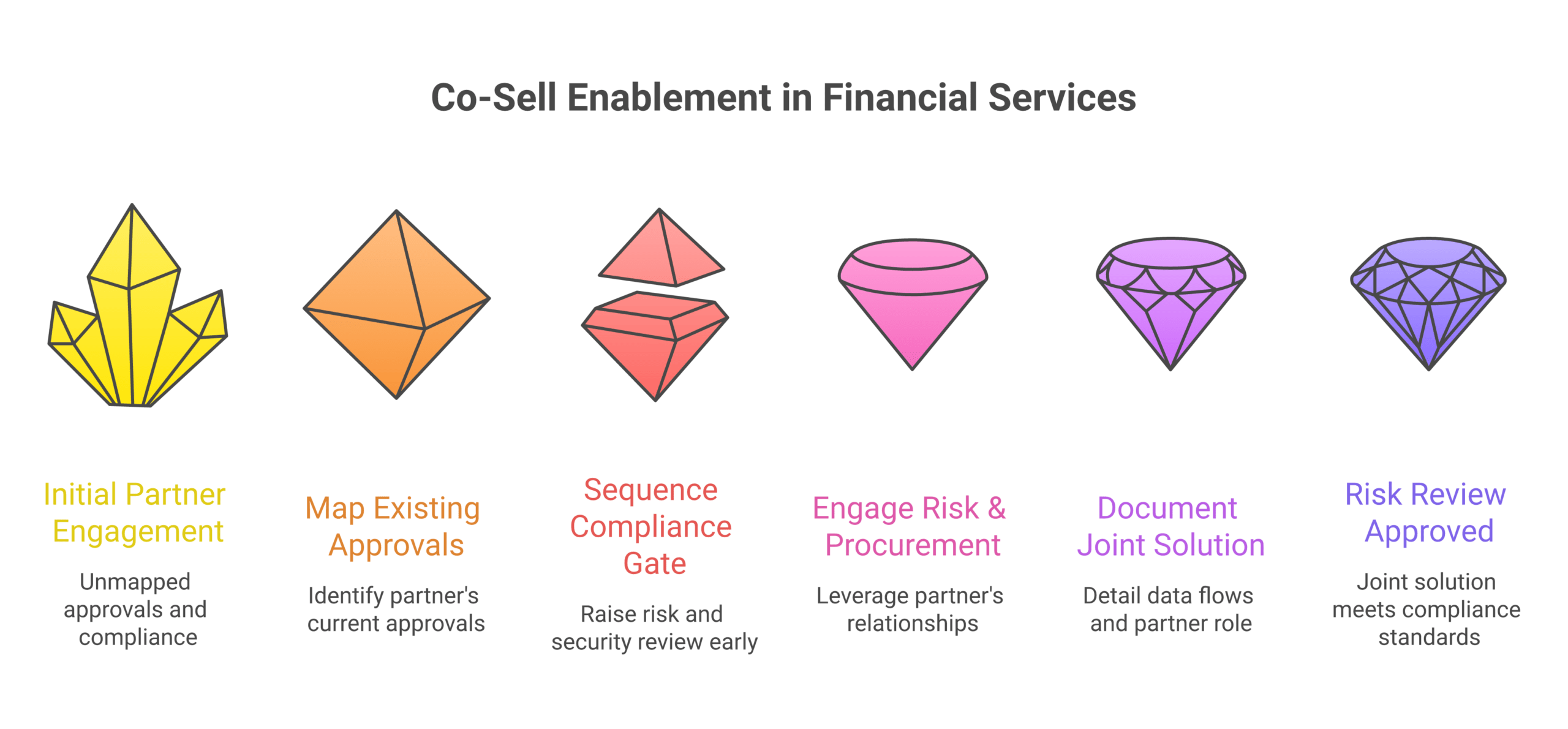
Framework diagram of the four adjustments that make co-sell work in financial services: mapping partner approvals, sequencing the compliance gate early, mapping risk relationships, and documenting the joint solution for risk review.

  1. Map the partner’s existing approvals first: Before account mapping for overlap, find out where the partner is already an approved vendor. A partner already through risk review at a target institution is the single biggest accelerator in the sector. That approval status is part of the overlap picture.
  2. Sequence the compliance gate early: The customer’s third-party risk and security review should be raised in the first joint customer conversation, not discovered at procurement. The deal review tracks the compliance milestone as a deal stage, with a named owner on the vendor side.
  3. Bring the partner’s risk and procurement relationships into the motion: The partner often knows the institution’s procurement lead and risk team. Co-sell enablement in this sector includes mapping those relationships, not just the buying-committee sellers.
  4. Document the joint solution for the risk review, not just the pitch: Financial-services risk teams evaluate the combined solution, including data flows and where the partner sits in the architecture. The joint pursuit playbook needs a risk-facing description, not only a customer-facing one.

The closing point is that these four adjustments share one principle: pull the gates forward. The standard co-sell motion treats compliance and procurement as things that happen at the end. The financial-services motion treats them as deal stages with owners and dates, raised early, tracked in the deal review. The gate does not move; the surprise does.

Common pitfalls

Co-sell failures in financial services are consistent, and almost all of them come from running a sector-blind motion.

  • Discovering the compliance gate late: The deal moves well until procurement, then the third-party risk review surfaces and adds two quarters nobody planned for.
  • Ignoring the partner’s approval status: The team account-maps for sales overlap but never checks where the partner is already an approved vendor, missing the fastest path in.
  • A customer-only joint solution doc: The pursuit playbook describes the pitch but not the data flows and architecture a risk team needs. The risk review then stalls on missing information.
  • Treating procurement as administrative: The team assumes procurement is a rubber stamp after the business decision. In this sector procurement is a real evaluation with its own timeline.
  • Co-selling with a partner with no footprint: Pairing with a partner that is also a newcomer at the institution. Two unapproved vendors do not clear a gate faster than one.

What this looks like in practice

Co-sell in financial services runs on the standard stack plus closer attention to the compliance record. The tools do not change; what gets tracked in them does.
A software vendor wants into a regional bank. Direct, it faces a full third-party risk review and a vendor onboarding queue measured in quarters. Instead it co-sells with a partner that is already an approved vendor at the bank. The partnerships team maps the partner’s approval status first, raises the compliance question in the first joint customer call, documents the combined solution with a risk-facing architecture description, and tracks the compliance milestone as a deal stage in the weekly review. The risk review still happens, but it runs in parallel with the sales process instead of after it. The deal closes in two quarters rather than four.

The contrast is the same vendor running a sector-blind co-sell motion. Strong pitch, good partner, but the compliance gate surfaces at procurement and nobody owned it. The deal adds two quarters and the partnership gets blamed.

Forecastable’s POV

The mistake vendors make in financial-services co-sell is treating the sector like every other, just slower. It is not just slower. It has gates that other sectors do not have, and those gates either get planned into the motion or they ambush it. A co-sell program that wins in financial services is not more patient. It is better sequenced.

Across our client base, the single highest-leverage move in this sector is choosing the partner for its approval footprint, not only its sales relationships. A partner already through risk review at a target institution can carry a co-seller through a gate that would take a newcomer two quarters to clear alone. That footprint is worth more than a warm intro, and most partnerships teams never check for it because their account mapping only looks at sales overlap.

The contrarian point is that the compliance gate is an asset, not an obstacle, when you co-sell correctly. The same gate that slows you down is the moat that keeps the next vendor out once you and your partner are through it. The teams that resent the gate run worse motions than the teams that design around it.

If you are co-selling into financial services, pick partners for their approvals, pull the compliance gate forward into the first customer call, and track it as a deal stage with an owner.

Forecastable is an independent third-party professional services company. Our evaluations of co-sell motions and tooling are based on publicly-available information as of May 2026 and our own client experience.

Frequently asked questions

How is co-sell in financial services different from other sectors?
The motion is the same, but the buyer adds third-party risk review, security evaluation, and a real procurement process that can extend cycles by quarters.

What makes a good co-sell partner in financial services?
A partner already an approved vendor at the target institutions. That existing approval footprint is the biggest single accelerator in the sector.

When should the compliance gate be raised?
In the first joint customer conversation. Raised early, the risk review runs in parallel with the sales process. Discovered late, it adds quarters.

Does co-sell shorten financial-services sales cycles?
It can, when the partner has an existing approval footprint and the compliance milestones are sequenced early. It does not shorten cycles if the motion is run sector-blind.

What does the joint pursuit playbook need for this sector?
A risk-facing description of the combined solution, including data flows and architecture, alongside the customer-facing pitch. Risk teams evaluate the joint solution, not just the sales story.

Should you co-sell into a bank with a partner that has no footprint there?
Rarely. Two unapproved vendors do not clear a risk gate faster than one. Pick a partner with standing at the institution.

Next step

If your co-sell deals in financial services keep stalling at procurement, the gate is not the problem. The motion was never designed for it. Pick partners for their approval footprint, raise compliance in the first customer call, and track it as a deal stage.

Talk to our team about co-sell in regulated sectors →

The co-sell hub holds the broader operating context, and the co-sell motion write-up covers the base mechanics this sector builds on.

Uncover Your Growth Potential

Whether starting with a single sales team or a single partner, any co-sell motion can be live within 30 days.

Schedule a Discovery Call
Latest Insights
Two professionals review charts and documents at a conference table as a presentation screen shows a business strategy slide on the wall.
  • Co-Selling
Alex Buckles

Co-Sell Strategy: Building a Motion That Produces

What is a co-sell strategy? Short answer: A co-sell strategy is the set of decisions about which partners you sell with, which accounts you go after together, and how the joint motion runs. It chooses where co-sell effort goes so the company produces partner pipeline by design rather than by lucky overlap. It is not […]

Read Article
A partner enablement lead running a co-sell training session with three account executives around a table, a printed joint pitch one-pager and a deal-registration workflow on the screen behind them, deep navy and warm amber palette
  • Co-Selling
Alex Buckles

Co-Sell Training: Teaching Reps to Sell With Partners

What is co-sell training? Short answer: Co-sell training is how a company teaches its reps to run joint deals with partners, the pitch, the workflow, and the handoffs that a co-sell motion requires. It exists to turn a co-sell strategy into rep behavior, so the motion runs in the field rather than living in a […]

Read Article
An account executive and a partner rep running a joint customer call, a shared screen showing the customer's account and a printed joint pitch on the desk, deep navy and warm amber palette
  • Co-Selling
Alex Buckles

How to Co-Sell: A Step-by-Step Guide for Reps

What is co-selling? Short answer: How to co-sell comes down to four steps: find the accounts you and a partner both have reason to work, agree who does what, run the joint deal, and settle credit before close. It is two companies working one account together so the combined motion closes faster than either would […]

Read Article
A sales leader and a partnerships lead at a sales floor reviewing a per-rep account list with a recommended partner per account, a printed spiff and registration workflow on the screen behind them, deep navy and warm amber palette
  • Co-Selling
Alex Buckles

How to Get Sales Team to Co-Sell, Step by Step

What does getting a sales team to co-sell mean? Short answer: How to get sales team to co-sell reduces to one rule: make the partner the easy path on accounts reps already work. They adopt a partner when it shortens their next close, not when they are told partners matter, so engineer that on real […]

Read Article
Logo — It’s All AboutThe Team

Quick Links

  • Who We Serve
  • Solutions
  • Resources
  • Pricing
  • Our History

Social Media

  • Linkedin

Legal

  • Privacy Policy
  • Terms of Service
Quick Links
  • Who We Serve
  • Solutions
  • Resources
  • Pricing
  • Our History
Social Media
  • Linkedin
Legal
  • Privacy Policy
  • Terms of Service

Stay ahead on ecosystem-led growth

Logo — It’s All AboutThe Team
© 2025 Forecastable. All rights reserved.
Book Your Strategy Call
Request Enrollment Details

[contact-form-7 id=”dfbeed3″ title=”Request Enrollment Details”]

Mollie Bodensteiner

Revops Advisory
  Mollie Bodensteiner is an experienced operations professional with a demonstrated track record of utilizing technology to support operational processes that drive performance and innovation. She currently is the Vice President of Operations at Sound and owns go-to-market agency, MB Solutions. Mollie has previously held operations leadership roles at Deel, Syncari, Corteva and Marketo. She has over 14 years of experience in both B2C and B2B operations and technology. When she is not working, Mollie enjoys spending time with her husband, three small children, and two large dogs. Childhood Career/Dream: Growing up in the age of Disney and Nick@Nite I always wanted to be a child actor (good thing that never was actually pursued 🙂 Favorite Win: I am not sure I have a specific “win” but I think I get the most joy and excitement from coaching others and watching them hit major milestones in their career. The first time you get to promote someone on your team or watch them lead a major project – are always career highlights! Personal Fun Facts: Favorite Song: If it’s love, Train Favorite Movie: Good Will Hunting Favorite Meme: Disaster Girl
Forecastable resources: Co-Sell Orchestration Platform · All Use Cases · Live in 30 Days · Co-Sell Playbook

Kelsey Buckles

Director of Operations


My journey from Education to Operations has equipped me with a unique perspective and skill set that perfectly aligns with Forecastable’s mission to help businesses improve sales collaboration through partner co-selling strategies.

At Forecastable, I am passionate about empowering teams and organizations to unlock the full potential of strategic partnerships. By leveraging my expertise in communication, leadership, and operational efficiency, I contribute to creating seamless co-selling processes that align with business goals and deliver exceptional results.

The intersection of my educational foundation and operational experience fuels my dedication to fostering alignment, building trust, and enhancing collaboration between partners. I am driven by the opportunity to contribute to a platform that not only optimizes sales strategies but also strengthens relationships that lead to long-term growth.

Paul Jonhson

Chief Technology Officer (Co-founder)


Paul Johnson has 20+ years of software development and consulting experience for a variety of organizations, ranging from startups to large-enterprise organization with highly-complex needs.

Mr. Johnson has a long track record of successful technology deployments.
This, combined with his deep passion for machine learning and exceptional user experience design, allows him to lead our technical direction from the front with confidence.

Alex Buckles

Product, Partnerships, and Value Engineering (Co-founder)


After serving in The United States Marine Corps, Alex Buckles spent the next two decades as a student of revenue production and an advocate for innovation.

Along the way, he has helped numerous companies achieve double and triple-digit growth by crafting and executing high-performing go-to-market strategies, with co-selling at the center of each.

As a once-advanced technical marketer, an expert sales & partner professional, and a strong customer success advocate, Mr. Buckles understands the impact of these functions aligning not only on revenue production, but on the day-to-day execution of the go-to-market strategy. This concept of revenue-team alignment is what quickly became the foundation of Forecastable back in January of 2018.

In his free time, you’ll find him spending quality time with his children, one of whom is on the autism spectrum. 1 in 36 children in the U.S. are on the spectrum and boys are four times more likely to be diagnosed than girls.

With that in mind, Mr. Buckles plans on dedicating the rest of his life serving those living with autism, through his organization Pathways for Autism. From his perspective, there must be a scalable and financially self-sustaining infrastructure established to put as many individuals with autism as possible on a path towards complete independence as adults.