Building a Partner Program: The 2026 Operating Blueprint

What is building a partner program?
Short answer: Building a partner program is the end-to-end exercise of designing and launching a partner-led growth system from zero, with a defined thesis, archetypes, operating model, partner journey, and measurement scoreboard. It is a system-design effort, not a hiring decision.
A working partner program has three properties. It produces forecastable partner-sourced pipeline within two quarters of launch. It runs on documented mechanics rather than a leader’s instincts. And every named role on the operating plan can point to a specific number they own on the scoreboard.
People conflate building a partner program with hiring a partnerships leader. The two are not the same. A program is the system; the leader is one component inside the system. A channel program, an ecosystem motion, and a partner-led GTM are all variants of the same underlying design exercise.
Why building a partner program matters in 2026
Three forces are converging. Buyers are running formal vendor consolidation reviews, which means the partner with shelf space gets the deal that your direct AE was working for nine months. Capital efficiency expectations on Series B and later companies now assume 20-40% of new pipeline sourced through partners, not “nice to have.” And the cost of a senior partnerships hire is now $250K+ all-in, which makes a nine-month “go figure it out” runway financially unviable.
The operating case lives on three layers. At the revenue layer, partner-sourced pipeline carries a 30-50% lift in win rate over cold-direct in the categories we work in. At the cost layer, partner-led deals require less SDR effort and shorter sales cycles, which lifts AE capacity. At the strategic layer, the partner ecosystem becomes a moat that compounds against competitors who skipped the design work.
The operating reality is that most companies launch a partner program by hiring a partnerships leader, handing them a Notion doc, and asking them to “go build it.” Twelve months later there is activity, there are partner announcements, and there is no measurable partner-sourced pipeline. The program is running on the leader’s instincts, not on a system. That is a budget conversation waiting to happen. For broader industry context, see Forrester’s partnerships research.
How building a partner program actually works
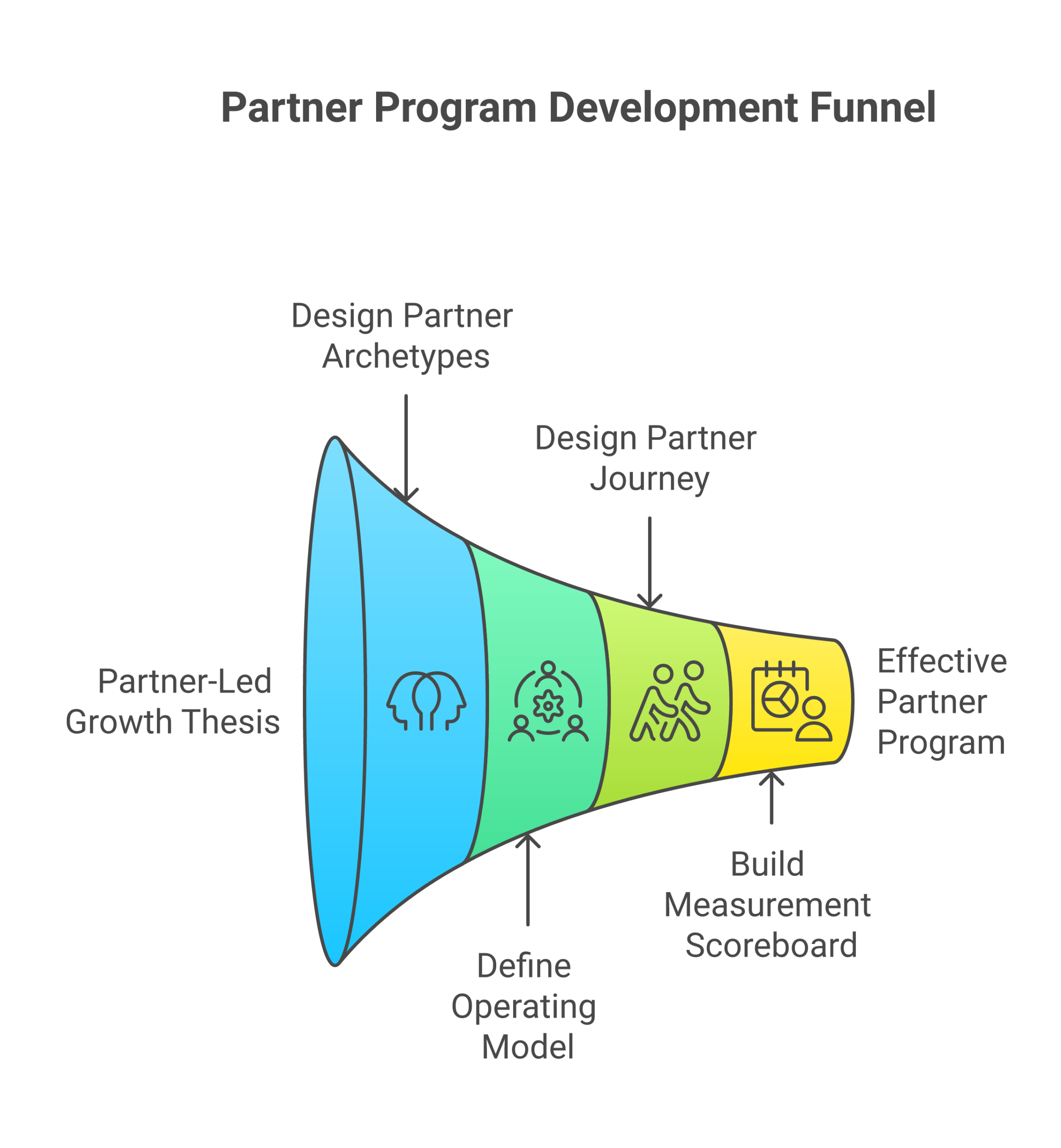
Five mechanics drive a partner program that produces forecastable revenue. The sequence matters. Skipping any of the first three breaks the next two.
- Define the partner-led growth thesis: Write down, in one page, why partners will produce more revenue than direct in your specific market, segment, and motion. Name the customer who buys faster with a partner involved, the partner archetype that owns the relationship, and the friction in your direct motion that partners remove. If you cannot fill the page, you do not have a thesis, you have a slogan.
- Design the partner archetypes: Pick the two or three archetypes that fit your thesis. Reseller, MSP, SI, ISV, referral, and agency are all different operating models with different economics, different enablement, and different cadences. A program that tries to support all six at launch produces six half-built motions. Pick the archetypes whose buyers match your ICP, then go deep.
- Define the operating model: Name the roles (partner manager, partner ops, partner marketing, executive sponsor) and the number each one owns. Pick the attribution model (sourced, influenced, co-sold) and write down how a deal moves between them. Define deal registration thresholds, tiering criteria, and the partner-side commitments at each tier. This is the document your future partner manager will run against in week one.
- Design the partner journey: Map the full lifecycle, recruit through off-board. Recruit (who, where, with what pitch), onboard (first 30 days, certification path, first joint motion), activate (first joint opportunity in pipeline), manage (cadence, QBR, escalation path), expand (tier upgrade criteria), and off-board (graceful exit for partners who do not meet the bar). Every stage gets a definition of done.
- Build the measurement scoreboard: Leading indicators measure capability, capacity, motion, and conversion. Capability is certified-partner count by archetype. Capacity is partner-rep count active in the last 60 days. Motion is co-marketed touches and registered deals per partner. Conversion is registered-deal-to-pipeline rate. Lagging indicators are partner-sourced pipeline, partner-influenced pipeline, and partner-sourced closed-won revenue. Put it in a dashboard the CRO opens weekly.
Do these five in order, before the partnerships hire, and the hire walks into a system they can run on day one. Do them after, and the hire spends nine months reverse-engineering what should have been written down before they joined.
Common pitfalls
- Hiring first, designing later: The most common failure mode. Founders hire a partnerships leader to “build the program,” then discover the leader is also being asked to define the thesis, design the operating model, recruit partners, run the first deals, and report on results. Nobody clears that runway in under twelve months.
- Picking too many archetypes: A pre-launch program that lists reseller, MSP, SI, ISV, referral, and agency is signaling that the team has not made the strategic choice. Each archetype carries its own enablement, contracting, and incentive design. Three is the upper limit at launch. Two is better.
- No attribution model: Without a documented sourced-versus-influenced-versus-co-sold model, every quarterly review devolves into a fight between Sales and Partnerships over who gets credit. The fight kills the program faster than any other failure mode.
- Activity metrics replace output metrics: Recruited-partner count, signed agreements, and joint-marketing emails sent are inputs, not outputs. The scoreboard the CRO and CEO look at is partner-sourced pipeline and partner-sourced revenue. If those are not on the dashboard, the program loses funding in the next budget cycle.
- No off-boarding plan: Three years in, the program has 200 signed partners and 12 active ones. The other 188 take portal logins, attend webinars, and produce zero pipeline. Without an off-boarding mechanic, the program becomes a list-management exercise instead of a revenue motion.
What this looks like in practice
Building a partner program requires three tooling layers. You do not need all three at launch, but you do need to know which layer you will buy at which milestone, and you need to avoid the trap of buying a PRM before you have a partner program design that justifies it.
Worked example. A Series B SaaS company with $20M ARR decides to build a partner program. Path A: founder writes the thesis and operating model in weeks 1-6, hires a Director of Partnerships in week 8, who recruits the first 12 partners against documented archetypes, ships first joint-sourced opportunity in week 16, and reports first partner-sourced closed-won deal at month six. Path B: same company hires the Director of Partnerships in week 1, asks them to “go build it,” and reports first partner-sourced closed-won deal at month nine to eleven. The delta is six months of pipeline and one budget cycle of executive credibility. Path A costs an additional six weeks of founder attention up front. Path B costs the program.
Forecastable’s POV
Most companies build a partner program by hiring a partnerships leader and asking them to figure it out. That produces a program that runs on the leader’s instincts, not a measurable system. When the leader leaves, the program leaves with them. That is not a program. That is a person.
The right sequence is to define the thesis and the operating model before the hire. That work belongs to the CEO, the CRO, and a partnerships advisor who has built the system before. Six weeks of design work at the front saves nine months of reverse-engineering at the back.
The scoreboard is the second non-negotiable. If the CRO and CEO cannot open a dashboard and see partner-sourced pipeline this quarter, partner-sourced closed-won last quarter, and forecast partner-sourced pipeline next quarter, the program will not survive the next budget review. Activity metrics get cut every time the company has a tough quarter.
The third non-negotiable is the partner journey definition. A program without a documented activate-to-expand path produces partners who sign agreements and then go dark. A program with a written first-90-days motion produces partners who close their first deal in the first quarter. Same partners, different outputs, driven entirely by whether the journey was designed.
Forecastable is an independent third-party professional services company. Our evaluations of partner-program design are based on publicly-available information as of May 2026 and our own client experience.
Frequently asked questions
How long does it take to build a partner program?
Six to eight weeks of design work before the hire, then 90 days from hire to first joint-sourced opportunity, then 90 days from first opportunity to first closed-won. Total of six to eight months from kickoff to first measurable revenue, assuming the sequence runs in the right order.
Should I hire a partnerships leader first or design the program first?
Design first. The thesis, archetypes, operating model, and scoreboard are CEO and CRO work. The hire runs the system once it is designed. Hiring first means paying a senior salary while the leader does work that should have been done before they joined.
Which partner archetype should I start with?
The one whose buyer matches your ICP and whose existing motion includes the friction your direct sales team hits. If you sell to mid-market RevOps and your direct cycle stalls on integration concerns, an SI or MSP archetype with implementation capacity is the right starting point.
Do I need a PRM at launch?
No. A PRM is the right purchase at 25 or more active partners with deal-registration volume that exceeds what a shared Notion can hold. At launch, a CRM with partner-attribution fields, a shared registration form, and a partner Slack channel is sufficient for the first 12 to 18 months.
What is the right attribution model?
A three-tier model. Sourced (partner brought the lead). Influenced (partner touched an existing opportunity in a measurable way). Co-sold (partner and your AE worked the deal jointly with a defined motion). Each tier carries a different incentive and a different reporting line.
How do I know if my partner program is working?
Partner-sourced pipeline as a percentage of total new pipeline. The healthy floor is 15% in year one, 25% in year two, 35% in year three. If the percentage is flat across years, the program is producing activity, not output.
Who owns the partner program?
The CRO or CEO owns the revenue line. The Head of Partnerships owns the system. The CFO owns the financial assumptions in the operating plan. Without all three engaged at launch, the program does not survive its first budget cycle.
Next step
Building a partner program from zero is a design exercise before it is a hiring exercise. The companies that get this right write the thesis, design the archetypes, define the operating model, map the journey, and build the scoreboard before they post the partnerships job. The companies that get it wrong post the job first and discover the rest later. The cost difference between the two paths is six months of pipeline and one budget cycle.
Talk to our team about building a partner program from zero to forecastable revenue
The partner program hub holds the broader context on how program design connects to roles, operating cadence, and the measurement system.
Uncover Your Growth Potential
Schedule a Discovery Call