Always-On Comms: The Partner Cadence That Keeps Mindshare

What are always-on comms?
Short answer: Always-on comms is the structured, recurring cadence of brief, value-add 1:1 communications from a vendor’s partner team to named contacts at partner firms. They are not newsletters, not marketing blasts, and not pitch sequences.
They run quietly in the background of a partnership and keep mindshare from decaying between deal cycles. The cadence is deliberate, the channel rotates, and each send carries a specific hook (a deal, a value story, an intelligence drop, or a relationship moment) rather than a generic update.
A working always-on motion has three properties. It is individually addressed to a named counterpart at the partner firm, not blasted to a list. It is brief enough that the partner rep reads it in under 30 seconds. And it is value-add for the recipient, meaning the partner rep is better off after reading it whether or not they reply.
If a “partner communication” can be opened by 200 people on the recipient side, it is a newsletter. If it cannot, and if the sender knows the recipient by name and role, it is on the way to being always-on comms.
Why always-on comms matters in 2026
Three forces make this cadence non-optional in 2026. First, partner reps at large firms are managing 50 to 200 vendor relationships and will only stay engaged with the vendors who stay top of mind. Second, marketing-driven newsletters have collapsed in performance, with most partner-facing newsletters getting filtered, muted, or marked as promotional by the partner rep’s inbox. Third, the partner-counterpart relationship is the single highest-leverage asset in a co-sell motion, and it decays fast when there is no contact between deals.
The operating case sits on three layers. At the contact layer, the partner team maintains a clean, persona-tagged list of who at each partner firm actually moves co-sell pipeline. At the cadence layer, those contacts get a planned series of touches on a recurring schedule. At the content layer, each touch carries a hook that justifies the send from the recipient’s perspective.
The operating reality is that most partner programs run zero structured comms to partner counterparts and then wonder why partner mindshare drops between deals. The default state of a partnership is silence, broken only by deal pings. The working state is a recurring 1:1 cadence with a clear hook per send and a calendar that survives partner manager turnover. For broader industry context, see Common Room’s community-signals writing.
How always-on comms actually works
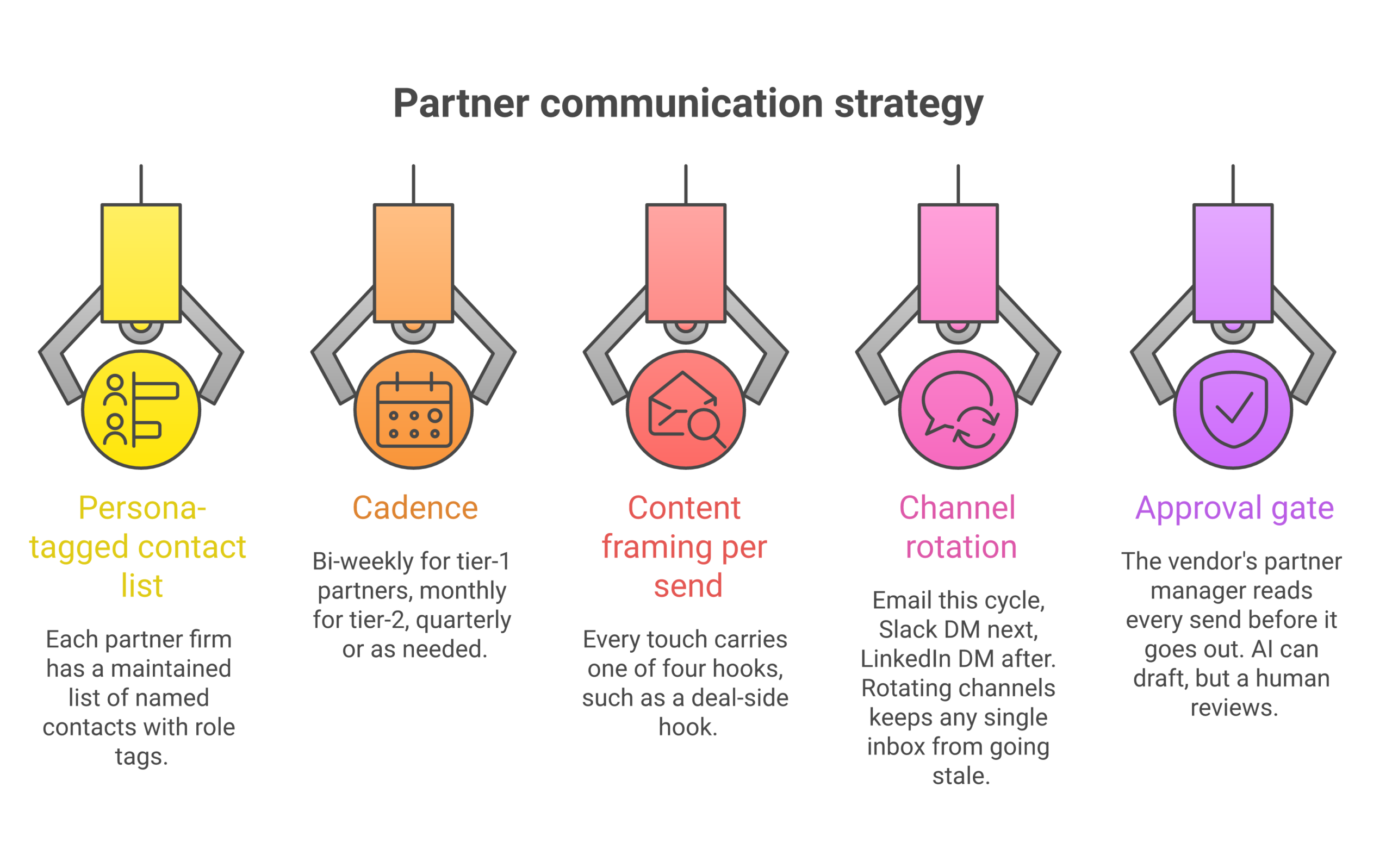
Five mechanics separate a working always-on motion from a well-intentioned newsletter or a sporadic round of “just checking in” emails. Each one is unglamorous, and each one is non-negotiable.
- Persona-tagged contact list per partner firm: Each partner firm has a maintained list of named contacts with role tags (AE, AM, partner lead, alliance leader, channel chief). The list is segmented because an AE and a partner lead get different content. If your partner CRM holds one generic contact per firm, you do not have a working list yet.
- Cadence: Bi-weekly for tier-1 partners (the 10 to 20 firms that drive most pipeline). Monthly for tier-2. Quarterly or event-driven for tier-3. The cadence is calendared in advance and protected, not opportunistic. Skipping cycles signals that the partnership is not a priority.
- Content framing per send: Every touch carries one of four hooks. A deal-side hook (we have a deal where you can help, or we can help on one of yours). A value-story hook (here is a relevant proof point from a similar customer). An intelligence hook (here is something we are seeing in your market that you can use). A relationship hook (congrats on the launch, the funding, the new role). Pitch is not a hook.
- Channel rotation: Email this cycle, Slack DM next, LinkedIn DM after. Rotating channels keeps any single inbox from going stale and meets the partner rep where they actually respond. Some partner reps live in Slack and ignore email; some are the opposite. Channel rotation surfaces that signal within two cycles.
- Approval gate: The vendor’s partner manager (or a delegated senior reviewer) reads every send before it goes out. AI can draft, a junior teammate can stage, but a human approves. Skipping the approval gate is how always-on comms collapse into spam within a quarter.
A program that runs three of these five but skips the approval gate or the content framing will see partner reps mute, filter, or block the sender. The mechanics are interlocking; you cannot drop one and keep the value.
Common pitfalls
- Defaulting to a newsletter: Marketing newsletters do not count as always-on comms. Partner reps mute, filter, or report them. If your “partner cadence” is a monthly email blast to a list of 400, you are not running always-on comms.
- Pitching every send: A “just wanted to share our new product” email is a pitch. Pitches get ignored once and trained against twice. The hook on every send has to be value-add for the partner rep, not for the sender.
- Skipping the persona tagging: Sending the same content to an AE, an AM, and a channel chief means at least two of them get something irrelevant. The list segmentation is the prerequisite to relevant content.
- Treating cadence as optional: A cadence that gets skipped when the quarter gets busy is not a cadence. It is wishful thinking. The whole value of always-on is that it survives whatever else is happening, because that is what builds the trust loop.
- Removing the approval gate: AI drafting plus auto-send is how 200 partner reps get the wrong message at the wrong time and your alliance team loses credibility for six months. Every send goes through a human who knows the relationship.
What this looks like in practice
The 2026 tooling for always-on comms sits in three layers that work together. None of them replace the partner manager’s judgment, and the best stacks are deliberately boring.
shows the math. A partnerships team that runs always-on comms on a 12-partner tier-1 cohort typically sees partner-counterpart response rates of 25 to 35 percent on the first send and 40 to 55 percent by cycle 3, because the trust loop compounds. The same cohort with zero comms cadence sees inbound from partner counterparts drop to near-zero within a quarter, because partner reps reallocate attention to vendors who show up.
The cost of running the motion is about 4 to 6 hours per week of partner manager time on a 12-partner cohort, plus tooling that most teams already own. The cost of not running it is a partner pipeline that decays between deals and a recurring need to “rebuild the relationship” every time a deal surfaces.
Forecastable’s POV
The default state of a partnership is silence. Partner reps do not call you. They do not check in. They do not naturally remember your value proposition between deals. Mindshare is something you earn through repeated, useful contact, and you lose it the moment you stop.
Marketing newsletters do not solve this. They make it worse, because they train the partner rep’s inbox to filter your domain as promotional. By the time you have a real deal to discuss, your emails are landing in a folder the partner rep never opens. The newsletter motion is not a substitute for always-on comms; it is what always-on comms is designed to replace.
The reason always-on comms works is structural. It is individually addressed, which means the partner rep reads it as a person rather than a list member. It is contextually relevant, which means each send has a hook the recipient cares about. And it is recurring, which means the trust loop compounds rather than resetting each quarter. Take away any of those three and the motion collapses.
We have built a methodology around this called the Forecastable Comms Engine, and we run it for clients across channel, alliance, and tech-partner motions. The methodology is not magic. It is the disciplined application of the five mechanics above, week after week, with a partner manager who treats the cadence as a contract with the partner firm rather than a marketing tactic. The teams that win at always-on comms are the ones who treat it as operational infrastructure, not as a campaign.
Forecastable is an independent third-party professional services company. Our evaluations of always-on comms are based on publicly-available information as of May 2026 and our own client experience.
Frequently asked questions
What is the difference between always-on comms and a partner newsletter?
A partner newsletter is one-to-many, marketing-authored, and broadcast on a marketing calendar. Always-on comms is one-to-one, partner-team-authored, and run on a relationship cadence. Partner reps treat the two very differently; newsletters get filtered, always-on gets read.
How often should I run always-on comms?
Bi-weekly for tier-1 partners (the 10 to 20 firms driving most pipeline), monthly for tier-2, and quarterly or event-driven for tier-3. The cadence is calibrated to the strategic weight of the partner, not to how busy the quarter is.
Who should send always-on comms?
The partner manager who owns the relationship, not marketing. The whole motion depends on the recipient recognizing the sender as a real person at the vendor who knows their world. Marketing-authored, partner-manager-signed sends get caught quickly and erode trust.
Can I automate always-on comms with AI?
You can use AI to draft, you cannot use AI to auto-send. Every send goes through a human approval gate. AI drafting plus auto-send is how partner reps get 50 wrong messages and your team loses credibility for two quarters. Draft, review, send.
What if my partner rep does not respond?
That is signal. If a tier-1 partner counterpart goes 3 cycles without responding, the partner manager investigates: wrong contact, wrong channel, wrong content, or genuinely cooled relationship. Each of those has a different fix. Silence is not failure; it is data.
How do I measure always-on comms?
Track response rate by cycle, channel preference per contact, and the lag between an always-on touch and the next inbound from that partner rep. The leading indicator is response rate compounding from cycle 1 to cycle 3. The lagging indicator is partner-sourced and partner-influenced pipeline that holds up between deal cycles.
Should marketing be involved at all?
Marketing can supply value-story assets, intelligence drops, and proof points that partner managers reuse in their sends. Marketing should not own the cadence, the contact list, or the send itself. The line between marketing newsletters and always-on comms is exactly the line between one-to-many and one-to-one.
Next step
If your partner program is running on deal pings and quarterly QBRs with nothing in between, you are leaking mindshare every week. Setting up a working always-on motion takes about a month of focused work: contact list cleanup and persona tagging, cadence calendar by tier, content frameworks for each hook type, channel rotation, and an approval workflow your partner managers will actually use. We help partnerships leaders build that motion and run it through the first three cycles, where the trust loop either compounds or breaks.
Talk to our team about always-on comms for your partner program →
The partner program hub holds the broader context on how always-on comms fits inside the larger partnerships operating model.
Uncover Your Growth Potential
Schedule a Discovery Call