Impartner Alternatives: A 2026 Buyer’s Comparison

What are the strongest Impartner alternatives in 2026?
Short answer: Impartner alternatives worth a real evaluation in 2026 are Channelscaler (now Channelscaler), ZINFI, Introw, Magentrix, Kiflo, PartnerStack, Mindmatrix, and Euler. Each is the better answer for a specific buyer condition, not a generic replacement for one of the deepest enterprise PRMs in the category. Buyers shop alternatives when they need a lighter footprint, a different through-channel marketing posture, a cleaner Salesforce-native build, an AI-native modern UX, or a SaaS affiliate motion that Impartner is not designed for.
The PRM hub holds the broader context on the partner-tech stack. Forecastable publishes this comparison as an independent analyst, not a vendor in the table. We help partnerships teams operationalize co-sell motions on top of these platforms; we do not sell PRM software, so we have no commercial incentive to favor any vendor. Validate specific feature scope and commercial terms with each vendor before signing.
Why buyers shop Impartner alternatives in 2026
Impartner is one of the deepest enterprise PRMs in the category and remains the right answer for many multi-tier channel programs. Three forces drive buyers to evaluate alternatives anyway. First, smaller and mid-market programs find the Impartner footprint heavier than their team can sustain operationally. Second, programs whose motion is Salesforce-native, AI-native, or SaaS-affiliate need a platform designed for that motion rather than configured into it. Third, the through-channel marketing layer matters more for some programs than the partner-tier layer, and other vendors go deeper on TCMA than Impartner does.
The honest framing: the right alternative depends on the partner motion and the team size, not on a generic feature-feature comparison. Programs that score vendors before defining the motion almost always pick the wrong tool.
At-a-glance comparison
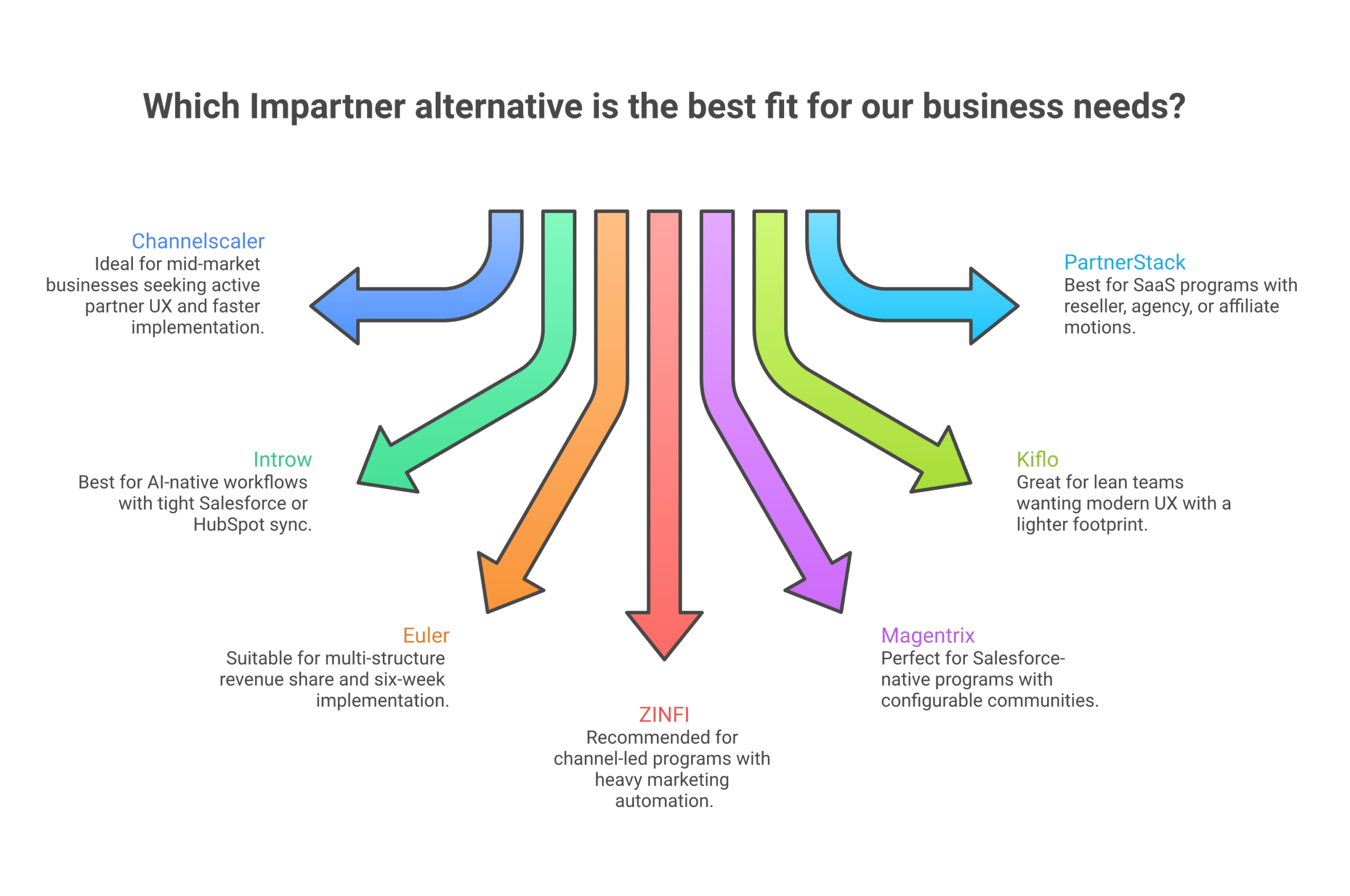
| Vendor | Best for | Top 3 features | Top 3 limits | Reviewer signal |
|---|---|---|---|---|
| Channelscaler (Channelscaler) | Mid-market programs needing active partner workflows and a partner-side UX that works today | Active partner portal UX, faster implementation than Impartner, decent integration breadth | Less depth on enterprise tier rules, lighter MDF than Impartner, recent rebrand may produce vendor-uncertainty | Strong on mid-market UX and implementation speed |
| ZINFI | Channel-led programs with heavy through-channel marketing automation needs | TCMA depth, multi-language, broad module coverage | Module sprawl, UX inconsistency across modules, depth varies module to module | Strong on TCMA breadth |
| Introw | Programs prioritizing AI-native workflows and tight Salesforce or HubSpot bidirectional sync | Agentic AI plus Claude MCP, full commission lifecycle, SOC 2 Type II | CPQ HubSpot-only, growth-stage customer base, narrower enterprise track record | Strong on AI-native depth and shipping cadence |
| Euler | HubSpot-centric programs wanting a modern, automation-first PRM with fast setup | CRM-native HubSpot and Salesforce sync, automated deal registration and attribution, modern partner portal | Newer entrant, smaller enterprise footprint, lighter MDF and TCMA depth | Strong on modern UX and CRM-native automation, early-stage market presence |
| Magentrix | Salesforce-native programs needing configurable partner communities | Deep Salesforce-native build, configurable communities, content distribution | Configuration-dependent setup, longer time to deploy, less depth on TCMA | Strong on Salesforce-native depth |
| Kiflo | Lean teams wanting modern partner UX with a lighter footprint | Modern partner UX, fast onboarding, lighter footprint | Less depth than enterprise PRMs, smaller integration ecosystem | Strong reviewer scores on usability and value |
| PartnerStack | SaaS programs with reseller, agency, or affiliate motions | Marketplace-style discovery, partner payments, fast onboarding | Less depth on enterprise tier rules and MDF, operates as affiliate or referral platform rather than multi-structure B2B PRM | Strong on payouts and SaaS partner motions |
| Mindmatrix | Channel-led teams that want PRM plus partner marketing in one suite | Combined PRM plus PMA, multi-tier hierarchies, MDF | Heavier setup, longer implementation, configuration-dependent, TCMA-leaning rather than PRM-core | Strong on combined PRM plus PMA |
The list intentionally stops at seven. A wider list adds noise without producing decision-grade differences. If a serious buyer’s three workflows are not well-served by one of these seven, the answer is usually that the buyer needs a clearer definition of the partner motion itself, not another PRM in the bake-off.
When Impartner is still the right answer
The cases where Impartner remains the best pick: an enterprise channel program with multi-tier hierarchies, mature MDF needs, partner-side workflows that are working today, and a buyer who values configurability over modern UX.
If the program runs enterprise channel hierarchies with tier rules that depend on multi-level criteria, the team has built workflows on top of Impartner’s MDF module, and current pain points are not specific to one of the alternative categories (Salesforce-native depth, AI-native workflows, SaaS payouts, lighter footprint), Impartner usually remains the right call at renewal. The cost and risk of re-platforming a deep enterprise PRM often exceed the marginal feature lift from a peer enterprise platform.
The poor-fit cases are clear. If the team is small and the Impartner footprint feels heavier than the program needs, Kiflo or Channelscaler are lighter. If the motion is Salesforce-native, Magentrix is closer. If AI-native partner workflows are a 2026 must-have, Introw is ahead. If the program runs on HubSpot and wants automation-first setup with minimal configuration, Euler is the closest modern fit. If the motion is primarily SaaS affiliate or referral payouts, PartnerStack covers it directly. If TCMA depth is the primary need, ZINFI or Mindmatrix go deeper than Impartner’s TCMA layer.
Methodology
The vendors above are evaluated on three dimensions: best-fit buyer profile, three top features versus three honest limits, and observable reviewer signal as of 2026. Sources are public product pages, integration directories, G2 and Capterra review patterns, and field-based observations from partnerships teams running active procurements between Q4 2024 and Q1 2026.
Five notes worth making explicit. There is no pricing column in the table, because PRM pricing varies widely with partner count, modules, term, and negotiation. Reviewer signal is qualitative, a summary of patterns across G2, Capterra, and field experience, not a single weighted score. The list is intentionally curated to vendors with enough public information and field signal to evaluate fairly. There is no vendor-paid placement on this page. And Forecastable is the analyst, not a vendor, we help partnerships teams build co-sell and ecosystem motions on top of whichever PRM fits, and we do not appear in the table.
Edge cases worth flagging
Three edge cases come up often enough to surface. Each one shifts the answer away from the headline pick.
- Enterprise tier rules are five-plus tiers deep with complex criteria: Impartner often remains the closest fit, and few alternatives match the depth. Audit whether the tier complexity is producing program value or producing exception sprawl before re-platforming.
- The team is fewer than three full-time partnerships people: most enterprise PRMs (Impartner included) carry administrative weight that small teams cannot sustain. A lighter platform (Kiflo, Channelscaler) often returns more program value per hour invested.
- The motion is splitting between B2B reseller and SaaS affiliate: few platforms cover both depths cleanly. The pragmatic answer is usually to run two platforms (one per motion) rather than force one platform to do both.
Forecastable’s POV
The honest test for any PRM is whether the partner side logs in, the deal-registration flow holds, and the partner-sourced number on the platform matches the partner-sourced number in the CRM. Programs that meet that test produce a forecastable partner pipeline; programs that do not produce a polished portal that nobody opens. The platform is the system of record, not the system.
The most common failure I see is the inverse, programs that pick the PRM before defining the partner motion, then configure the platform until the team can describe what the program does. The configuration is rarely the right design. Programs that ship the partner motion on a spreadsheet and a CRM custom-field first, then upgrade to a PRM when the motion is producing predictable output, end up with both the right PRM and the right motion. Programs that buy the PRM first end up reconfiguring it through three full procurement cycles.
The second move is to stop framing the choice as Impartner-versus-alternative and reframe it as motion-first. The right vendor question is: which partner motion is this program actually running, and which platform was designed for that motion. Impartner wins enterprise multi-tier channel. Channelscaler wins mid-market active partner workflows. ZINFI wins TCMA-heavy programs. Magentrix wins Salesforce-native. Kiflo wins lean teams. PartnerStack wins SaaS affiliate. Introw wins AI-native. The motion determines the answer, and a vendor-feature score sheet does not.
Forecastable is an independent third-party professional services company. Our evaluations of PRM platforms are based on publicly-available information as of May 2026 and our own client experience.
Frequently asked questions
Is Channelscaler (formerly Channelscaler) a real Impartner alternative? For mid-market programs, yes. Channelscaler is the closest peer on active partner UX and implementation speed. The platforms differ on enterprise tier depth and MDF maturity, where Impartner is deeper.
Is Introw production-ready for an enterprise replacement? Introw is the fastest-shipping AI-native PRM in the category as of 2026 and works well for AI-native or HubSpot-centric programs. Enterprise programs running deep tier hierarchies on Salesforce should validate the specific workflows before switching.
When is ZINFI the better choice than Impartner? When through-channel marketing automation is the dominant need and the program runs across multiple languages and regions. ZINFI’s TCMA depth is among the deepest in the category.
Is Magentrix a Salesforce add-on or a full PRM? Magentrix is a Salesforce-native PRM, built on the Salesforce platform with deep configurability. Programs that already standardize on Salesforce often find the native build the cleanest path; programs not on Salesforce should look elsewhere.
Should we evaluate PartnerStack against Impartner? Only if the motion is SaaS affiliate, agency, or referral with payouts. PartnerStack and Impartner serve different motions; comparing them directly usually means the buyer has not yet defined the partner motion.
How long does an Impartner-to-peer migration typically take? Six to twelve months end-to-end for an enterprise migration; mid-market programs can compress this to four to six months. Most of the cost is workflow re-architecture, not data migration.
Next step
Document the three workflows that are not working today before scoring vendors. If two of the three map to a specific alternative’s strength (Salesforce-native, AI-native, TCMA depth, SaaS affiliate, lighter footprint), the alternative deserves a real evaluation. If the three workflows are operating-cadence problems rather than platform-feature problems, the fix is upstream of the vendor choice.
Talk to our team about choosing the right PRM for your partner motion →
The PRM hub holds the broader context on where PRM fits inside the partner-tech stack.
Uncover Your Growth Potential
Schedule a Discovery Call