Partner Sourcing: How to Find the Partners You Need

What is partner sourcing?
Short answer: partner sourcing is the deliberate process of identifying, prioritizing, and engaging prospective partners against an ideal partner profile, run like account-based selling rather than inbound waiting. In 2026, the programs that recruit the partners they actually need do partner sourcing as a discipline; the ones that recruit whoever applies end up with a roster that does not match the profile.
The ideal partner profile is the filter that sourcing applies, and the partner recruitment strategy is the broader operating motion that sourcing feeds. Sourcing is the upstream funnel work; recruitment is the conversion work.
A working sourcing discipline has three properties. It is named: a target list of specific partners by name, not a category. It is prioritized: ranked by fit against the ideal partner profile, not alphabetically. And it is worked: the list gets contacted with a structured cadence, the same way an SDR works an outbound list.
Why partner sourcing matters in 2026
Partner programs that wait for inbound applications recruit slowly and unevenly. Programs that source actively can choose their roster, which is the difference between a program built around the partners it needs and a program built around the partners that happened to find it.
Three forces sharpened this. First, partner-sourced revenue is on the board deck, which means the program has to recruit for production, not whoever shows up. Second, partner ecosystems matured to the point where the right partners exist for most motions, finding them is mechanical, not aspirational. Third, partner managers’ time is the program’s bottleneck, and outbound sourcing has higher conversion-per-hour than inbound triage in most programs.
The mechanical case is simple. A program that sources actively recruits 12 partners that match the profile within two quarters. A program that waits for applications recruits 30 partners over the same period, of which 8 match the profile and the other 22 absorb partner-manager time that produces nothing. The first program is healthier from day one.
This is also a competitive issue. The strongest prospective partners are being sourced by multiple programs simultaneously. The program that has done the sourcing homework, overlap data ready, named-account list aligned, joint value proposition crisp, wins those partners’ attention.
How partner sourcing actually works
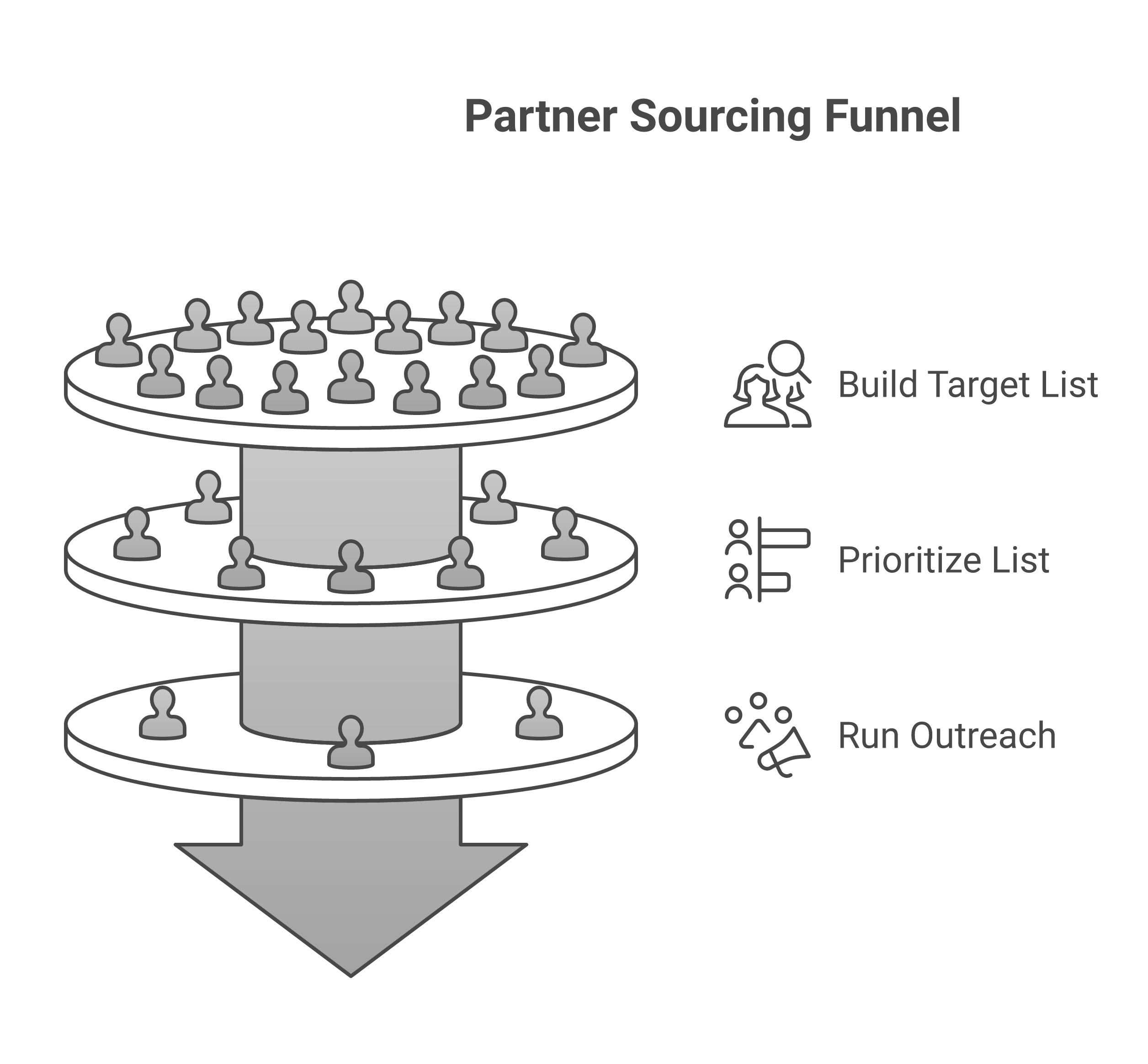
Five mechanics turn partner sourcing into a working discipline. The order matters: the profile precedes the list, the list precedes the priority, the priority precedes the outreach, the outreach precedes the conversion.
- Define the partner type and motion: see ideal partner profile. Partner sourcing is account-based work and requires a clear definition of what “in profile” means before any names go on the list.
- Build the named target list: 30-80 specific partners by name, identified through ecosystem overlap data, referral networks, customer advisory boards, and analyst directories. The list is the work product, without it, sourcing reverts to opportunistic conversations.
- Prioritize by fit, not alphabet: score each name against the profile’s production traits, overlap with target ICP, named champion access, prior co-sell behavior with a peer vendor. Top quartile gets sourcing-team focus; bottom quartile gets nurture or removal.
- Work the list with a structured cadence: warm intro first, then targeted outreach, then a structured discovery call against the profile. The cadence is the SDR motion applied to partners.
- Convert sourced partners into partner recruitment: a partner sourced into discovery is not yet recruited. The recruitment motion takes the qualified partner through joint planning, contracting, and activation. Sourcing’s job is the qualified hand-off, not the closed partnership.
Programs that run all five build a partner roster that matches the production profile. Programs that skip the named target list end up sourcing through whoever introduces themselves at conferences, which is a recruitment lottery.
Common pitfalls
Four repeating failures show up across partner-sourcing efforts. All four are recognizable from the way the team talks about the funnel.
- Inbound-only sourcing: relying on partners to find the program produces a slow, uneven funnel and a roster that drifts away from the profile. Inbound is fine as a supplement; never as the primary engine.
- Long lists with no prioritization: a sourcing list of 300 names without ranking is a research document, not an operating plan. Concentrate the team’s time on the top quartile; nurture the rest.
- Sourcing without profile alignment: sourcing against a vague mental model produces a target list nobody can defend. Write the profile first; let the profile do the filtering work.
- No hand-off to recruitment: a sourced partner sitting in a CRM with no next step is a sourced partner who will go cold. The hand-off from sourcing to recruitment has to be operationalized, or the funnel breaks at the conversion step.
What this looks like in practice
Partner sourcing draws on three layers that already exist in most revenue stacks, plus the targeted outreach motion that partnerships teams adopt from sales.
a mid-stage SaaS company writes an ideal partner profile for its tech ISV motion and builds a 40-name target list using ecosystem overlap data, customer referrals, and analyst directories. Each name is scored on five profile traits. The top 12 get prioritized for warm-intro outreach by the VP Partnerships; the next 18 get sequenced touches by the partner manager; the bottom 10 stay in nurture. Within one quarter, four of the top 12 have signed and entered activation. The roster matches the production profile from the start.
Forecastable’s POV
The most common partner-sourcing failure is mental, not operational. The team has internalized the idea that partners “come to us”, that the right partners will find the program through marketing and inbound. They will not, or rather, the ones that find you inbound are not necessarily the ones that match your profile. Partner sourcing is account-based work; it requires the same outbound discipline as sales prospecting. Programs that adopt this mental model recruit faster and better.
The fix is to run sourcing as an SDR motion adapted to partners. Build the named target list against the profile. Score it. Sequence the outreach. Track the funnel from sourced → contacted → qualified → recruited. Treat the partner-sourcing funnel like the sales pipeline it is. Sourcing teams that operationalize this way recruit predictable numbers of in-profile partners per quarter; teams that keep sourcing as a “see who comes to us” activity recruit unpredictable numbers of off-profile partners.
The second move is to be ruthless about the prioritization. A target list of 80 partners is fine; expecting the partner manager to engage all 80 is not. Concentrate engagement time on the top quartile by profile fit, run a lighter sequence on the next quartile, and let the bottom half sit in nurture or remove them from the list. This concentration is what separates productive sourcing from busy sourcing, the team that engages 20 of 80 names deeply will out-recruit the team that engages all 80 lightly.
The third move is to operationalize the hand-off from sourcing to recruitment. Sourcing creates qualified prospective partners; recruitment converts them into signed and activated partners. The hand-off is where most funnels leak, the sourcing team treats a qualified discovery call as a win and moves on; the recruitment work never starts; the partner cools and goes elsewhere. Define the hand-off explicitly: when does sourcing end and recruitment begin, who owns the partner during the transition, and what does the partner experience between the two steps. The funnel survives only if the hand-off does.
Forecastable is an independent third-party professional services company. Our evaluations of sourcing and ecosystem platforms are based on publicly-available information as of May 2026 and our own client experience.
Frequently asked questions
What is partner sourcing? The deliberate process of identifying, prioritizing, and engaging prospective partners against an ideal partner profile, run like account-based selling, not inbound waiting.
How is partner sourcing different from partner recruitment? Sourcing identifies and qualifies prospective partners; recruitment converts qualified prospects into signed and activated partners. Sourcing is the funnel work; recruitment is the conversion work.
Should partner sourcing be inbound or outbound? Primarily outbound. Inbound is fine as a supplement, but the strongest partners need to be sourced actively, they are being recruited by multiple programs simultaneously.
What does a partner target list look like? 30-80 named partners scored against the ideal partner profile, with prioritization based on production traits (overlap, named champion, prior co-sell). The list is the operating plan, not a research document.
Who should own partner sourcing? The partnerships team owns it. The VP Partnerships often handles top-tier outreach personally; partner managers run the sequenced touches on the mid-tier; partner ops or BDR support is helpful at scale.
How long does partner sourcing take to produce signed partners? Variable by motion. A well-sourced tech ISV partnership can sign within one quarter; a strategic alliance with a major SI typically takes two to four quarters from first sourcing contact to signed agreement.
What is the most common reason partner sourcing fails? Inbound-only orientation. Programs that wait for partners to find them recruit slowly and unevenly. The right partners need to be sourced like target accounts.
Next step
Build a named target list of 20-40 partners against your current ideal partner profile, scored by fit. If you do not have a written profile yet, that is the upstream fix, see the ideal partner profile work. Then prioritize the list and start outreach on the top quartile this week.
The partner program hub holds the broader context on where sourcing fits inside the program design.
Uncover Your Growth Potential
Schedule a Discovery Call