Partner-Led Growth: What It Is and When It Works

What is partner-led growth?
Short answer: partner-led growth is a go-to-market motion in which partners produce the majority of new pipeline and revenue, and the company’s direct sales motion is sized around amplifying partner deals rather than running its own primary funnel. In 2026, it is a real and powerful motion for a specific set of companies, and a marketing label everywhere else.
The partner program hub holds the broader context, and the partner-sourced revenue metric is what proves the motion is actually partner-led rather than partner-assisted. Partner-led growth is a measurable state, not an aspiration.
A working definition has three properties. It is measurable: partner-sourced revenue is the majority of new revenue, not a side number. It is primary: the company designs its sales motion around partners, not as a supplement to direct. And it is intentional: leadership chose the motion based on the company’s economics, not because partnerships made a slide.
Why partner-led growth matters in 2026
The phrase “partner-led growth” became fashionable in 2024-2025, and like every fashionable phrase, it now describes both real motions and aspirational ones. Knowing which one you have matters because the design of the company depends on it.
Three forces sharpened the question. First, ecosystem-led growth thinking put partner contribution on the board deck, which means the partner number now gets scrutinized. Second, capital efficiency became a board metric, and partner-led motions have very different capital profiles than direct-led motions. Third, partner ecosystems matured to the point where a real partner-led motion is mechanically possible for many more companies than it used to be, but the design work still has to be done.
The mechanical case is simple. A genuinely partner-led company designs its rep capacity, marketing spend, and product roadmap around partner deals; a partner-influenced company runs a direct motion with partners helping at the margins. Both are valid. Confusing them is expensive, a direct-motion company that brands itself partner-led ends up under-investing in both motions.
This is also a strategic question. The partner-led motion is the right answer for some companies and the wrong answer for others. Choosing correctly is a function of where the buyer prefers to buy, how the product needs to be implemented, and how the unit economics work.
How partner-led growth actually works
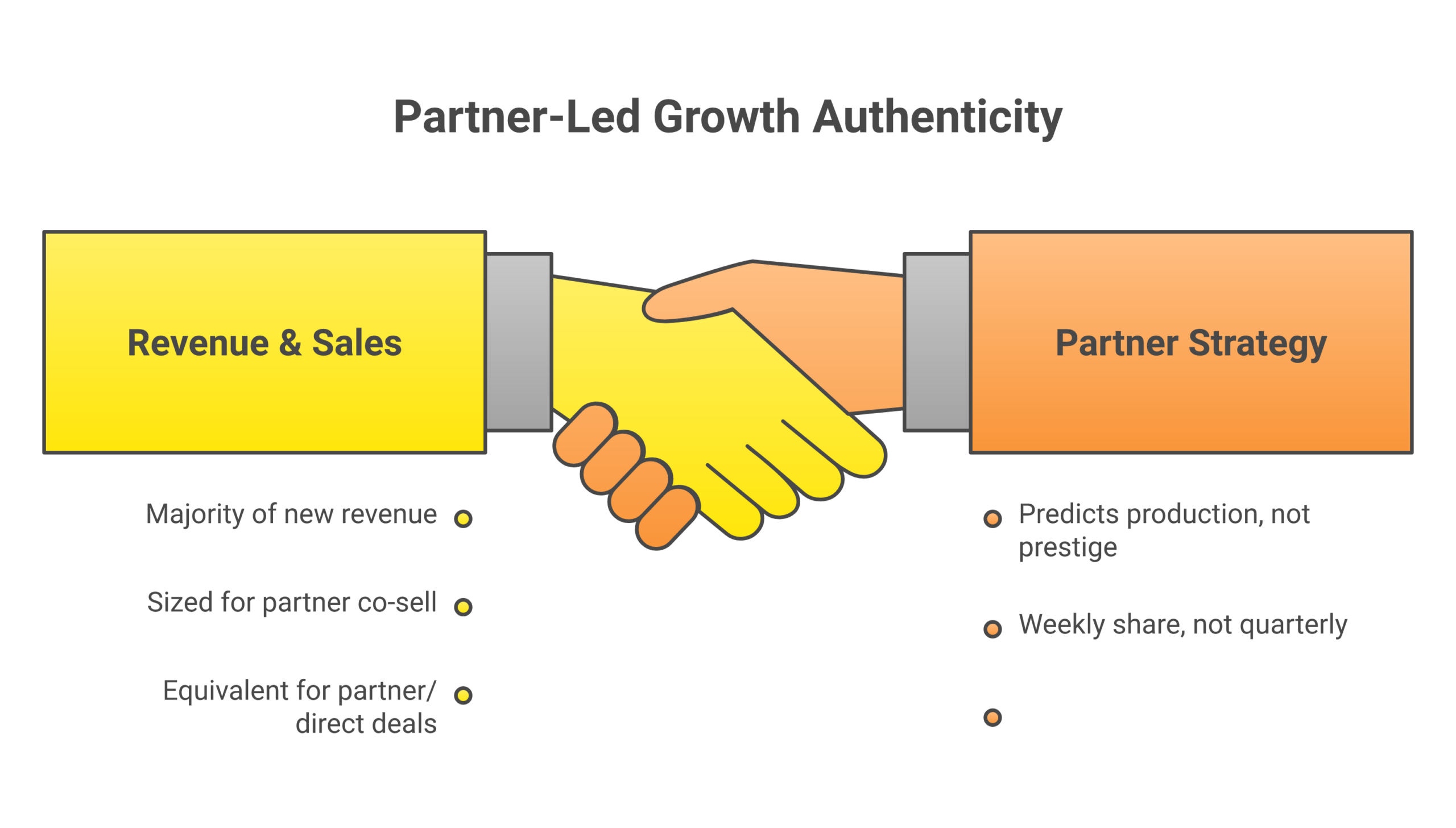
Five mechanics make partner-led growth real rather than aspirational. The order matters: the economics decide whether it makes sense, the partner profile decides who can produce, the sales structure adapts, the comp aligns, and the system measures.
- Verify the economics first: partner-led growth makes sense when partners can produce pipeline at lower fully-loaded cost than direct sales can, or when partners are the only viable access to a buyer that direct cannot reach. Run the math; if direct beats partners on cost per qualified opportunity, the motion is not actually partner-led.
- Build an ideal partner profile that predicts production: see ideal partner profile. A partner-led motion lives or dies on whether the partner type the program built around actually produces. Profile drift is the first failure mode.
- Size and structure direct sales as an amplifier, not a primary funnel: in a true partner-led motion, AEs are sized to co-sell partner deals at high velocity, not to run their own primary pipeline. Coverage models, account assignment, and quota design all shift.
- Align comp so direct and partner-driven revenue pay equivalently: if direct deals pay better than partner deals, AEs ignore partner deals. Equalize comp treatment, then the AEs co-sell the partner deals the program needs them to co-sell.
- Measure the motion’s share, weekly: partner-sourced revenue as a share of total new revenue, weekly. The motion is partner-led when the share is consistently >50%. The number tells you the motion is real; the absence of the number tells you it is a label.
Companies that run all five build a genuinely partner-led motion. Companies that stop at the language end up with a sales org that says “partner-led” and operates “direct-led with partner spurts.”
Common pitfalls
Four repeating failures show up across attempts to operate a partner-led motion. All four are recognizable from the way leadership talks about the number.
- Aspirational labeling: branding the motion “partner-led” before the partner-sourced share crosses 50% creates an expectation the field cannot meet. Wait for the number; let the label follow.
- AEs paid less on partner deals: any comp differential that disadvantages partner deals signals to AEs that partner work is a side hustle. Equalize, or watch the AEs prioritize direct.
- Direct motion staffed for primary funnel while calling itself partner-led: a sales org with AE territory coverage designed for direct outbound is not built for partner-led. The coverage model, not the language, defines the motion.
- Partners chosen on logo prestige instead of production traits: a partner-led motion fails fast when the partner roster looks impressive on slides and does not produce. The motion only works when the partner type actually delivers; recruit accordingly.
What this looks like in practice
Partner-led growth operates across three layers, none of which is unique, the difference is in how they are configured.
a mid-stage SaaS company verifies that its top 12 implementation partners can deliver qualified pipeline at 60% of the cost-per-qualified-opportunity of its direct outbound. The company shifts AE quota assignments to over-index on partner co-sell, equalizes comp across direct and partner deals, and aligns the marketing team to run joint campaigns rather than direct demand-gen. Within two quarters, partner-sourced revenue crosses 55% of new revenue. The motion is now genuinely partner-led, and the language matches the math.
Forecastable’s POV
The honest test for partner-led growth is the math, not the marketing. A motion is partner-led when partners produce the majority of new revenue, sustainably, with comp and coverage designed around them. Until that math holds, the motion is direct-led with partner contribution, which is a fine motion, just a different one, and one that should be branded honestly.
The most common failure I see in companies trying to be “partner-led” is the aspiration outpacing the design. Leadership decides partner-led is the future, the marketing team writes the page, the partnerships team commits to a roadmap, and then the comp plan still pays AEs more on direct deals, the territory coverage is still built for outbound, and the partner roster is recruited on prestige instead of production traits. The motion never operates as partner-led; the language just claims it does. Six quarters later, the partner-sourced share is still in the 20s and leadership wonders why.
The fix is to redesign the operating system, not the slide. Equalize the AE comp on partner deals first. Restructure territory coverage to optimize for partner co-sell. Recruit partners on production traits, not logos. Measure the share weekly and protect it. After all of that is done, the language follows the reality. Skipping the design work and adopting the language anyway just creates an organization that talks about partners and operates around direct, and that’s a uniquely frustrating place to work, for both the partnerships team and the field reps.
The second move is to be willing to say a company is not partner-led when the math says it is not. Some companies will never be partner-led because the buyer prefers direct, the product implements simply, or the unit economics favor a direct motion. Those companies should run partner-influenced motions and brand them accurately. The brand isn’t smaller; it is honest, and the AE org isn’t confused about which deals to prioritize because the company has stopped pretending the motion is something it is not.
The third move applies to the companies where partner-led genuinely fits: invest seriously in the partner manager layer. Partner-led growth is operationally heavier than direct, not lighter, the team needs more partner managers, better tooling, and tighter coordination between the partnerships and sales orgs. Companies that adopt the partner-led label expecting it to be cheaper than direct learn the cost in missed quarters.
Forecastable is an independent third-party professional services company. Our evaluations of partner-led GTM design are based on publicly-available information as of May 2026 and our own client experience.
Frequently asked questions
What is partner-led growth? A go-to-market motion in which partners produce the majority of new pipeline and revenue, with the company’s sales structure, comp, and coverage designed around partner deals rather than primary direct outbound.
How is partner-led growth different from ecosystem-led growth? Ecosystem-led growth treats the partner ecosystem as a key input to the company’s GTM. Partner-led growth is the stronger claim, that partners produce the majority of new revenue. ELG is the broader framing; partner-led is a specific motion within it.
How is partner-led growth different from partner-influenced or partner-assisted? Partner-led means partner-sourced revenue is the majority of new revenue. Partner-influenced or partner-assisted means partners contribute to deals direct sales originated. The two motions have different operating models and different cost structures.
When does partner-led growth make sense? When partners can produce qualified pipeline at lower fully-loaded cost than direct sales, or when partners are the only viable access to the target buyer. Run the math before committing to the motion.
How do you know if your company is actually partner-led? Measure partner-sourced revenue as a share of total new revenue, weekly. If the share is consistently >50%, the motion is partner-led. If it is <40%, the motion is partner-influenced at best.
Should AEs be paid the same on partner deals and direct deals? Yes. Any comp differential disadvantaging partner deals signals to AEs that partner work is a side hustle. Equalize comp, or watch direct deals get prioritized every quarter.
Is partner-led growth cheaper than direct? Sometimes per qualified opportunity, often not at the operating-system level. Partner-led growth needs more partner-manager headcount, more cross-functional coordination, and tighter program discipline. The savings are in pipeline cost; the investment is in operating capability.
Next step
Measure your partner-sourced share of new revenue over the last two quarters. If the share is below 50%, you are running a partner-influenced motion regardless of what the website says. Decide whether to invest to make it truly partner-led or to brand the motion honestly as partner-influenced.
Talk to our team about designing a partner-led growth motion that the math actually supports →
The partner program hub holds the broader context on where partner-led growth fits inside revenue strategy.
Uncover Your Growth Potential
Schedule a Discovery Call