Channel Manager Job Description: A Template That Predicts Hires Who Hit Quota

A channel manager job description that just lists “manage partner relationships” predicts a hire who underperforms in the first 18 months. A channel manager JD that names the producer-consumer ratio target, the partner-attached pipeline expectation, the operating cadence the role will run, and the compensation tied to revenue outcomes predicts a hire who hits quota. The difference between the two JDs is whether the operating outcome was written before the job description was written.
The pattern across channel manager hires that work versus the ones that don’t is consistent. Hires who work were brought in for a defined operating outcome (manage X partners, produce Y partner-attached pipeline, run Z cadence) and were compensated on those outcomes. Hires who don’t were brought in for “channel manager” duties with no specific motion attached.
This piece covers what a channel manager job description should look like, the four sections every JD needs, the compensation structure that predicts performance, the failure modes I see most often in channel manager hiring, and how the role fits inside the broader partner program.
What is a channel manager job description?
A channel manager job description defines the role responsible for managing a portfolio of partner relationships against a partner-attached pipeline target. The role sits between the partner program (which sets the rules) and the field (which closes deals). A working JD names the partner cohort the role will own, the pipeline target the role will produce, the operating cadence the role will run, and the compensation structure that ties the role to revenue outcomes.
The channel manager role is one of several partner-facing roles, with significant overlap in title and responsibility. “Channel manager,” “partner manager,” “alliance manager,” and “ecosystem manager” are sometimes used interchangeably. The structural distinction that matters is whether the role focuses on resale partners, tech-ecosystem partners, or strategic platform partners.
The category is downstream of the channel sales strategy. The strategy names the partner-attached revenue target, the producer-consumer ratio, the partner profile, and the operating cadence; the channel manager JD operationalizes those into a hireable role.
The four sections every channel manager JD needs
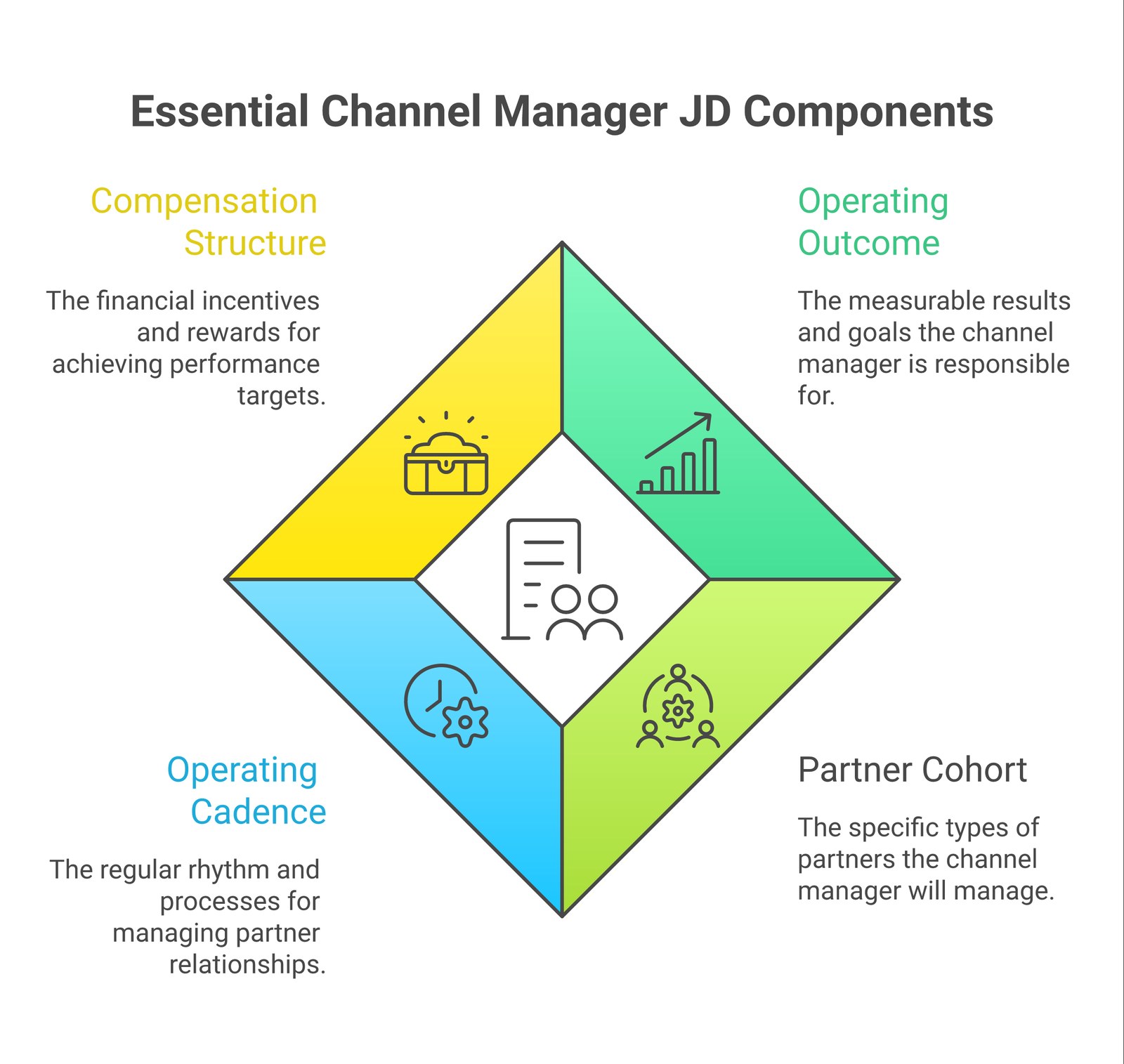
A channel manager JD that predicts hires who hit quota has four sections: the operating outcome, the partner cohort, the operating cadence, and the compensation structure. Every section is concrete and measurable; vague language at any layer produces generic candidates.
The operating outcome
The first section names the specific outcome the role is responsible for. “Produce $X in partner-attached pipeline by end of FY1” beats “manage partner relationships” because the candidate can self-evaluate fit. Strong outcomes are quantified, time-bounded, and tied to the company’s revenue plan.
The partner cohort
The second section names the specific partner cohort the role will own. “Manage 8-12 named tech-ecosystem partners in the financial services vertical” beats “manage strategic partnerships” because the candidate can evaluate whether their experience matches.
The operating cadence
The third section names the operating cadence the role will run. “Monthly per-partner pipeline review with named accounts and explicit dispositions; quarterly QBR with partner leadership; weekly deal-pairing ritual at the AE level; quarterly executive sponsor cadence with partner C-suite.” Cadence specificity tells the candidate what the day-to-day work looks like.
The compensation structure
The fourth section names the compensation structure with enough specificity to evaluate fit. OTE band, variable mix percentage, the metrics the variable comp is paid on, and the timing of payouts. “OTE $180K-$220K, 60/40 base/variable, variable paid on partner-sourced revenue at 50% and partner-attached revenue at 50%, paid quarterly.”
How the JD fits into the broader hiring motion
The channel manager JD is downstream of the channel sales strategy and upstream of the candidate evaluation. Three operating decisions determine whether the JD-to-hire flow produces strong candidates: the JD has to match the upstream strategy, the candidate evaluation has to match the JD, and the comp plan has to match the comp structure named in the JD.
The JD-to-strategy match is the upstream check. Does the JD reflect the partner-attached pipeline target named in the channel sales strategy? Does the partner cohort match the producer-consumer ratio? Does the operating cadence match the program structure?
The candidate-evaluation-to-JD match is the recruiting check. Does the candidate evaluation rubric test for the operating outcome, the cohort experience, and the cadence experience? Or does it test for generic competencies (communication, leadership, drive) that don’t predict performance in this specific role?
The comp-plan-to-JD match is the offer-stage check. Does the offered comp structure match what the JD said? Does the variable mix and metric set match? Misalignment at this stage produces candidates who accept under one set of expectations and operate under another.
Common pitfalls in channel manager JD design
The pitfalls are operating pitfalls and specificity pitfalls. Three patterns repeat across underperforming channel manager hires.
The first pitfall is generic JD language that doesn’t tie to a specific operating motion. “Manage strategic partnerships,” “develop the channel,” “build the partner ecosystem”; none of these tell the candidate what they’ll actually do or tell the hiring manager what they’re hiring for. Generic language produces generic candidates.
The second pitfall is comp structure that pays on the wrong metric. Channel managers paid on partner count produce a portfolio of unproductive partners. Channel managers paid on partner-sourced revenue produce sourced revenue. The metric the variable comp is paid on is the metric the hire will optimize for.
The third pitfall is reporting line ambiguity. A channel manager JD that doesn’t specify reporting line or specifies “matrix to sales and marketing” produces a hire who doesn’t know who their boss is. Strong JDs specify a single reporting line, typically into sales (CRO or VP Sales) or directly into the head of partnerships.
Compensation benchmarks (US, 2026)
| Role variant | OTE band | Variable mix | Variable metric |
|---|---|---|---|
| Junior channel manager (1-3 years) | $110K-$140K | 25-35% | Partner-sourced pipeline |
| Mid channel manager (3-7 years) | $150K-$200K | 30-45% | Partner-sourced revenue |
| Senior channel manager (7+ years) | $200K-$260K | 35-50% | Partner-attached revenue + portfolio retention |
| Channel sales director (manager-of-managers) | $260K-$340K+ | 35-55% | Region or vertical revenue plus team performance |
Compensation varies meaningfully by industry, region, and partner motion. Enterprise software channel manager comp runs higher than SaaS-platform channel manager comp; international comp varies by region. The numbers above are US mid-market and enterprise SaaS averages; calibrate against your specific market and motion.
The variable metric matters more than the OTE band for predicting performance. A junior channel manager paid on partner-sourced pipeline who has the right operating motion produces sourced pipeline. A senior channel manager paid on partner count or partner-sentiment metrics produces partners-without-revenue.
Forecastable’s POV
The single most important channel manager JD decision is what the variable comp is paid on. Pay on partner count and you get partners. Pay on partner-sourced revenue and you get partner-sourced revenue. Pay on partner-sentiment metrics and you get relationship management without revenue. The metric is the predictor; the OTE band is a downstream concern.
Two specific calls Forecastable makes consistently. First: the JD should be written from the operating outcome backward. Start with the partner-attached pipeline target tied to the company’s revenue plan, derive the partner cohort from the producer-consumer ratio, derive the operating cadence from the cohort size, and only then derive the JD language. JDs written from the title forward produce generic hires.
Second: the comp metric should be partner-sourced or partner-attached revenue, not a sentiment or activity metric. Sentiment is a leading indicator; activity is a leading indicator; revenue is the actual outcome. Channel managers paid on the actual outcome produce the actual outcome.
The benchmark resources worth borrowing from are the published JD templates from PartnershipLeaders, the AchieveUnite Partner Excellence Framework’s role definitions, Crossbeam’s “A Hiring Manager’s Guide to Partnerships Roles and Job Titles,” and ChannelNomics’s role-design content.
Frequently asked questions
What does a channel manager do?
Manages a portfolio of partner relationships against a partner-attached pipeline target. Responsibilities typically include partner enablement, deal-stage coordination, joint pipeline review, QBR planning, and conflict resolution between partner sales and direct sales.
What’s the difference between a channel manager and an alliance manager?
Channel manager typically refers to roles managing resale partners. Alliance manager typically refers to roles managing tech-ecosystem or strategic platform partners. The terms are sometimes used interchangeably.
How is a channel manager compensated?
OTE typically ranges $110K-$260K+ depending on seniority, with 25-50% variable mix paid on partner-sourced or partner-attached revenue. Variable metric matters more than OTE band for predicting performance.
Who does a channel manager report to?
Most commonly into sales (CRO or VP Sales) or into the head of partnerships. Reporting into marketing is appropriate only when the partner motion is fundamentally a co-marketing motion.
What’s the right portfolio size for a channel manager?
Depends on partner archetype and program maturity. A junior channel manager managing transactional resellers can cover 30-50 partners; a senior channel manager managing strategic resellers can cover 8-12; an alliance manager covering tech-ecosystem partners can cover 3-7 named relationships.
What experience predicts a strong channel manager hire?
Field sales experience (SDR-to-AE-to-senior AE), partner motion experience, and operating discipline (forecast accuracy, deal-stage management, attribution rigor). Pure relationship-management experience without sales experience predicts underperformance.
What’s the most common channel manager hiring mistake?
Writing a generic JD that doesn’t name the operating outcome, the partner cohort, the cadence, or the comp metric. Generic JDs produce generic candidates and predictable misses.
Next step
If you’re hiring a channel manager, start with the operating outcome before you write the JD. Write three to four sentences that specify what the role will produce in 12 months, then derive the partner cohort, the operating cadence, and the comp structure from that outcome.
Forecastable is an independent third-party professional services company. Our evaluations of other vendors are based on publicly-available information as of May 2026 and our own client experience.
Talk to our team about hiring a channel manager who produces pipeline →
By Alex Buckles
Uncover Your Growth Potential
Schedule a Discovery Call