Partner Content Syndication: A Field Guide for B2B SaaS

Short answer: partner content syndication is one of the cheapest pipeline sources in B2B SaaS. Most programs underperform because they treat it as a logo-swap, not a real demand motion. The model that works is simple. Syndicate content only when it is valuable on its own, attribute leads at the source, and build a follow-up motion just for syndicated leads. Done right, it produces 3 to 8x ROI on production cost. Done wrong, it makes email lists nobody touches.
Every year, I see partnerships teams put real budget into content syndication. Most cannot tell me what pipeline came out of it. The reason is not that syndication does not work. Instead, the typical program never captures or follows up on the leads it makes.
Why most partner content syndication underperforms
Three structural problems show up again and again. Each one looks small on its own. Combined, they are why most syndication budget makes clicks, not pipeline.
Content quality does not justify the syndication. The content was written for your direct audience. It does not carry over to the partner’s audience. So syndication makes clicks but no conversion. The content is not valuable on its own.
Lead capture is broken or absent. The syndicated content sits behind a partner-controlled form. You either do not get the leads, or you get them stripped of UTM data. So attribution becomes impossible.
Follow-up motion is absent. Syndicated leads land in your CRM with no campaign source. There is no context about which partner audience they came from. There is no follow-up motion. So the SDR team treats them like cold leads, and conversion craters.
The four design decisions that make syndication work
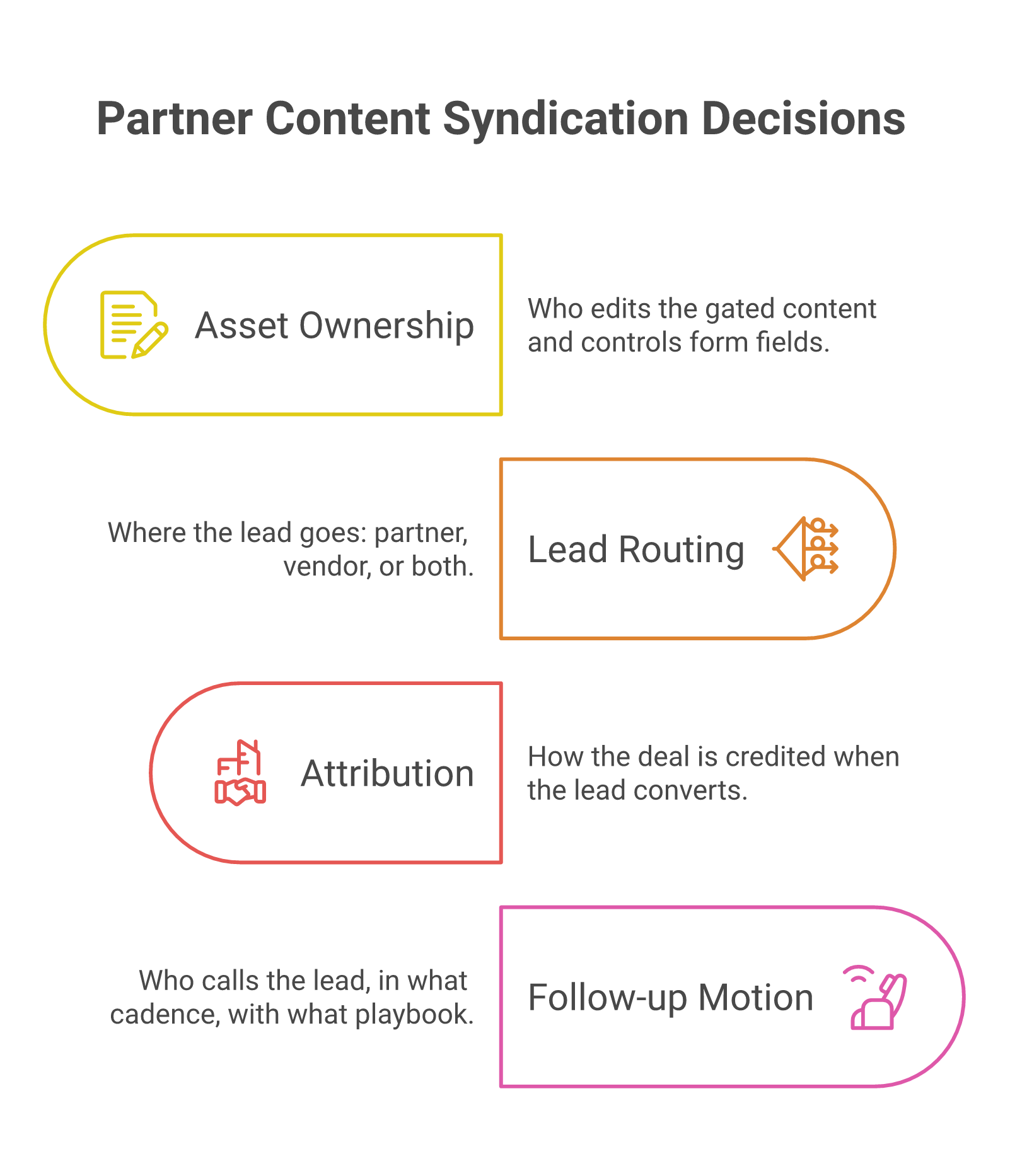
| Decision | What it looks like |
|---|---|
| Content selection | Independently valuable to the partner’s audience without requiring knowledge of your product. Original research, frameworks, or strategic content, not product collateral. |
| Distribution agreement | Partner agrees to syndicate to a specific audience segment with measurable reach. Both parties get lead capture data with full UTM and source attribution. |
| Lead routing | Syndicated leads route to a dedicated nurture sequence, not the standard inbound queue, with messaging that acknowledges the partner audience source. |
| Follow-up motion | Specific to syndicated leads: a longer nurture cycle of 6 to 12 weeks, a partner-aware first touch, and a joint motion option for sales-qualified leads. |
Notably, these four decisions are not optional add-ons. They are a chain. If content selection is wrong, the distribution agreement carries weak content. If lead capture has no attribution, the follow-up motion has no source to name. So treat all four as launch gates, not as a backlog.
Content selection drives the other three
The first decision sets the ceiling on every other one. When the content is useful to the partner’s audience on its own terms, the partner will put real distribution behind it. The leads then arrive warm enough to justify a dedicated nurture track. By contrast, when the content is repackaged product collateral, nothing can rescue it. No distribution deal helps. No follow-up motion helps. So before anything else, ask one question. Would this content be worth reading if the reader had never heard of your product? If the answer is no, do not syndicate it yet.
The five syndication formats that produce the highest ROI
Format choice changes ROI a lot. Here is how the common formats rank, based on what I have seen across B2B SaaS programs.
Co-branded research reports syndicated to partner audiences. Highest ROI by far. This pairs the content quality of original research with the audience reach of syndication. Conversion rates from syndicated download to qualified pipeline run 3 to 5x normal cold outbound conversion.
Guest content in partner newsletters or blogs. Mid to high ROI when the partner audience is a close fit. It works best when the content is strategic, not promotional. Search Engine Journal coverage of content syndication shows that audience relevance predicts ROI better than content topic does.
Webinar replays distributed via partner channels. Mid ROI. This works when the original webinar was strong and the partner has a reliable channel.
Tool or framework templates with both logos. High ROI for utility content, such as assessment tools, scoring frameworks, and calculators. It draws qualified leads who are actively trying to solve a problem.
Joint case studies syndicated to both audiences. Mid to high ROI when the case study shows a real customer outcome. It draws mid-funnel leads that close faster than top-funnel leads.
The follow-up motion that distinguishes syndicated leads
Syndicated leads are not cold leads. They have engaged with content from a source they trust, the partner. However, they are not warm inbound leads either. They did not come to your website looking for you. So the follow-up motion has to thread that needle.
First touch names the source. The first email or call references the partner audience and the exact content the lead engaged with. By contrast, generic outbound messaging burns the lead.
Nurture cycle runs 6 to 12 weeks. Syndicated leads convert on a longer cycle than warm inbound. SDR teams that treat them like 7-day inbound leads kill conversion.
Joint motion option for sales-qualified leads. If the lead becomes sales-qualified, offer to bring the partner into the talk. This often speeds up the deal. The partner relationship is already in place. It is the point where syndication turns into a real co-sell motion, and where the lead crosses into the wider partner activation for SaaS companies motion.
Attribution captured at every touch. Every interaction logs the syndication source. By close, attribution back to the syndication campaign is undeniable.
The economics of syndication versus other lead sources
Content syndication is underused for one reason. It is hard to compare to other lead sources without clean attribution. Once attribution is clean, the math usually favors syndication for top-of-funnel B2B SaaS pipeline.
Consider the cost per qualified lead. Cold outbound typically runs $150 to $400 in B2B SaaS, depending on ICP. Paid demand-gen typically runs $200 to $800. By contrast, partner content syndication runs $50 to $150 when the program is built right. The content production cost spreads across many channels and partners. So each new channel gets cheaper.
There is one catch. Syndication ROI needs both partners to invest in lead capture and the follow-up motion. Skip those and the math breaks. Demandbase research on B2B demand-gen efficiency shows partner-driven content channels beat paid acquisition on cost per qualified lead when attribution is properly captured.
How to defend the comparison to a CFO
The economics only land if you can show the work. So track three numbers per syndication motion. First, the fully loaded production cost. Second, the qualified leads it made with source attribution intact. Third, the pipeline those leads created. Then divide. Put that table next to your cold outbound and paid numbers. Now syndication is no longer the channel nobody can defend. Instead, it is the one the CFO asks you to scale.
The bigger picture for partnerships leaders
Partner content syndication is one of the highest-leverage motions in the partnerships playbook. It is also one of the easiest to do badly. So spend the upfront time on the four decisions. Pick content that is valuable to the partner audience on its own. Sign distribution agreements with full attribution. Route leads to a dedicated nurture sequence. Build a follow-up motion that is partner-aware, runs a longer cycle, and offers a joint motion option. Do those four things and syndication compounds. Skip them and the program makes email lists that quietly get archived.
Frequently Asked Questions
What is partner content syndication?
Partner content syndication means distributing your content through a partner’s audience channels to generate leads. That content can be research reports, guest posts, webinars, tools, or case studies. Done right, it produces qualified pipeline at a lower cost per lead than cold outbound or paid demand-gen.
Why do most content syndication programs underperform?
Three structural problems. First, content quality does not justify syndication, because it was written for your audience, not the partner’s. Second, lead capture is broken or absent. Third, the follow-up motion is undefined. So syndicated leads get treated like cold outbound and conversion craters.
What is the highest ROI content syndication format?
Co-branded research reports syndicated to partner audiences. This combines content quality with audience reach. Conversion rates from syndicated download to qualified pipeline run 3 to 5x normal cold outbound conversion. Tool and framework templates also produce high ROI.
How should we follow up on syndicated leads?
First touch acknowledges the partner source and the specific content engagement. The nurture cycle runs 6 to 12 weeks, longer than warm inbound. Offer a joint motion option for sales-qualified leads, bringing the partner back into the conversation. Then capture attribution at every touch.
What is the cost per qualified lead from partner content syndication?
Typically $50 to $150 for properly designed programs. By contrast, cold outbound runs $150 to $400, and paid demand-gen runs $200 to $800. Syndication wins on cost when the content production cost amortizes across multiple syndication channels and the follow-up motion is built.
Should syndicated leads route to the standard inbound queue?
No. Syndicated leads behave differently than warm inbound, because they convert on a longer cycle and need partner-aware messaging. They should not compete with high-intent leads in the SDR queue. Instead, route them to a dedicated nurture sequence designed for syndicated leads specifically.
Next step: pick one piece of content you already syndicate, and run it through the four-decision check. Is it independently valuable to the partner audience? Does the distribution agreement preserve attribution? Do the leads route to a dedicated nurture track? Is the follow-up motion partner-aware? Fix the weakest link first.
Talk to our team about building a partner content syndication motion that converts →
Uncover Your Growth Potential
Schedule a Discovery Call