Alex Buckles
Multi-Touch vs Last-Touch Partnerships Attribution: What B2B SaaS Should Pick

Last-touch partner attribution credits a single partner per deal. Multi-touch attribution credits multiple partners across the deal cycle. For B2B SaaS, last-touch is almost always the right answer because multi-touch creates compensation disputes, dilutes accountability, and produces aggregate numbers that no CFO can model. Multi-touch only works in mature partnerships organizations with dedicated RevOps headcount and a comp pool large enough to absorb the credit-sharing complexity.
The marketing world has been chasing multi-touch attribution for over a decade. The partnerships world is now starting to follow, mostly because vendors are pitching the model as more rigorous than last-touch. The lesson from marketing should be the warning for partnerships. Multi-touch attribution looks rigorous, costs more to maintain than the insights are worth, and rarely changes the strategic decision the data was supposed to inform.
The honest answer for most B2B SaaS partnerships teams is to stick with last-touch. This piece walks through why, when multi-touch is actually worth the operational cost, and what to do about the rare deal where two partners genuinely contributed equally.
The two attribution models compared
Last-touch and multi-touch are not on a quality spectrum. They are different operating models with different organizational requirements. Picking the wrong one has nothing to do with sophistication and everything to do with what your team can actually maintain.
| Last-touch attribution | Multi-touch attribution | |
|---|---|---|
| How it works | One partner gets full credit per deal. | Multiple partners share credit by stage or role in the deal cycle. |
| Comp impact | Clean. One partner manager gets quota credit. One partner gets revenue share. | Complex. Multiple partner managers split credit. Multiple partners split revenue share. Comp disputes are routine. |
| CRM complexity | Three custom fields per opportunity. | Ten or more fields per opportunity, plus a partner-touch table for stage-level tracking. |
| Reporting | One number per deal feeds straight into pipeline projections. | Aggregate numbers require fractional math the CFO has to trust. |
| Best for | Most B2B SaaS partnerships organizations. | Mature orgs with dedicated RevOps team and large comp pool. |
Why last-touch wins for most B2B SaaS teams
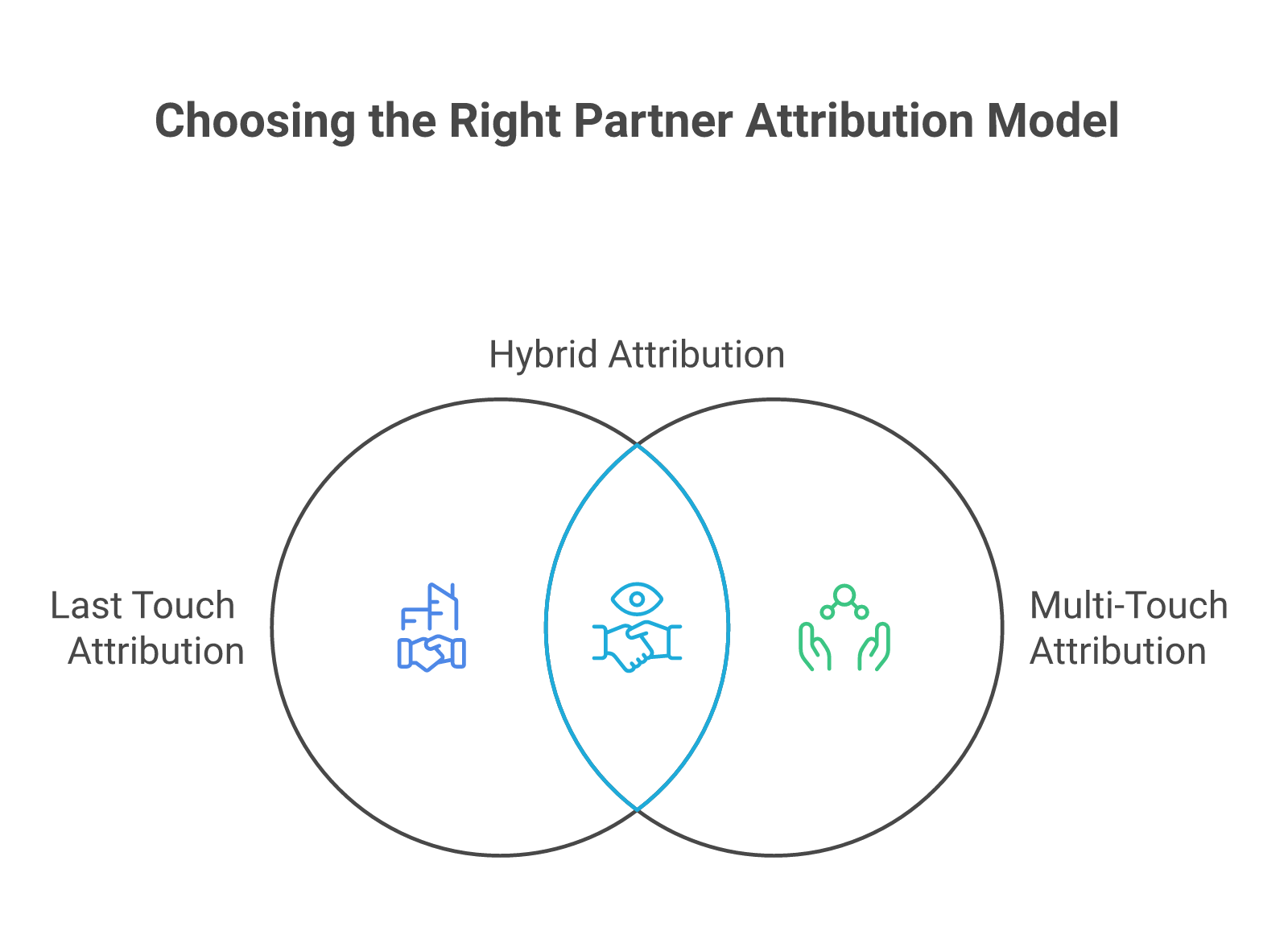
Last-touch is not a compromise. It is the right answer for most B2B SaaS teams because it solves four operational problems that multi-touch creates.
Compensation is clean. One partner manager gets quota credit per deal. Disputes are binary, not allocation arguments. The comp team does not need a spreadsheet to figure out who gets paid what. The partner managers do not waste hours per quarter negotiating credit splits.
The CFO can model it. A single number per deal feeds straight into pipeline projections. Cash flow modeling becomes a math problem instead of a methodology debate. The CFO can reconcile partner pipeline against actual closed revenue without ambiguity.
It reflects reality. In most B2B SaaS deals, one partner did the heavy lifting. Splitting credit pretends otherwise and rewards partners who showed up at the last minute as much as the partner who originated the relationship. The incentive structure that produces is exactly wrong.
It scales. One hundred partner deals at three fields each equals three hundred data points to maintain. One hundred deals at ten fields each equals one thousand data points. Hygiene at scale only works for the simpler model. The complex model fails the moment the partner manager’s calendar gets busy.
When multi-touch attribution is actually worth it
Multi-touch attribution makes sense in three specific situations. Outside those situations, the operational cost exceeds the insight value, and the team would be better served by sticking with last-touch and spending the saved time on actual deal work.
- Multi-partner deals are the norm, not the exception. If your business runs deals where a GSI plus an ISV plus a reseller all touch the same enterprise opportunity routinely, then multi-touch reflects reality and last-touch hides it. Most B2B SaaS does not run this way. The teams that do are usually selling into highly regulated industries (healthcare, financial services, government) where the partner ecosystem is dense by design.
- You have RevOps headcount dedicated to maintaining the model. Multi-touch attribution requires someone whose job is the data hygiene. Not a partner manager, not a marketing ops generalist, a dedicated RevOps person with the partnerships function as their primary scope. Without that role, the model breaks within a quarter.
- The comp pool is large enough to absorb credit-sharing. Splitting credit means each partner manager gets a smaller piece. If the comp pool is small, partner managers will revolt. If the pool is large enough that fractional credit still pays meaningfully, partner managers can tolerate the complexity. The threshold varies by company but typically requires partner-sourced ARR targets in the eight-figure range.
If you cannot check all three boxes, last-touch is the right call. Forrester research on partnerships operations consistently shows that organizations attempting multi-touch without all three foundations end up with worse data hygiene than peers running last-touch with discipline.
What to do about the rare equal-contribution deal
The hardest case is the deal where two partners genuinely contributed equally. The intro came from one. The technical evaluation came from another. The customer success engagement that prevented churn came from a third. All three contributions are real. The temptation is to split credit.
Resist the temptation. Apply the rubric instead. Which partner’s specific action would, if removed, have prevented the deal from existing? That is the attributed partner. The other contributions are documented in a notes field for relationship purposes but do not affect attribution in the CRM.
This is harder than it sounds because it forces an honest conversation about which contribution was actually load-bearing. Most contributions feel important to the people who made them. The rubric forces a single decision instead of a feel-good split. The partner relationships survive better with a clean decision than with a contested split.
What about marketing-style fractional attribution
Some teams want to apply marketing-style fractional models to partnerships. Forty percent to first touch, forty percent to last touch, twenty percent split among middle touches. The argument is that this approach captures partner contributions across the cycle without the binary harshness of last-touch.
The honest answer is do not do this. Marketing fractional models work because marketing automation tools maintain them automatically. Every email open, every page view, every form fill gets logged without human intervention. Partnerships data is captured manually, or at best by a Co-Sell Alignment Specialist. Fractional models in partnerships create maintenance burdens that exceed any insight value, and the resulting numbers cannot be defended to the CFO because nobody can audit how the fractional weights were applied.
The bigger picture for partnerships operations
Multi-touch attribution sounds rigorous. In practice, it produces aggregate numbers nobody trusts, comp disputes that drain partner manager morale, and CRM hygiene burdens nobody can sustain. Pick last-touch. Spend the saved time on the parts of the partnerships function that actually move pipeline, like running the weekly cadence on active partner deals or building the next strategic partnership.
The teams that get partnerships right are not the teams with the most rigorous attribution model. They are the teams with the cleanest attribution data. Those are not the same thing.
Frequently Asked Questions
Is multi-touch partner attribution better than last-touch?
For most B2B SaaS teams, no. Multi-touch creates comp disputes, requires dedicated RevOps headcount, and produces aggregate numbers the CFO cannot model. Last-touch is the right answer unless you have multi-partner deals as the norm AND a RevOps team to maintain the model AND a comp pool large enough to absorb credit-sharing.
How does last-touch attribution work in practice?
One partner gets full credit per deal. The partner manager who closed the partnership relationship that produced the deal gets quota credit. The partner gets full revenue share. If multiple partners contributed materially, the secondary partners are documented in notes but do not share credit at the CRM level.
What if a deal genuinely had two partners contribute equally?
It is rarer than partnerships teams think. Apply the rubric. Which partner’s specific action would, if removed, have prevented the deal from existing? That is the attributed partner. The other contribution is documented for relationship purposes but does not affect attribution.
What about fractional attribution like marketing uses?
Do not apply fractional attribution to partnerships. Marketing fractional models work because marketing automation tools maintain them automatically. Partnerships data is captured manually, and fractional models create maintenance burdens that exceed any insight value. The resulting numbers cannot be defended to the CFO.
When should we move from last-touch to multi-touch?
When all three conditions are true: multi-partner deals are the norm, you have dedicated RevOps headcount for the partnerships function, and your comp pool is large enough that fractional credit still pays meaningfully. If any condition is missing, stay with last-touch.
Forecastable turns scattered partner relationships into predictable, forecastable pipeline. See the platform or start your growth journey.
Uncover Your Growth Potential
Schedule a Discovery Call