Partnership Strategy Framework: A Step-by-Step Model
Short answer
Short answer: A partnership strategy framework is a repeatable structure for building a partner strategy, so you make the key decisions in a deliberate order instead of improvising them. It matters because a framework turns “we should do partnerships” into a set of answerable questions, which is what lets a team build a strategy in a week that would otherwise take a year of trial and error.
A framework is a tool, not a trophy. Filled in as a working document that drives decisions, it is worth a lot. Presented as a slide and filed away, it is worth nothing, and most frameworks end up as slides.
What is a partnership strategy framework?
A partnership strategy framework is a structured method that walks you through the decisions a good partnership strategy requires, in the right sequence. Where the strategy is the specific set of choices your company makes, the framework is the reusable template that makes sure you make all of them, and make them in the order that keeps them honest.
The distinction matters because teams conflate the two. Having a framework is not the same as having a strategy, any more than owning a recipe is the same as having dinner. The framework is the method; the strategy is what you produce when you actually run the method against your own goals, partners, and constraints. A good framework is generic enough to reuse and specific enough to force real decisions.
What a framework is not is a maturity model or a scorecard you fill in once for a report. Those have their place, but a strategy framework is a decision tool: its output is a plan you will run, with a goal, chosen partner types, and a scoreboard, not a grade you file.
Why a partnership strategy framework matters in 2026
A partnership strategy framework matters because it protects a team from the two most common failure modes: improvising the strategy and skipping the hard decisions. Without a framework, partnership strategies tend to start from whichever partner is in the room and back-fill a rationale. A framework forces the sequence that keeps a strategy sound: goal first, partner types second, value exchange third, motion fourth, measurement last.
It also compresses time. Partnerships is a function where the same mistakes recur across companies, and a framework encodes the lessons so a team does not have to relearn them. As partner leadership becomes a more strategic function, reflected in the rise of the Chief Partner Officer, leaders need to produce a defensible strategy quickly, and a framework is how you get to a credible plan in weeks rather than quarters.
The caveat is that a framework is only as good as the honesty you bring to it. The most common way frameworks fail is that teams fill them in optimistically, checking boxes rather than confronting the real answer to whether a partner is a fit or whether the value exchange is balanced. A framework applied as theater produces a strategy-shaped document with no strategy in it.
How a partnership strategy framework actually works
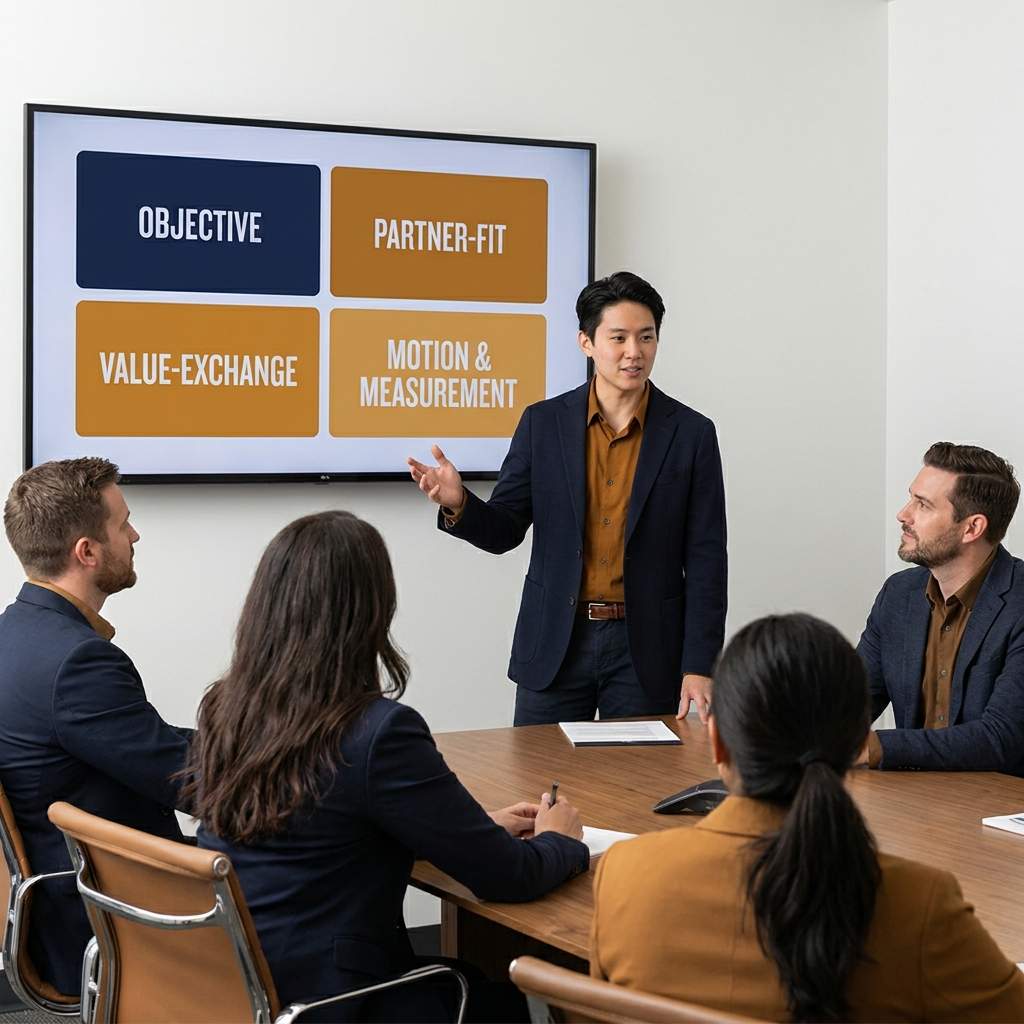
The framework has five parts, applied in order. Each part is a question the previous one sets up, which is why sequence matters as much as content.

- Objective: name the business outcome partnerships must move, in numbers. Everything downstream is judged against this, so a vague objective makes the whole framework vague. Start here or the rest is decoration.
- Partner-type fit: decide which partner types, reseller, technology, referral, or strategic, actually serve that objective, and rule out the ones that do not. Fit is a filter, not a wish list, and the discipline is in what you exclude.
- Value exchange: define the mutual win, and pressure-test it with real underwriting criteria: are the right people involved, is there genuine motivation on both sides, is the internal politics survivable, and can each side match the other’s pace. A partnership that fails those questions will fail regardless of intent.
- Motion design: choose the specific plays, co-sell, referral, co-marketing, and the cadence that runs them. This is where the strategy becomes an operating plan with owners and dates rather than a set of intentions.
- Measurement: define the scoreboard and the review rhythm before you start, so the strategy is accountable from day one. A framework that ends without a measurement step produces a plan no one can grade.
The pattern is that a partnership strategy framework is a decision sequence, not a document template. Run in order and answered honestly, it produces a strategy you can defend. Filled in out of order or optimistically, it produces a deck.
Common pitfalls
- Treating the framework as the deliverable: a filled-in framework is an input to a strategy, not the strategy itself. If the output is a slide rather than a running plan with owners, the framework did nothing.
- Skipping the value-exchange step: teams love the objective and the motion and rush past the partner’s win. A one-sided value exchange is the most common reason partnerships stall, and the framework exists partly to force that question.
- Filling it in optimistically: checking the fit and value-exchange boxes to make the partnership look good defeats the purpose. The framework is only useful if you let it tell you no.
- No owner on the output: a strategy produced by a framework still needs a person accountable for running it. A framework with no owner downstream produces a plan that no one executes.
- Copying a framework without adapting: a template borrowed from another company encodes that company’s goals and constraints. Applied unchanged, it forces the wrong decisions in the wrong order for you.
What this looks like in practice
The best use of the framework I have run treated the value-exchange step as the gate, not a formality. Before committing serious resources to a partnership, the team scored it against the underwriting questions: right people, real motivation, survivable politics, matched pace. One promising partner failed on motivation, the champion was excited but the partner’s leadership was not, and the framework caught it before six months of effort went into a partnership that was structurally going to stall. That single honest answer saved a quarter.
The rest of the value is in sequence. When a team fills in the objective first and lets it constrain the partner-type and motion choices, the strategy comes out coherent, everything ties back to the goal. When a team starts from an exciting partner and reverse-engineers an objective to justify it, the framework produces a strategy that looks complete and points nowhere. Same five boxes, opposite outcomes, decided entirely by whether the objective or the partner came first.
The contrast is the framework-as-slideware version, where a team runs a nice-looking template in an offsite, produces a filled-in canvas, and never turns it into an operating plan with owners and a scoreboard. The framework was fine. It was used as a workshop artifact instead of a decision tool, and a framework that does not change what the team does next is decoration.
Forecastable’s POV
A partnership strategy framework is valuable exactly to the degree that it forces honest decisions in the right order and produces a plan someone runs. The framework itself is not special, plenty of good ones exist. What is rare is the discipline to run it in sequence, answer the value-exchange question truthfully, and treat the output as an operating plan rather than a workshop deck. The framework is the easy part; using it as a decision tool is the hard part.
At Forecastable we care about what happens after the framework. We are a partnerships operating platform focused on connecting partner conversations and actions to CRM pipeline and revenue, the flywheel that runs from conversations to actions to pipeline to revenue. The framework produces the plan; the work we deliver as part of the service is running the motion and the attribution that prove the plan against its objective, on the Forecastable platform. The framework answers “what should the strategy be.” We answer “is it working, and can you show it.”
My bet: the teams that get value from frameworks are the ones that use them to say no, to off-goal partners, to one-sided value exchanges, to motions they cannot resource, and then measure what they said yes to. A framework that only ever produces a longer list of partners is being used backward.
Forecastable is an independent third-party. Any tools or vendors named here are described from public information for the reader’s own evaluation, not as paid placements, and Forecastable does not resell them.
Frequently asked questions
What is a partnership strategy framework? It is a repeatable structure for building a partner strategy, walking a team through the key decisions, objective, partner-type fit, value exchange, motion, and measurement, in a deliberate order. It is the method you use to produce a strategy, not the strategy itself.
What is the difference between a partnership strategy and a partnership strategy framework? The strategy is the specific set of choices your company makes. The framework is the reusable template that makes sure you make all of them in the right order. Having a framework is not the same as having a strategy, just as owning a recipe is not the same as having dinner.
What are the parts of a partnership strategy framework? A practical version has five: objective, partner-type fit, value exchange, motion design, and measurement. They are applied in order, because each part sets up the next, and starting from the objective is what keeps the rest honest.
How do you apply a partnership strategy framework? Run the five parts in sequence, answer each honestly rather than optimistically, and treat the output as an operating plan with an owner and a scoreboard. The value-exchange step, pressure-tested with real underwriting criteria, is the one teams most often rush and most need.
Why do partnership strategy frameworks fail? Usually because they are treated as a deliverable instead of a decision tool. A filled-in canvas that never becomes a running plan with owners and measurement produces a strategy-shaped document with no strategy in it.
Can you reuse another company’s partnership strategy framework? The structure travels, but the answers do not. A framework encodes generic decisions; the objective, partner fit, and value exchange are specific to your goals and constraints. Copy the method, not another company’s conclusions.
Next step
Take your current partnership plan and check whether the objective came first or a favorite partner did. If the plan was built around a partner and back-fills a goal, run it back through the framework starting from the objective, and see how much of it survives.
If you want help running the framework and then operating what it produces, that is exactly what we do. Start your growth journey with Forecastable and we will build the plan and the scoreboard with you. Our partner program guide covers how the framework connects to the wider motion.
Uncover Your Growth Potential
Schedule a Discovery Call